

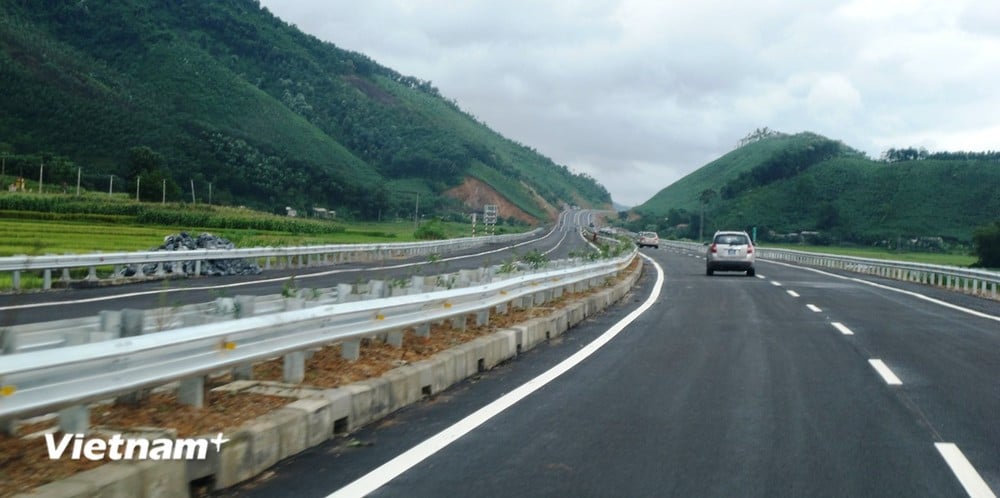
A series of regulations on highway construction investment have been adjusted by the Ministry of Transport through the issuance of Circular No. 06/2024 on National Technical Regulation QCVN 115:2024/BGTVT on highways.
Accordingly, expressways have a minimum scale of 4 lanes (2 lanes for each direction), with emergency lanes arranged continuously (except for the following locations: across bridges with a span of 150m or more; bridges with pillars 50m or more high; tunnels; with acceleration and deceleration lanes; and auxiliary lanes for climbing slopes).
Regarding the design speed of expressways, the new regulations stipulate that the design speed of expressways is divided into three levels: 120 km/h; 100 km/h; and 80 km/h. For locations with particularly difficult terrain or where national defense and security factors are a concern, the Ministry of Transport allows the application of a design speed of 60 km/h.
The maximum permitted speed on expressways shall not exceed 120 km/h. The maximum permitted speed and the design speed shall not differ by more than 20 km/h; the maximum permitted speed of two consecutive sections shall not differ by more than 20 km/h.
Regarding the number of lanes, the new standard requires the number of lanes to be determined based on the design traffic volume, but not less than 2 lanes in each direction. The minimum lane width is 3.75m for 120km/h and 100km/h roads and a minimum of 3.5m for 80km/h roads.
Emergency lanes must have a minimum width of 3m for roads with speed limits of 120km/h and 100km/h, and a minimum width of 2.5m for roads with speed limits of 80km/h.
In addition, the highway standards also stipulate that a median strip (including a median strip and a safety strip on both sides of the median strip) must be arranged to separate the two directions of traffic in the case of a highway cross-section arranged on the same roadbed. The minimum width of the safety strip is 0.75m for 120km/h and 100km/h grade roads and at least 0.5m for 80km/h grade roads. The median strip is designed to ensure safety.
In case the two-way traffic is arranged on two separate roadbeds without a median strip, on the left side of the traffic direction, a safety strip and a dirt shoulder are arranged. The safety strip has a minimum width of 1m for roads of 120km/h, 100km/h and a minimum of 0.75m for roads of 80km/h.
Works associated with expressways include: route traffic management and operation centers; rest stops; non-stop electronic toll collection systems for toll routes; vehicle load inspection stations; and protective fences.
According to the Ministry of Transport, this circular will take effect from October 1, 2024.
Regarding transitional regulations, Circular 06/2024 of the Ministry of Transport stipulates that expressway construction investment projects that have been decided on investment policies before the effective date of this Circular shall continue to be implemented in accordance with the regulations at the time of deciding on investment policies.
For expressways with a design speed of 80km/h or less in operation before the effective date of this circular, when investing in upgrading or expanding, it is allowed to apply technical factors for projects approved before the effective date of this circular.
TB (according to Vietnam+)Source

![[Photo] Closing Ceremony of the 10th Session of the 15th National Assembly](/_next/image?url=https%3A%2F%2Fvphoto.vietnam.vn%2Fthumb%2F1200x675%2Fvietnam%2Fresource%2FIMAGE%2F2025%2F12%2F11%2F1765448959967_image-1437-jpg.webp&w=3840&q=75)
![[Photo] Prime Minister Pham Minh Chinh holds a phone call with the CEO of Russia's Rosatom Corporation.](/_next/image?url=https%3A%2F%2Fvphoto.vietnam.vn%2Fthumb%2F1200x675%2Fvietnam%2Fresource%2FIMAGE%2F2025%2F12%2F11%2F1765464552365_dsc-5295-jpg.webp&w=3840&q=75)







































![[OFFICIAL] MISA GROUP ANNOUNCES ITS PIONEERING BRAND POSITIONING IN BUILDING AGENTIC AI FOR BUSINESSES, HOUSEHOLDS, AND THE GOVERNMENT](https://vphoto.vietnam.vn/thumb/402x226/vietnam/resource/IMAGE/2025/12/11/1765444754256_agentic-ai_postfb-scaled.png)








































Comment (0)