

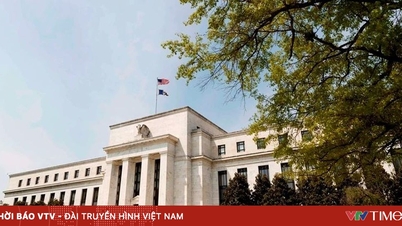
With the Fed cutting interest rates, the stock market is anticipating gains in two groups of stocks.
At this point in September, according to expert Nguyen Duc Khang, the Vietnamese stock market is anticipating gains in two groups of stocks, following the US Federal Reserve's 50-basis-point interest rate cut.
 |
| With the Fed's move, foreign capital flows may stop net selling and even return to the Vietnamese stock market. |
Mr. Nguyen Duc Khang, Head of Securities Analysis at Pinetree, shared his views with Baodautu.vn (Investment Newspaper ) on the impact of the US Federal Reserve's 50-basis-point rate cut and the serious consequences of Typhoon Yagi (Typhoon No. 3) on the Vietnamese economy and stock market.
The US Federal Reserve (Fed) decided to cut interest rates by 50 basis points last night, bringing the benchmark rate to 4.75-5% (Vietnam time). Could you please share your assessment of the impact of this decision on the Vietnamese stock market?
For the first time since March 2020, the Federal Open Market Committee ( FOMC) – the Fed's policymaking body – implemented an interest rate cut of 50 basis points, bringing the federal funds rate range to 4.75%–5%. The Fed's 50-basis-point cut at its September meeting is expected to be a positive factor for the market.
This factor is expected to have two effects.
The first impact suggests that the US economy is facing the risk of recession, forcing the Fed to lower interest rates to support the economy. A US recession would have an adverse effect on Vietnam, especially export businesses (the US is one of our largest export partners).
On the other hand, the second impact is that the Fed's interest rate cut will reduce pressure on the exchange rate, thereby increasing the State Bank of Vietnam's (SBV) ability to maintain its loose monetary policy (low interest rates as currently). In the last two months, the exchange rate has decreased after a long period of being "anchored" at its peak.
In summary, assessing the overall impact, I believe the Fed's decision has had more positive effects. However, from an investment perspective in the stock market, investors should not expect a sharp market surge after this information, as it is not entirely new news but has already been anticipated by the market and is reflected to some extent in current price levels.
Although Chairman Powell noted at the press conference that the Fed would not rush to ease monetary policy, this interest rate cut is still considered a strong start to a reversal in monetary policy.
In the long term, how will this trend impact the Vietnamese stock market? Could you share some key considerations when building an investment portfolio in the coming months?
On a macroeconomic level, the factor that could be positive for the market is the Fed's interest rate policy from now until the end of 2024. Based on the spread between current and future yields (implied Fed rate), the market expects the Fed to cut interest rates by at least another 50 basis points in 2024, with a 75% probability that the reduction will be 75 points.
According to the Dot Plot chart – a visual representation of interest rate forecasts from FOMC members – the most likely scenario presented by FOMC members is that the Fed will cut interest rates by another 100 basis points in 2025 and 50 basis points in 2026, potentially bringing the federal funds rate range to around 2.75%–3% by the end of 2026. If the Fed actually acts decisively, this would be a positive factor to support the market.
We can expect foreign capital flows to stop net selling and even return when the Fed lowers interest rates, reversing the net selling trend by foreign investors over the past nearly two years.
Recently, there have been some signs of foreign investors returning to some surrounding markets, for example Thailand. Therefore, at this point in September, I expect two groups of stocks with two supporting factors. First, the group of large-cap stocks favored by foreign investors (such as VNM,ACB , MBB, MWG…). At the same time, stocks that could benefit from improved domestic buying power and market conditions in the fourth quarter of this year (such as VNM, TLG, MSN, PNJ…) are also worth considering for investors.
 |
| Mr. Nguyen Duc Khang, Head of Securities Analysis Department, Pinetree |
Besides significant changes in international macroeconomic factors, in Vietnam, Typhoon No. 3 ( Yagi ) – the strongest typhoon in the past 30 years in the East Sea region – has just caused very serious damage. How do you assess the impact of this factor on the economy and businesses, especially those listed on the stock market?
Typhoon Yagi, with its immense destructive power, caused serious damage to infrastructure, property, and lives in areas such as Quang Ninh, Hai Phong, Hanoi, and the northern mountainous provinces. The estimated damage amounts to trillions of Vietnamese dong.
According to the Ministry of Planning and Investment, the total estimated damage from the storm reached 50 trillion VND, reducing GDP growth in the third and fourth quarters by 0.35% and 0.22% respectively; and overall GDP decreased by 0.15% for the whole year. These are some initial estimates, and the actual figures may be higher due to indirect impacts such as supply chain disruptions and interruptions in agricultural production, tourism, and consumption.
Typhoon Yagi also had a significant and rapid impact on businesses listed on the stock exchange, for example, the insurance sector – with increased compensation costs. Airlines (VJC, HVN) and airports (ACV) were also affected, with many flights canceled and operations disrupted.
In addition, the port sector, especially the ports in the Hai Phong area, suffered infrastructure damage due to the storm. The petroleum business sector was also affected due to a decrease in consumption.
Conversely, as the reconstruction and recovery phase begins after the storm, market demand will boost production in certain sectors, such as businesses producing roofing sheets and other roofing materials; or the possibility of a short-term increase in pork prices could impact some agricultural businesses…
These are the direct impacts. In addition, there are indirect impacts that affect the recovery of consumer purchasing power, such as in the retail and consumer sectors. From my perspective, except for the insurance sector, the impact of Typhoon Yagi on listed companies will not be too significant.
Specifically, how will the business operations of non-life insurance companies be affected in the short and long term?
It can be said that insurance was one of the sectors most severely affected by Typhoon Yagi, particularly the non-life insurance sector (most insurance companies listed on the stock exchange are non-life insurance companies).
In the short term, non-life insurance companies may be affected in terms of profitability due to compensation payments. According to the latest update from the Insurance Supervision and Management Department, based on figures reported by businesses as of the end of September 12th, the total amount paid out for human and property damage is estimated at approximately 7,000 billion VND, with over 9,000 cases of property and motor vehicle damage; recording 14 deaths and 18 cases under health insurance policies. Leading non-life insurance companies in terms of market share also announced large compensation payments, such as PVI (2,000 billion VND), Bao Viet Insurance (950 billion VND), etc.
The above estimates are preliminary and the actual figures may change depending on reinsurance activities. The reinsurance rate will depend on the risk appetite of each insurance company as well as the type of insurance they offer. For property insurance (factories, ships, etc.), the reinsurance rate is usually high due to the large compensation value; whereas, for example, with motor vehicle insurance, the reinsurance rate is usually lower.
Furthermore, the full extent of the losses may not be reflected in the short-term earnings report because most insurance companies have substantial provisions for losses. However, in the short term, I believe that non-life insurance and reinsurance companies will be affected to some extent.
In the long term, when provisions are used, although the company's reported profits may not decline too sharply, the company's cash flow is actually depleted, leading to a negative impact on future income from financial investments.



![[Photo] Closing Ceremony of the 10th Session of the 15th National Assembly](/_next/image?url=https%3A%2F%2Fvphoto.vietnam.vn%2Fthumb%2F1200x675%2Fvietnam%2Fresource%2FIMAGE%2F2025%2F12%2F11%2F1765448959967_image-1437-jpg.webp&w=3840&q=75)
![[Photo] Prime Minister Pham Minh Chinh holds a phone call with the CEO of Russia's Rosatom Corporation.](/_next/image?url=https%3A%2F%2Fvphoto.vietnam.vn%2Fthumb%2F1200x675%2Fvietnam%2Fresource%2FIMAGE%2F2025%2F12%2F11%2F1765464552365_dsc-5295-jpg.webp&w=3840&q=75)









































![[OFFICIAL] MISA GROUP ANNOUNCES ITS PIONEERING BRAND POSITIONING IN BUILDING AGENTIC AI FOR BUSINESSES, HOUSEHOLDS, AND THE GOVERNMENT](https://vphoto.vietnam.vn/thumb/402x226/vietnam/resource/IMAGE/2025/12/11/1765444754256_agentic-ai_postfb-scaled.png)














































Comment (0)