

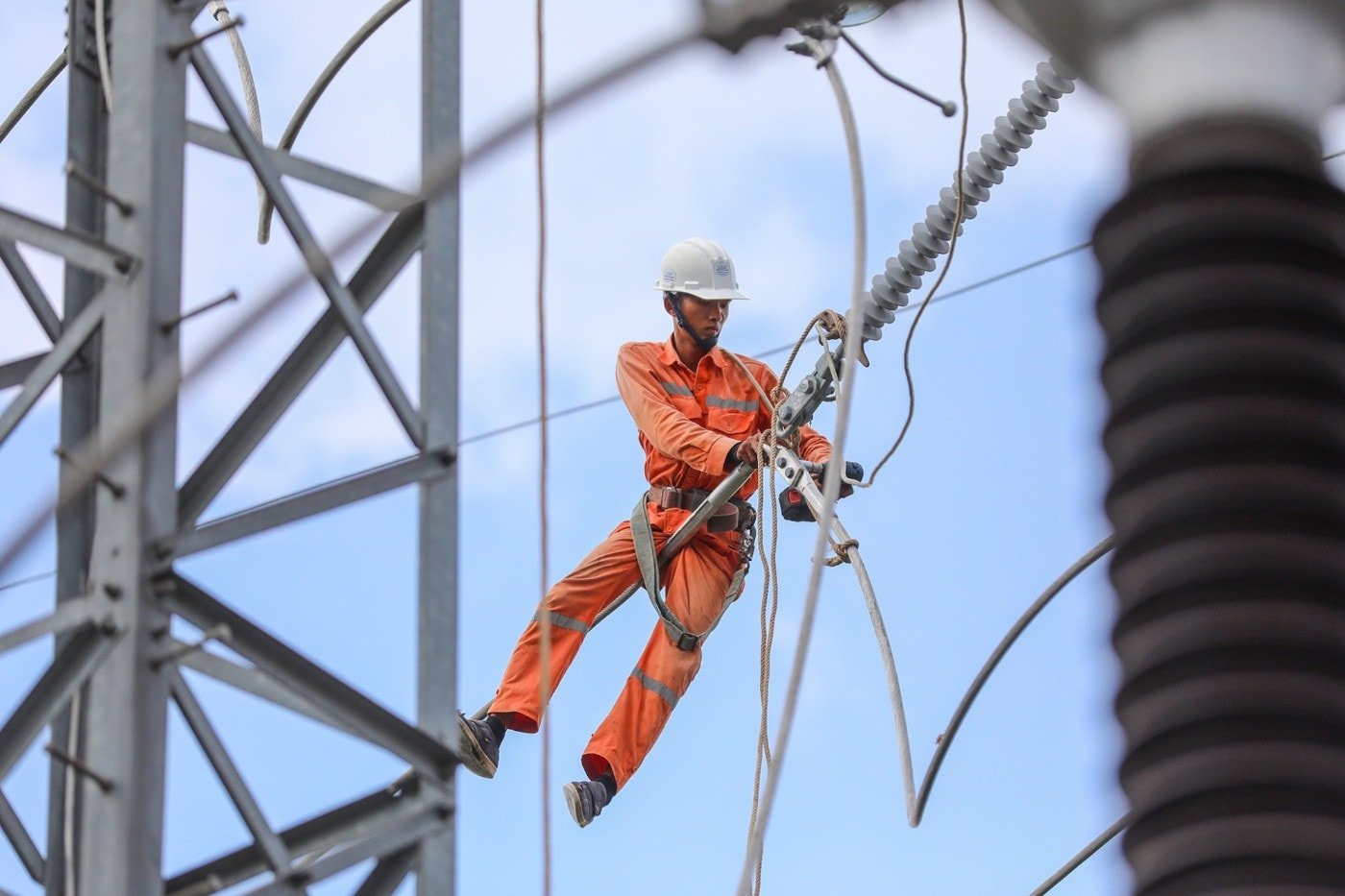
Reduced from 6 levels to 5 levels
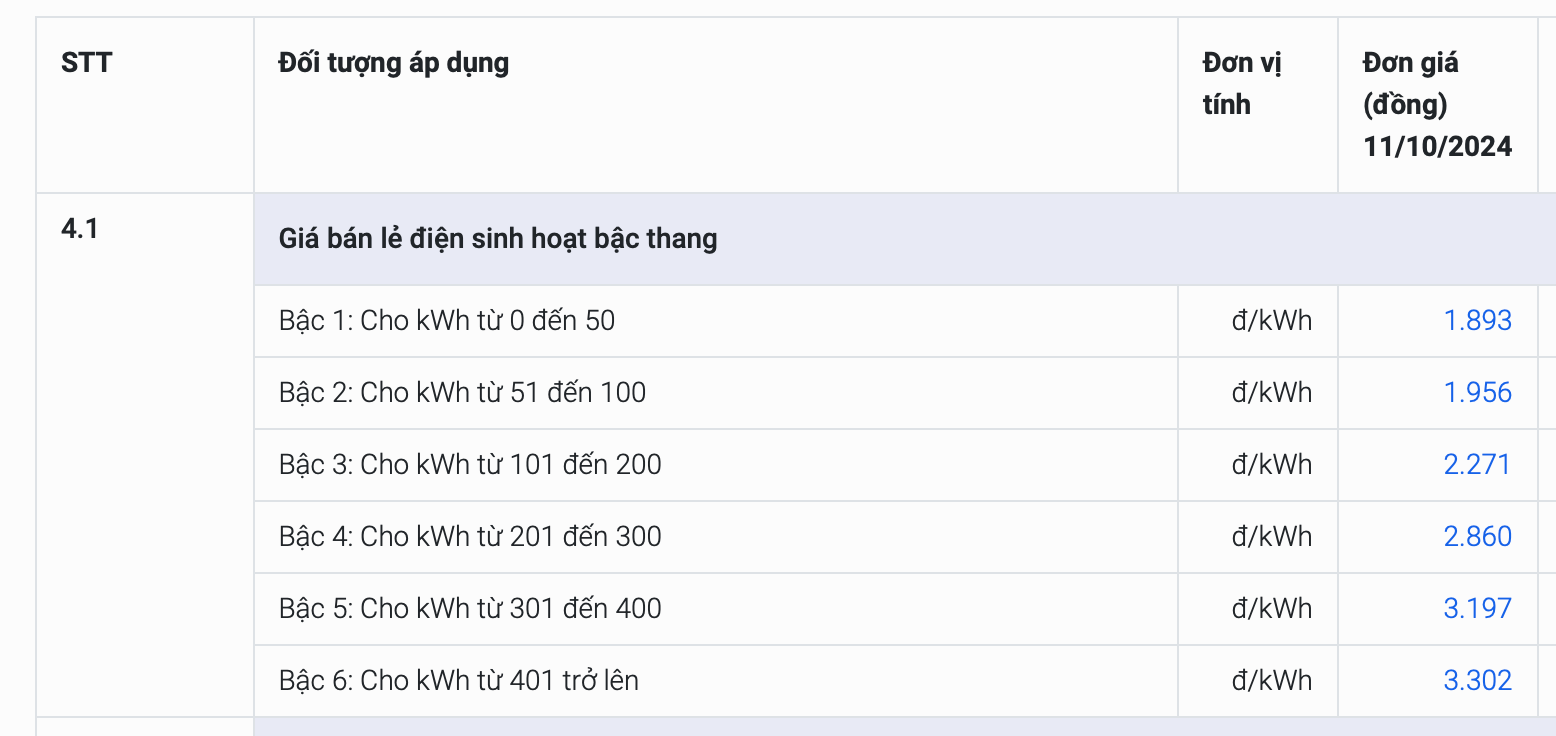
In the draft Decision of the Prime Minister regulating the structure of retail electricity tariffs submitted to the Ministry of Justice for appraisal, the Ministry of Industry and Trade proposed improving the structure of retail electricity tariffs for household consumption by shortening it from 6 tiers to 5 tiers, as proposed by EVN and its consultants, with changes in the proportion structure compared to the average retail electricity price.
Specifically:
+ Tier 1: for the first 100 kWh
+ Tier 2: for kWh from 101 - 200
+ Tier 3: for kWh from 201 - 400
+ Level 4: for kWh from 401 - 700
+ Tier 5: for kWh from 701 and above
With this proposal, the price of electricity for household use would be tiered as follows:
| Level | The adjustment structure is based on the current average retail electricity price (2,103.1159 VND/kWh). | New proposed tiered electricity pricing (kWh) |
| Level 1: The first 0-100kWh | 90% | 1,892.8 VND |
| Level 2: for kWh from 101-200 | 108% | 2,271.5 VND |
| Level 3: For kWh from 201-400 | 136% | 2,860.2 VND |
| Level 4: For kWh from 401-700 | 162% | 3,407 VND |
| Level 5: for kWh from 701 and above | 180% | 3,785.6 VND |
Therefore, the Ministry of Industry and Trade proposes maintaining the current electricity price for the first tier (0-100 kWh) to ensure price stability for poor households and social policy beneficiaries with low electricity consumption (accounting for 33.48% of households). The difference in reduced electricity revenue will be compensated by households using 401-700 kWh and over 700 kWh.
In addition, the current electricity prices for consumption tiers of 101-200 kWh and 201-300 kWh remain unchanged.
However, the electricity prices for consumption tiers from 401-700 kWh and from 700 kWh and above are designed to increase the electricity selling price structure in order to compensate for revenue losses in lower tiers and encourage energy saving.
Therefore, compared to the current residential electricity price, customers using 400 kWh or more will have to pay a higher price.
Tourist accommodation establishments are charged electricity at production rates.
In addition to residential electricity prices, the Ministry of Industry and Trade also proposed separating "tourist accommodation establishments" from other business customers and applying the same pricing structure as manufacturing customers.
According to the results of a public consultation on revenue compensation options in the case of applying the same electricity price for export industries to tourism accommodation establishments, the agency stated that the majority (11 out of 18 opinions) chose option 2 (the difference in electricity sales revenue shortfall is allocated to all customer groups); 7 out of 18 opinions chose option 1 (the difference in electricity sales revenue shortfall, due to the inclusion of tourism accommodation establishments in the production price, is compensated for in the off-peak electricity price for the production group).
According to reports and calculations by EVN and its consultants in the project to improve the structure of retail electricity tariffs, the current electricity price for production does not accurately reflect the full cost of electricity production and business (it is lower than the allocated cost). The Ministry of Industry and Trade believes that Option 1 can be applied immediately to ensure a step-by-step approach to accurately and fully calculating costs for the production customer group.
Accordingly, the revenue shortfall based on updated 2023 data due to the addition of the "tourism accommodation" customer group may be considered for offsetting from the electricity selling price of the manufacturing customer group, increasing the retail electricity price structure for the manufacturing sector by 1% to 2% compared to the average retail electricity price, and manufacturing businesses will be affected by an increase in electricity prices ranging from 2.41% to 3.34%.
Adding a group of manufacturing customers at the 220 kV voltage level.
According to EVN's report, customers currently purchasing electricity at 220 kV and 500 kV voltage levels (connected to the transmission grid) are power plants (buying electricity from the grid for self-consumption, startup, etc.).
According to statistics on electricity production and business costs from 2010 to 2023, the cost at the 220 kV voltage level accounts for 84.6% of the average cost. Based on the allocation of costs at peak and off-peak hours to the current average retail electricity price, the retail electricity price structure at the voltage level up to 220 kV is as follows:
- Electricity price during normal hours: 84% of the average retail electricity price (1,766.6 VND/kWh)
- Off-peak electricity price: 53% of the average retail electricity price (1,114.6 VND/kWh)
- Peak hour electricity price: 146% of the average retail electricity price (3,073.4 VND/kWh)
It is expected that in the near future, more customers will purchase electricity at voltage levels up to 220 kV for production purposes. According to the Ministry of Industry and Trade, customers purchasing electricity at voltage levels up to 220 kV do not use the distribution grid (up to 110 kV), so adding this group of customers to the Draft Decision, based on the allocation of electricity production and business costs, excluding the costs of electricity distribution and retail, is consistent with the principle of ensuring that electricity prices accurately reflect costs.
VN (according to Vietnamnet)Source: https://baohaiduong.vn/gia-ban-le-dien-sinh-hoat-du-kien-cao-nhat-gan-3-800-dong-mot-kwh-402802.html






















![[Photo] Prime Minister Pham Minh Chinh holds a phone call with the CEO of Russia's Rosatom Corporation.](/_next/image?url=https%3A%2F%2Fvphoto.vietnam.vn%2Fthumb%2F1200x675%2Fvietnam%2Fresource%2FIMAGE%2F2025%2F12%2F11%2F1765464552365_dsc-5295-jpg.webp&w=3840&q=75)














































Comment (0)