

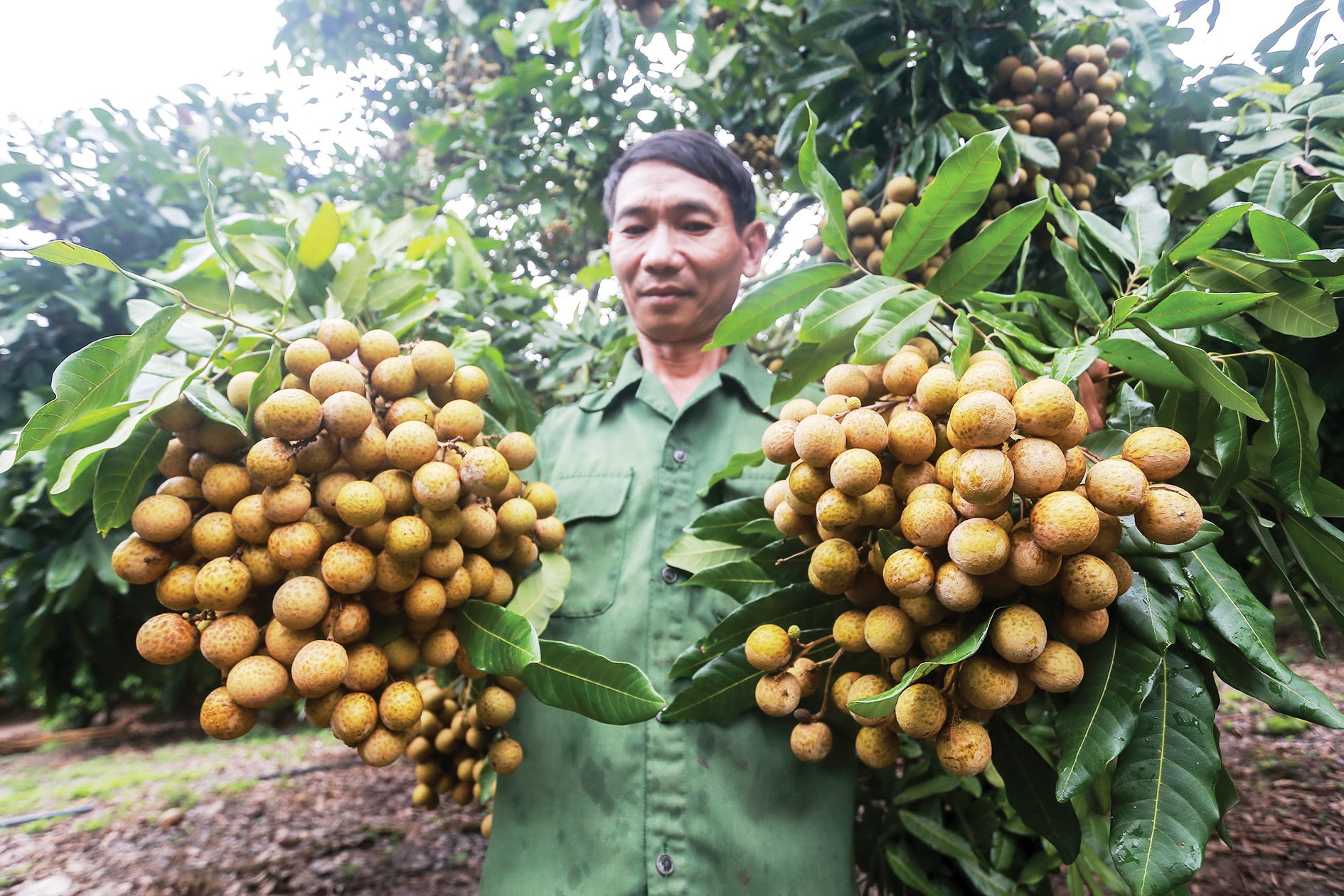
Mr. Tran Van Loc – director of Hung Loc Agricultural Service Cooperative – harvests high-quality longan orchard, meeting export standards – Photo: C. TUỆ
There was a time when Son La was the capital of corn cultivation, with the saying "corn climbs the mountain, the mountain bows its head," reflecting the precariousness of harvests, sometimes enough to eat, sometimes not. But now, corn has given way to mangoes, custard apples, longan, dragon fruit, strawberries, etc., so that each hectare can bring in hundreds of millions to billions of dong for farmers.
International farmers in Son La
Mr. Tran Van Loc – director of Hung Loc Agricultural Service Cooperative (Chieng Khuong commune, Song Ma district, Son La province) – sent six crates of mangoes to China to offer for sale. Each crate weighed only 20 kilograms, and he asked a Chinese friend to deliver them to six different stores in six different locations in China to gauge consumer preferences.
In less than a few dozen minutes, the mangoes were all sold out! The shop owner messaged to ask about ordering more. These are Australian mangoes that Mr. Loc grafted onto 2,000 nearly ten-year-old Taiwanese mango trees in his garden.
Mr. Loc said that the new mango variety and cultivation process, which he researched and applied over the past two years, have been successful. Each fruit is golden yellow, perfectly round, and as yellow as a regular mango, with a spotless skin. "I only have half a hectare, but this year I harvested six tons. And importantly, the price at the farm is 18,000 VND/kg," Mr. Loc said.
This elderly mountain farmer plans to export his first container of mangoes to China next season. In the next three years, he aims to send at least three containers (approximately 60 tons) of high-quality mangoes to the Chinese market.
The story of growing high-quality fruit trees, selling them at high prices, and orienting them towards export is something Mr. Loc has been doing with longan for the past ten years. This man has spent money traveling throughout Hung Yen and Hanoi , attending training courses and classes at the Hanoi Agricultural Academy… to learn how to graft, propagate, and care for longan trees.
It was still the "Mien Thiet" variety of longan (a grafted longan variety originating from Hung Yen) that Mr. Loc sold at 48,000 VND/kg at the beginning of the season. Mr. Loc broke off a bunch of longan, shook it in front of me and explained: "My cultivation method has to produce longan fruits of about 40-60 fruits per kilogram like this. This is the most expensive kind, foreign customers compete to buy them."
"Type two consists of 60-85 fruits per kilogram. This is the most exported type, while type three, with over 85 fruits per kilogram, is used for dried longan. However, the fruit must have a bright appearance and be absolutely free from fungal diseases."
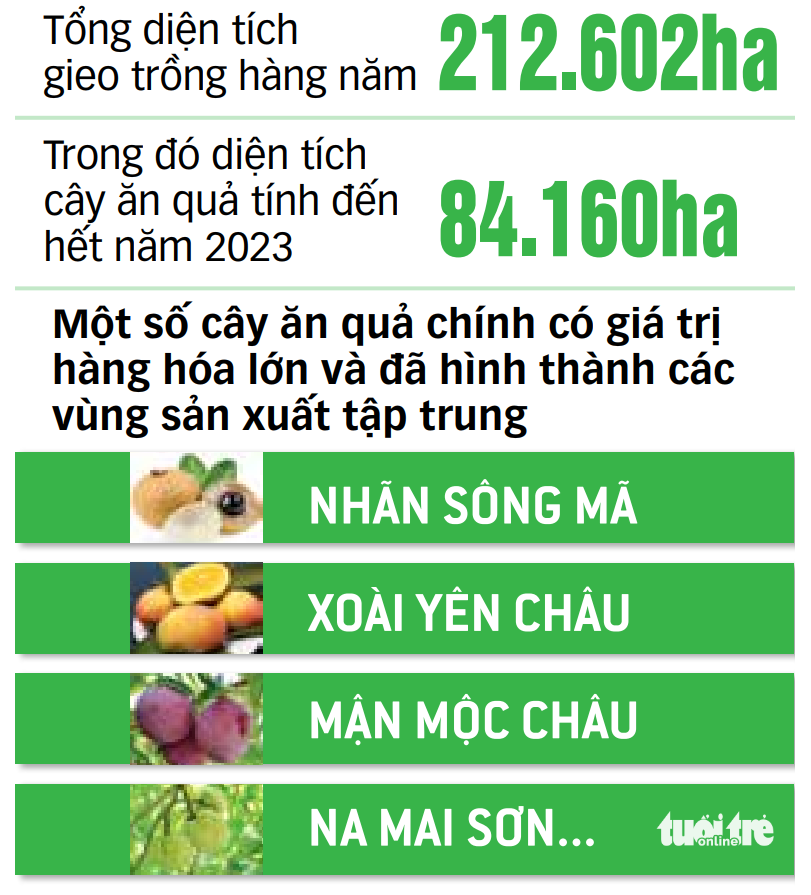
Mr. Loc bought the longan orchard in 2010 and decided to establish a cooperative in 2017. To date, Hung Loc Cooperative has linked production on 46 hectares of longan orchards, harvesting more than 60 tons of fruit annually.
"We have to abandon old ways of farming! We must first find markets. To have markets, we must grow crops that the market accepts. We should cultivate small areas but with high quality. To achieve this, we must consider exports because if the price is high, the domestic market won't buy, but if we sell cheaply, it will inadvertently reduce our value," Mr. Loc said.
Mr. Nguyen Tien Hai, Vice Chairman of the People's Committee of Song Ma District, said that more than a decade ago, the district encouraged farmers to apply science and technology to increase crop yields, while in recent years, the district has supported farmers in improving the quality and value of fruit trees.
“In addition to provincial and district policies supporting farmers in applying science and technology to planting, caring for, and processing fruit trees, as well as promoting and finding markets, we are shifting towards encouraging farmers to produce according to GlobalGAP standards… Fruit products from the people of Song Ma have been exported to the US, China, Australia, and even demanding markets like Europe and New Zealand,” Mr. Hai said.
In the coming period, Son La province will develop raw material areas to serve the processing industry, aiming to stabilize 100,000 hectares of fruit trees by 2025 and strive to become a center for processing agricultural products and fruits in the Northwest region.
Mr. Ha Nhu Hue (Director of the Department of Agriculture and Rural Development of Son La province)
From a corn field worth a few million to a dragon fruit orchard worth hundreds of millions.
Mr. Quang Van Trung – director of the An Phu Clean Agriculture Cooperative in Chieng An ward, Son La city – is the person who makes dragon fruit trees bear fruit consistently and uniformly. The dragon fruit from this cooperative also sells for two or three times the price of dragon fruit grown on a large scale by others in Son La.
This farmer-director quit his job as a hydroelectric engineer earning tens of millions of dong a month to transform his cornfield into a dragon fruit plantation. Trung says that the very plot of land where he started his business was once a cornfield that yielded only a little over 1kg of corn seeds, barely enough to feed a litter of five pigs. Yet, this same plot of land now brings in hundreds of millions of dong annually from dragon fruit.
In 2012, Trung and a friend traveled to Binh Thuan province to learn how to grow dragon fruit. More than a year later, he returned with 400 dragon fruit cuttings. Two years later, the first harvest from Quang Van Trung's garden yielded plump, bright red dragon fruits with prominent "dragon whiskers." The average selling price reached 50,000 VND/kg, three times the price of dragon fruit from other gardens.
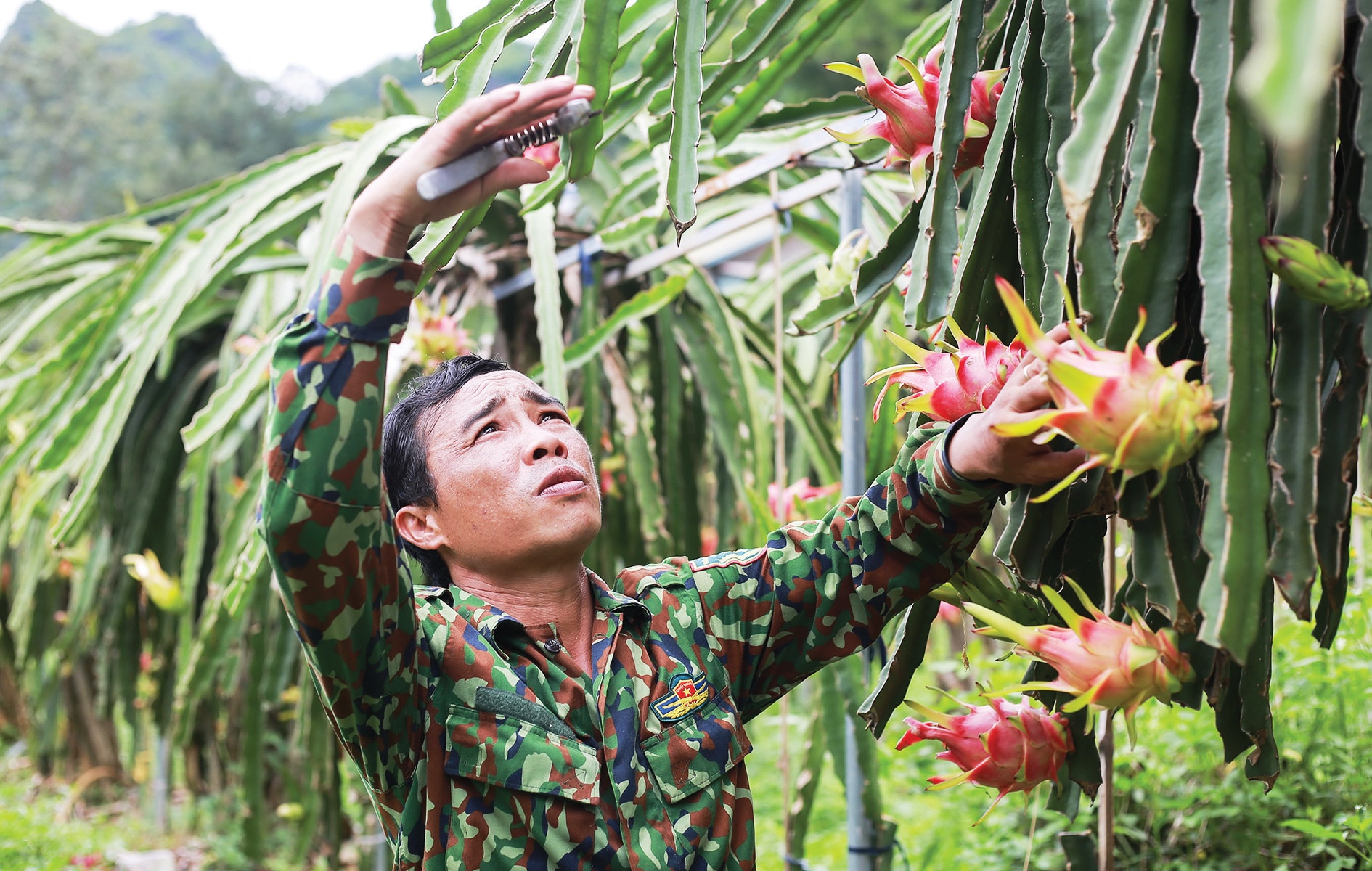
Quàng Văn Trung, director of the An Phú Clean Agriculture Cooperative, owns a dragon fruit orchard with 400 trees, earning hundreds of millions of VND annually – Photo: C. TUỆ
In early 2018, Trung established a cooperative with 10 members. To date, the cooperative has 18 members and 28 households involved in production. The total area is just over 40 hectares, but the income is high, with some orchards earning no less than 400 million VND per year.
The requirements to join this cooperative are very strict, the most difficult being to follow the correct procedures, grow clean dragon fruit using the right techniques, and minimize the use of pesticides... according to GlobalGAP standards. "We apply the process, leaving only about 20 flower heads per plant, but there are always 5 consecutive harvests on each plant. The fruit is large and uniform, and we control the ripening time to coincide with the full moon or the beginning of the month, which is when the price is high," Trung revealed.
Besides dragon fruit, this cooperative also grows plums and custard apples in Mai Son district and Son La city. Currently, Mr. Trung's cooperative is also linked with Ngoc Hoang Cooperative (Mai Son district) to export dragon fruit to Russia, France, etc. Each year, the cooperative harvests nearly 500 tons of various fruits, earning over 13 billion VND, with members and affiliated households of the cooperative earning between 200 and 500 million VND per year.


![[Photo] Prime Minister Pham Minh Chinh holds a phone call with the CEO of Russia's Rosatom Corporation.](/_next/image?url=https%3A%2F%2Fvphoto.vietnam.vn%2Fthumb%2F1200x675%2Fvietnam%2Fresource%2FIMAGE%2F2025%2F12%2F11%2F1765464552365_dsc-5295-jpg.webp&w=3840&q=75)
































































Comment (0)