

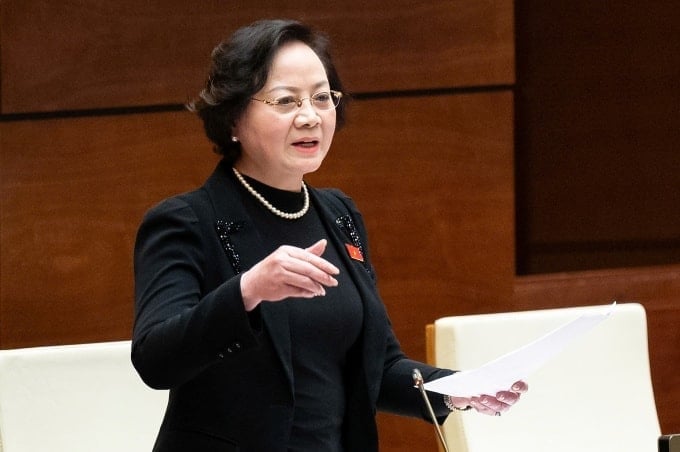
Speaking on February 15th in response to explanations regarding the draft Law on the Organization of Local Government, Minister of Home Affairs Pham Thi Thanh Tra explained that the agency in charge of reviewing and drafting the law agreed to maintain the current model of local government "to ensure the overall stability of the entire political system."
"Immediate adjustments would create disruptions in the operation of the organizational system and local government model. Therefore, the model will temporarily remain unchanged, and I request delegates to support this option," she said, adding that this is also appropriate in the context of the nationwide restructuring of the administrative apparatus.
She stated that the Ministry of Interior has coordinated with the Central Organization Committee to conduct a comprehensive assessment and study of the organizational model, including the organization of local governments. Urban governments will continue to operate according to the resolutions of the National Assembly. Centrally-administered cities such as Hanoi, Ho Chi Minh City, Hai Phong, Can Tho, and Hue may propose adjustments.
According to the Minister of Home Affairs, the amendment to the Law on Local Government aims to create a strict legal framework, implementing the principles of decentralization, delegation of power, and authorization between the Government and local authorities.
"The government is moving towards fundamental and comprehensive reform, however, there are still issues that need to be stabilized in the short term to ensure the smooth operation of local governments in the reorganization of the apparatus," she said, emphasizing that "adjusting this issue or that issue will not guarantee the interconnectedness and uniformity needed to streamline the apparatus."
Speaking earlier, Tran Quoc Tuan, Head of the Propaganda Department of the Tra Vinh Provincial Party Committee, expressed concern that the model of local government organization in the draft "contains no innovation and goes against the current trend of streamlining the administrative apparatus."
He emphasized that the Party's policy, through many congresses, has consistently directed the reform of the organization and operation of local governments to suit the characteristics of urban areas, rural areas, and islands. Practical experience also shows that after the amendment of the Law on the Organization of Local Government in 2019, Da Nang City, Ho Chi Minh City, and Hai Phong City were allowed by the National Assembly to implement a single-tier urban government system, which has proven effective.
"As we are carrying out a revolution to streamline the organizational structure, the local government structure also needs to be redesigned to suit the characteristics of urban and rural areas," Mr. Tuan said, adding that this is not contrary to the Constitution.
Representatives from Tra Vinh province suggested that while the organization of local government in rural areas cannot yet be reformed, a strong reform of local government organization in urban areas is necessary to promote development.
Meanwhile, Pham Van Hoa, Vice Chairman of the Dong Thap Provincial Lawyers Association, agreed with the local government model as outlined in the draft law, which includes both the People's Council and the People's Committee. The delegate emphasized that "it is impossible to do without a People's Council at the commune level."
However, given the recent success of piloting the urban governance model, he suggested studying this model for nationwide implementation.
National Assembly Chairman Tran Thanh Man previously affirmed that "it is currently impossible to abolish the People's Councils at the commune level." Some localities such as Hanoi, Ho Chi Minh City, Da Nang, and Hai Phong have piloted the model of not organizing People's Councils at the district, county, and ward levels. Those places with pilot programs will continue to implement them, then summarize the results to consider expanding the model. However, expanding this model would require amending the Constitution.
According to Mr. Man, the exercise of the people's right to self-governance at the local level is through the People's Council. "If the People's Council is abolished, where will the people exercise their right to self-governance?" he said, explaining that through the People's Council, the people exercise their right to self-governance and supervise the activities of the government.
In a draft prepared in mid-January, the Ministry of Interior proposed abolishing People's Councils at the district and ward levels nationwide. However, the draft submitted to this session has dropped the aforementioned proposal, maintaining the current model of local government as stipulated in the existing law; except in specific cases where the National Assembly stipulates that it is not a level of local government.
The bill outlines Vietnam's administrative units, which include provinces (comprising provinces and centrally-administered cities), districts (counties, towns, cities within provinces, and cities within centrally-administered cities), communes (communes, wards, townships), and special administrative-economic units.
Depending on geographical conditions, population, socio-economic development requirements, and national defense and security, islands and archipelagos that are district-level administrative units may not have commune-level administrative units. Local governments at the provincial, district, and commune levels consist of the People's Council and the People's Committee; except in specific cases where the National Assembly stipulates that they are not local government levels. The National Assembly regulates the organization of local governments in special administrative and economic units upon their establishment.
The National Assembly will pass this draft law on February 19th.
University (according to VnExpress)Source: https://baohaiduong.vn/giu-mo-hinh-chinh-quyen-dia-phuong-de-tranh-hut-hang-405283.html



















![[Photo] Prime Minister Pham Minh Chinh holds a phone call with the CEO of Russia's Rosatom Corporation.](/_next/image?url=https%3A%2F%2Fvphoto.vietnam.vn%2Fthumb%2F1200x675%2Fvietnam%2Fresource%2FIMAGE%2F2025%2F12%2F11%2F1765464552365_dsc-5295-jpg.webp&w=3840&q=75)















































Comment (0)