

Two districts in Hanoi , Ba Dinh and Hoan Kiem, will pilot a program to restrict vehicles that cause air pollution due to greenhouse gas emissions exceeding standards.
Motorcycles that do not meet level 2 standards are prohibited.
On the morning of December 12th, with high consensus, the delegates of the Hanoi City People's Council passed a Resolution stipulating the implementation of low-emission zones in Hanoi City.

Hanoi City People's Council delegates pressed the button to vote on the Resolution stipulating the implementation of low-emission zones in Hanoi City.
According to the resolution, the criteria for identifying low-emission zones are specifically defined as: belonging to strictly protected zones and emission-restricted zones as defined in the Capital City Planning to 2030 with a vision to 2050; and areas where traffic congestion frequently occurs from level D to F according to TCVN 13592:2022 Urban roads - Design requirements.
The average annual air quality assessed in at least the most recent year does not meet the National Technical Standard on Air Quality (QCVN 05:2023/BTNMT) for the main parameters: SO2, NO2, Total Suspended Particulate Matter (TSP); PM10 Dust, PM2.5 Dust.
Conditions for establishing a low-emission zone include: an area planned for urban development with a public transport orientation or an area with sufficient road infrastructure to organize appropriate traffic; a plan for monitoring and evaluating emission levels and emission reduction processes in the area; and the ability to implement appropriate transportation conversion solutions.
Based on one of the criteria specified above, the People's Committee of the district level shall develop a low-emission zone plan suitable to the characteristics and capacity of the locality. The agency developing the plan is responsible for publicly posting the plan through mass media;
The organization shall solicit opinions from organizations based in low-emission zones and individuals residing in low-emission zones for a minimum of 30 days; and shall also solicit opinions from the city's state management agencies on environmental protection and transportation, as well as other relevant agencies and organizations.
The measures applied in low-emission zones are specifically regulated as follows: Vehicles that produce no emissions, environmentally friendly vehicles, vehicles using clean energy, green energy, environmentally friendly vehicles, priority vehicles, and vehicles with permits issued by competent authorities are allowed to circulate in low-emission zones;
Prohibit the circulation of heavy diesel trucks in low-emission zones; Restrict or prohibit the circulation of cars that do not meet emission standard level 4 and motorcycles that do not meet standard level 2 from entering low-emission zones during specific hours/times or areas;
Proposals are being made to introduce fees and charges for road motor vehicles with emissions circulating in low-emission zones;
Propose policies to support individuals and organizations living and working in low-emission zones in transitioning from fossil fuel-powered vehicles to clean energy and zero-emission vehicles.
Propose policies to support investment in the development of clean energy-powered transportation infrastructure from the city budget and other legitimate funding sources.
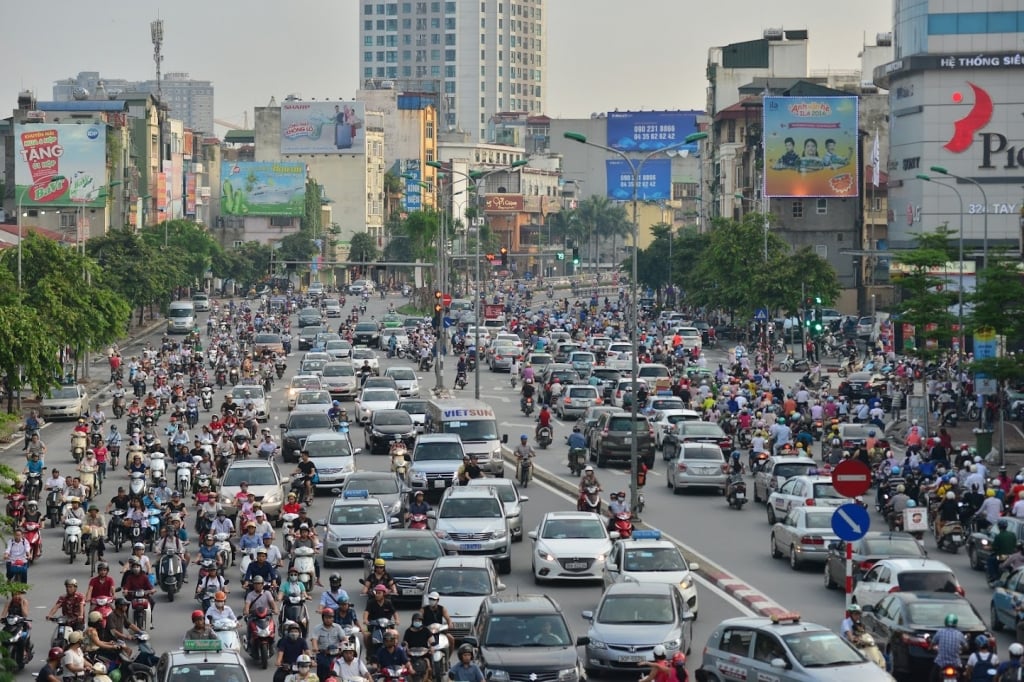
Hanoi is piloting restrictions on polluting vehicles in Ba Dinh and Hoan Kiem districts.
The specific implementation roadmap is as follows: From 2025 to 2030, a pilot program will be implemented to establish low-emission zones in one area within Hoan Kiem and Ba Dinh districts; localities are encouraged to establish low-emission zones.
From 2031 onwards, areas within the city that meet one of the criteria stipulated in this resolution must implement low-emission zone policies.
Many cities around the world have adopted low-emission zones.
The Hanoi City People's Council's verification report clearly states that Hanoi is facing challenges and shortcomings in the management and protection of air quality due to the widespread deterioration of air quality, which significantly impacts people's health.
To date, low-emission zones have been implemented in 320 European cities. In Asia, capital cities and other cities have also begun implementing low-emission zones, such as Beijing, Xining , and Ezhou (China); Seoul (South Korea); Jakarta (Indonesia), etc.
Based on political, legal, practical, and international experience, the issuance of a resolution by the City People's Council on regulations for implementing low-emission zones in the city is necessary and within its authority.
Earlier, clarifying further issues of concern to voters, the Director of the Hanoi Department of Natural Resources and Environment, Le Thanh Nam, stated that when drafting the resolution, the units had widely consulted with 30 districts, counties, and towns. The resolution also has a specific roadmap; the people's opinions are basically in agreement with the contents of the resolution.
Regarding the impact on the people, the Director of the Department of Transport, Nguyen Phi Thuong, cited the example of Beijing (China), where the transition to new modes of transport included numerous policies and mechanisms, from switching from gasoline and diesel to green energy, to providing support policies for the people.
Mr. Thuong further informed that among the contents that the department is preparing to concretize the Law on the Capital City, there is a policy related to this matter.
Source: https://www.baogiaothong.vn/ha-noi-thi-diem-han-che-phuong-tien-giao-thong-gay-o-nhiem-o-2-quan-trung-tam-19224121210181989.htm












































































Comment (0)