

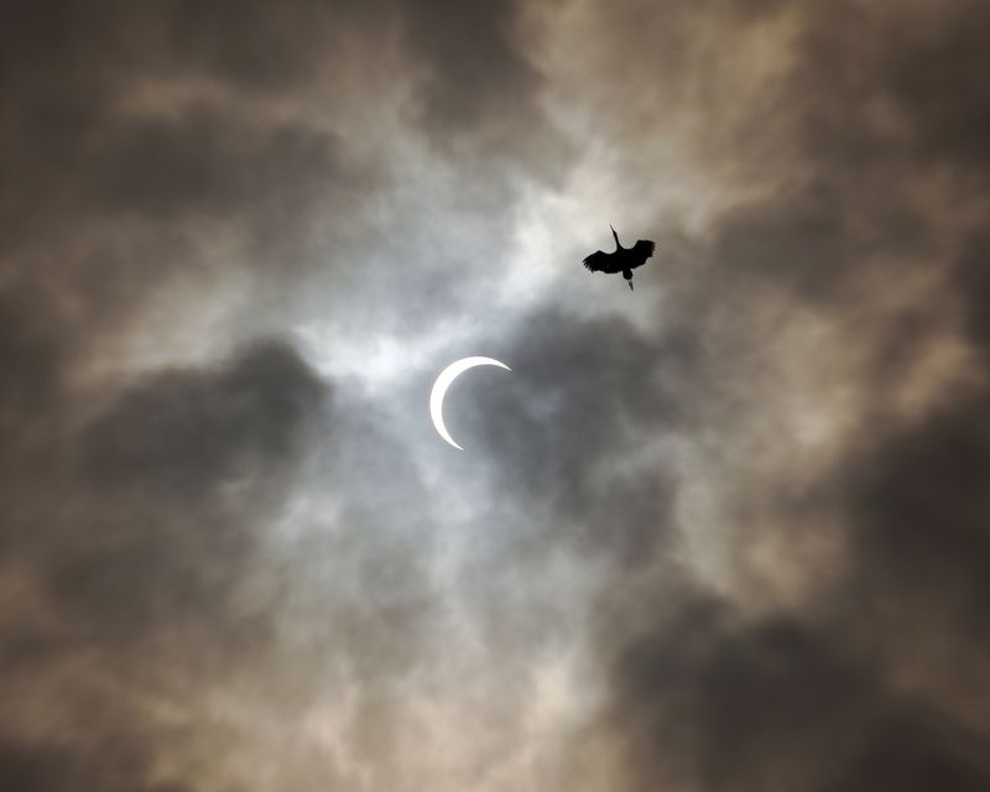
Scientists will closely monitor the behavior of birds as the sun gradually disappears during the day (Photo: Yunus Malik/Shutterstock.com).
While millions across North America will gaze up at the sky to witness the total solar eclipse on April 8th, some scientists are concerned about the behavioral changes in certain animal species, particularly flying ones, as a result of this natural phenomenon.
A team of researchers from Cornell's Ornithology Laboratory has been closely monitoring birds, bats, and insects after these creatures exhibited some rather unusual behavior during the most recent total solar eclipse in North America.
Andrew Farnsworth, lead author of the study on the behavior of flying animals during the 2017 eclipse, said: "At dusk, insects, birds, and bats usually descend to the ground to sleep or prepare for their nocturnal activities. However, during the 2017 eclipse, we observed a significant and unusual decrease in the number of insect and bird flight movements as the light faded and the sun suddenly disappeared."
The upcoming solar eclipse will give the team an opportunity to further study these unusual changes.
To do this, they are planning to use weather radar stations in the path of the eclipse in the US to measure aerial activity. By filtering out signals from weather phenomena, they can measure the movement of flying animals – such as birds – over short periods of 3-4 minutes.
Then, at sunset, they will measure their activity again to compare even the smallest changes in behavior during the total solar eclipse.
Only eight stations were installed along the path of the 2017 eclipse. With 13 stations expected for the next eclipse, scientists hope to get a more complete picture of the behavioral changes in flying animals in response to variations in sunlight.
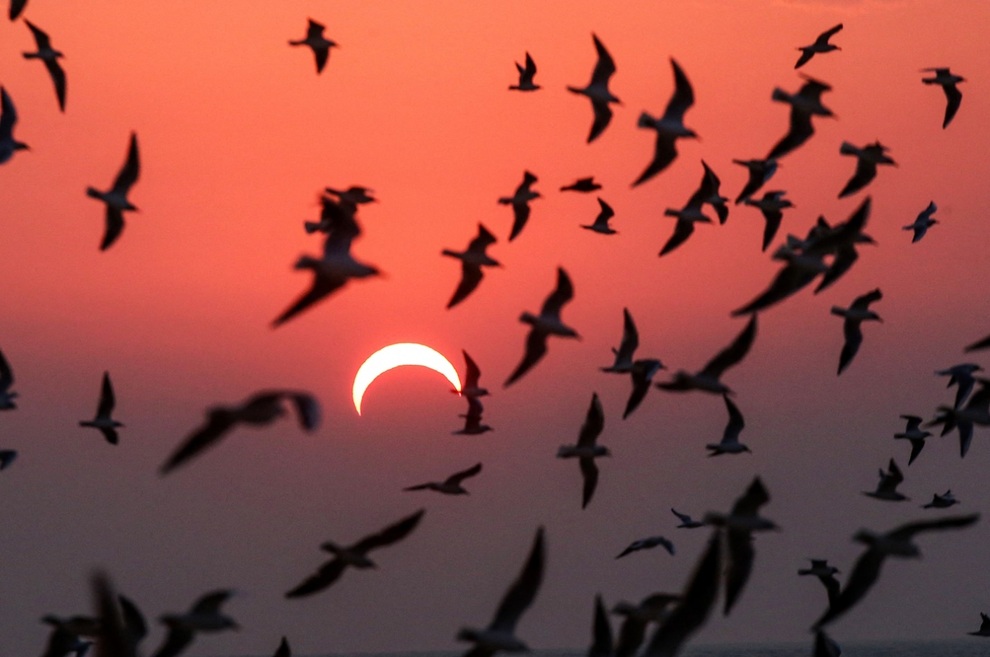
The unusual behavior of birds during a solar eclipse may be related to their reaction to light (Photo: The Washington Post).
"It's very difficult to control light on a large scale," said Cecilia Nilsson, a behavioral ecologist and lead researcher in the 2017 study, "and this unique natural phenomenon is helping us set up a huge 'experiment'."
During the most recent total solar eclipse in the US in 2017, animals at many zoos exhibited numerous strange behaviors that surprised researchers, such as: turtles suddenly rocking, giraffes gathering and galloping, captive baboons suddenly preening themselves vigorously, spiders unraveling their webs, some amphibians making unusual noises, and bees flying back to their hives...
Source


![[Photo] Closing Ceremony of the 10th Session of the 15th National Assembly](/_next/image?url=https%3A%2F%2Fvphoto.vietnam.vn%2Fthumb%2F1200x675%2Fvietnam%2Fresource%2FIMAGE%2F2025%2F12%2F11%2F1765448959967_image-1437-jpg.webp&w=3840&q=75)

![[Photo] Prime Minister Pham Minh Chinh holds a phone call with the CEO of Russia's Rosatom Corporation.](/_next/image?url=https%3A%2F%2Fvphoto.vietnam.vn%2Fthumb%2F1200x675%2Fvietnam%2Fresource%2FIMAGE%2F2025%2F12%2F11%2F1765464552365_dsc-5295-jpg.webp&w=3840&q=75)
















































![[OFFICIAL] MISA GROUP ANNOUNCES ITS PIONEERING BRAND POSITIONING IN BUILDING AGENTIC AI FOR BUSINESSES, HOUSEHOLDS, AND THE GOVERNMENT](https://vphoto.vietnam.vn/thumb/402x226/vietnam/resource/IMAGE/2025/12/11/1765444754256_agentic-ai_postfb-scaled.png)








































Comment (0)