

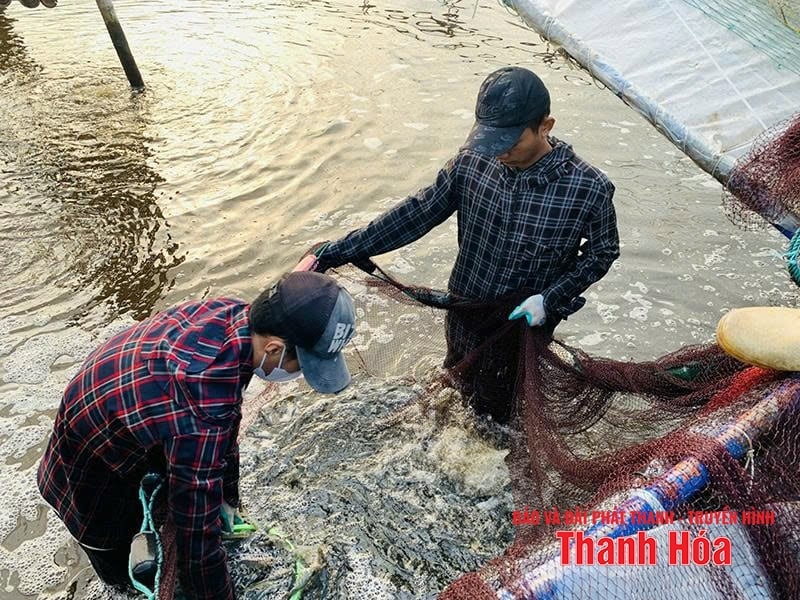
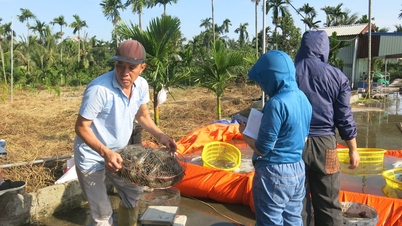
Harvesting whiteleg shrimp in covered tanks at an aquaculture farm in Hoang Chau commune.
The fields outside the Ma River dike are considered the "shrimp farming capital" of Hoang Chau commune. Standing on the dike, you can see dozens of industrial shrimp ponds covered with white and green roofs, like giant mushrooms rising amidst a vast aquaculture area. In previous years, the people here mainly practiced extensive shrimp farming, but due to climate change, environmental pollution, and difficulties in controlling diseases, in the last 5 years, many households have gradually switched to intensive shrimp farming models applying high technology. With large investment capital and the application of proper technical procedures, some models have yielded high economic efficiency.
As one of the pioneers in building a high-tech whiteleg shrimp farming model, Mr. Nguyen Van Suot's family in Chau Trieu village boldly converted their entire extensive shrimp farming area to invest in a system of 12 covered shrimp ponds, each with an area of over 500m2; at the same time, they built a water treatment system and equipment to regulate water and air in the ponds. Mr. Suot said: When he first started the conversion model, he failed immediately after stocking the first batch of shrimp fry because he did not fully understand the process and techniques of the new model. After that, he traveled everywhere to learn about shrimp farming in covered ponds. When he accumulated a wealth of experience, he continued to renovate the shrimp farming system and began to live and breathe with the shrimp. Shrimp farming in covered ponds has many advantages over traditional methods, reducing dependence on weather conditions.
To care for and protect their farmed shrimp, in addition to using quality feed, his family also uses probiotics to treat the pond bottom, clean the water source, improve the pond environment, and prevent disease-causing agents. In favorable years, his family can raise 3-4 crops per year, yielding high productivity and profits of hundreds of millions of VND annually. His family also provides employment for 3 permanent workers with an income of 10 million VND per month and dozens of seasonal workers during pond cleaning and shrimp harvesting.
Besides shrimp farming, crab farming is also one of the characteristic products from aquaculture activities in Hoang Chau commune. Most crab farmers use intercropping and selective harvesting methods, supplying mainly meat crabs to the market. Molting crabs are very rare, even though molting crabs are the most sought-after and expensive product among consumers.
Recognizing market demand and the advantages of the local farming area, Mr. Le Van Chau, Director of SH79 Co., Ltd. in Dinh Long village, invested in a model of raising molting crabs in plastic boxes. The farm covers nearly 1 hectare in a covered area with sturdy tanks, a water treatment system, and cold storage. Crabs are carefully selected before being raised, weighing between 150 and 250g. They are then disinfected and placed in individual plastic cages for daily care and monitoring, ensuring optimal environmental conditions for molting. Each day, the crabs are fed a ration, primarily consisting of herring, clams, mussels, and snails. Molting crabs are considered a high-end food item, with prices currently ranging from 800,000 to 1,000,000 VND/kg depending on size. SH79 Co., Ltd. currently produces approximately 5 tons of crabs per year. This is the first soft-shell crab farming model in Hoang Chau commune. The company's product was recognized as a 3-star OCOP product in 2023.
Aquaculture is considered a key economic sector in coastal communes, with farming increasingly accounting for a significant proportion. High-tech shrimp and crab farming models will open up prospects and new directions in the aquaculture sector in Hoang Chau commune. However, this also brings concerns about environmental issues and water resource protection for aquaculture areas. Therefore, the development of aquaculture areas needs to be planned and managed sustainably, creating breakthroughs in the development of intensive farming areas using high technology to increase production, quality, and economic efficiency, while strictly ensuring environmental factors for the sustainable and long-term exploitation of aquaculture potential and advantages.
Text and photos: Minh Hien
Source: https://baothanhhoa.vn/hieu-qua-tu-mo-hinh-nuoi-trong-thuy-san-o-xa-hoang-chau-253872.htm

![[Photo] Prime Minister Pham Minh Chinh holds a phone call with the CEO of Russia's Rosatom Corporation.](/_next/image?url=https%3A%2F%2Fvphoto.vietnam.vn%2Fthumb%2F1200x675%2Fvietnam%2Fresource%2FIMAGE%2F2025%2F12%2F11%2F1765464552365_dsc-5295-jpg.webp&w=3840&q=75)


![[Photo] Closing Ceremony of the 10th Session of the 15th National Assembly](/_next/image?url=https%3A%2F%2Fvphoto.vietnam.vn%2Fthumb%2F1200x675%2Fvietnam%2Fresource%2FIMAGE%2F2025%2F12%2F11%2F1765448959967_image-1437-jpg.webp&w=3840&q=75)





































![[OFFICIAL] MISA GROUP ANNOUNCES ITS PIONEERING BRAND POSITIONING IN BUILDING AGENTIC AI FOR BUSINESSES, HOUSEHOLDS, AND THE GOVERNMENT](https://vphoto.vietnam.vn/thumb/402x226/vietnam/resource/IMAGE/2025/12/11/1765444754256_agentic-ai_postfb-scaled.png)











































Comment (0)