

According to the President of the Osaka Healthcare Association (Japan), Vietnamese nurses working in Japanese hospitals are considered the "best" among Asian trainees.
VJEPA Program: An opportunity for nurses to work long-term in Japan |
Vietnamese workers account for the highest proportion of foreign workers in Japan. |
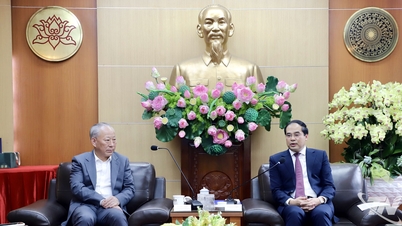
On June 12th, during a meeting with leaders of the Ministry of Labor, Invalids and Social Affairs, Mr. Takeshima Tenmi, President of the Osaka Healthcare Association, praised the group of Vietnamese nurses working in major hospitals in Japan.
The caregivers work for three years under a cooperation program between the Center for Overseas Labor (Colab) of the Ministry of Labour, Invalids and Social Affairs and the Osaka Healthcare Association, implemented since 2019.
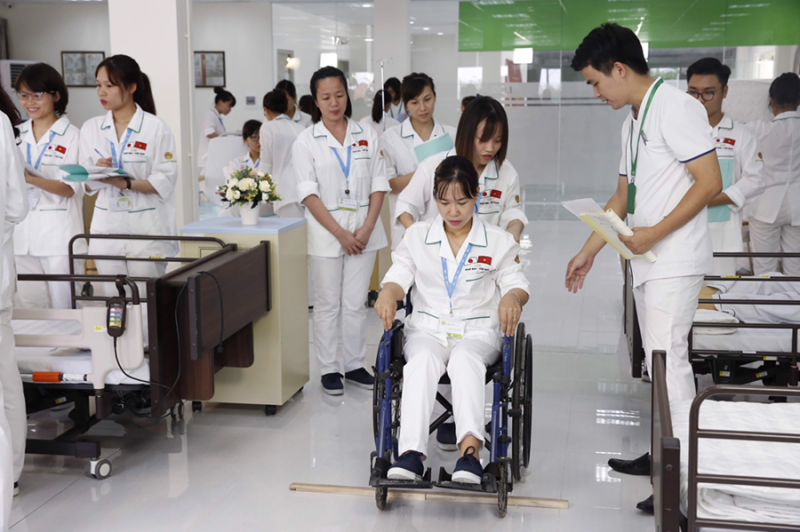 |
| Vietnamese nurses and caregivers have passed the highest-level national professional certification exam in Japan among the countries sent to Japan. Photo: People's Police Newspaper. |
Mr. Takeshima Tenmi recalled that in 2019 Japan had hoped to accept around 500 people, but due to the impact of the Covid-19 pandemic, only 20 nurses from three different cohorts have been sent to work at Japanese medical facilities so far. These facilities accept trainees and students from many Asian countries, but Vietnamese nurses "are considered the best" in terms of skills and work ethic.
With one year remaining, the first batch of 13 nurses will complete their contracts and return to Vietnam. Hospital management is concerned about finding replacements and hopes they can return to Japan to work. "Since their arrival, we haven't heard any complaints from the hospital because they've been working very well," he said, thanking Vietnam "for sending such outstanding trainees."
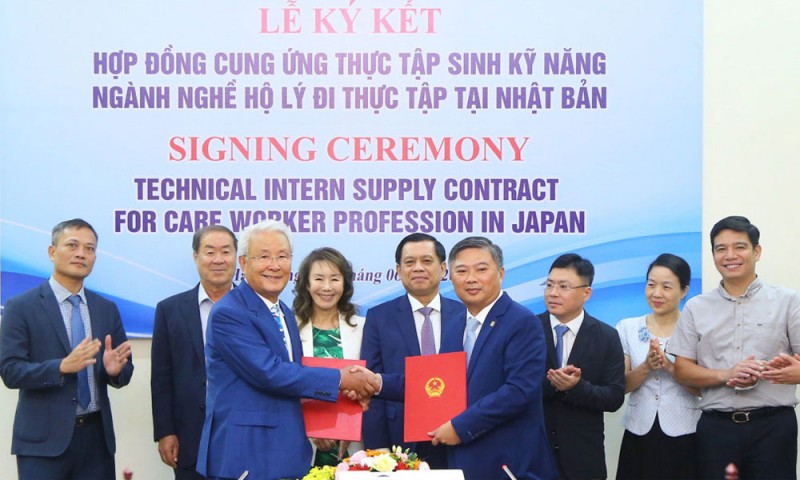 |
| The signing ceremony took place at the Ministry of Labour, Invalids and Social Affairs on June 12th. |
On the morning of June 12th, representatives from Vietnam and Japan signed a contract to supply skilled nursing trainees to work in Japan on a non-profit basis. The goal is to increase the number of nurses going to work in Japan over the next five years, with an expected 500 people.
According to the supply contract signed by both parties, the recruitment criteria are for workers who have graduated in nursing; for workers who have graduated from high school, they will receive one year of nursing training (with a certificate of completion).
After being selected, workers will receive 8-11 months of Japanese language training to reach N4 level. Workers participating in the program will have all expenses covered by the Osaka Healthcare Association: all costs for Japanese language training in Vietnam (8-11 months to reach N4 level), Japanese language proficiency test fees (one time), visa application fees, health check-up fees (twice), and airfare (departure and return upon completion of the contract).
Workers who come to Japan for internships are assigned to work at healthcare facilities of the Association or hospitals that are partners of the Osaka Healthcare Association.
Workers receive training in a professional and friendly work environment with modern equipment, and are paid a salary equivalent to the basic salary of Japanese workers in the same position, approximately 36 million VND per month (excluding allowances and overtime pay). They also receive social benefits and participate in various types of insurance as stipulated by Japanese law.
Therefore, workers only have to pay for food and accommodation during the training period, and vocational training costs, for those who have not received specialized training in nursing.
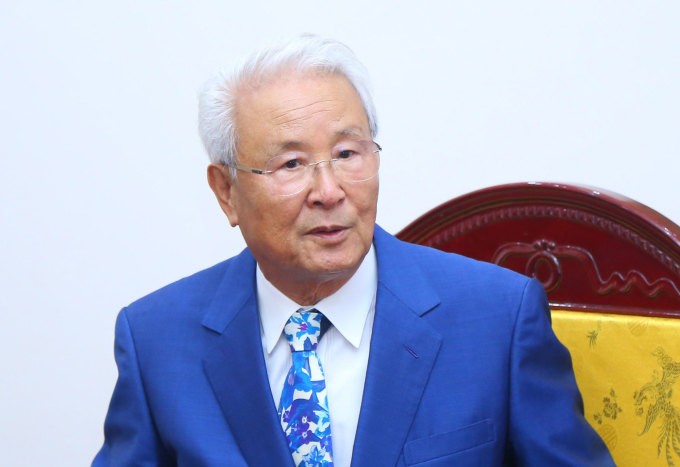 |
| Mr. Takeshima Tenmi, President of the Osaka Healthcare Association. Photo: Gia Doan. |
Mr. Takeshima Tenmi expects that the signing of the supply contract between the Center for Overseas Labor and the Osaka Medical Care Association regarding the dispatch of Vietnamese nursing trainees to Japan will contribute to strengthening cooperation in medical personnel training between the two countries and increase the number of Vietnamese nursing candidates going to work in Japan in the coming years.
| Vietnam and Japan established official diplomatic relations in 1973. Vietnam began sending workers to Japan in 1992, for a period of 3-5 years, with an average income currently reaching 1,200-1,400 USD per month. |
 Young director defrauds nearly 200 people seeking overseas employment in Japan, embezzling over 5 billion VND. Young director defrauds nearly 200 people seeking overseas employment in Japan, embezzling over 5 billion VND.Despite not having a license, Nguyen Huy Vinh arbitrarily put up a sign advertising an office recruiting people for labor export to Japan. In a short period of time, he defrauded nearly 200 people, appropriating more than 5 billion VND. |
 6,000 Vietnamese people go to Japan to work every month. 6,000 Vietnamese people go to Japan to work every month.With nearly 6,000 Vietnamese workers arriving each month, Japan has become the world's largest recipient of Vietnamese labor. |
Source: https://thoidai.com.vn/ho-ly-viet-nam-duoc-danh-gia-tot-nhat-trong-nhom-lao-dong-nuoc-ngoai-tai-nhat-ban-201084.html

![[Photo] Closing Ceremony of the 10th Session of the 15th National Assembly](/_next/image?url=https%3A%2F%2Fvphoto.vietnam.vn%2Fthumb%2F1200x675%2Fvietnam%2Fresource%2FIMAGE%2F2025%2F12%2F11%2F1765448959967_image-1437-jpg.webp&w=3840&q=75)














































![[OFFICIAL] MISA GROUP ANNOUNCES ITS PIONEERING BRAND POSITIONING IN BUILDING AGENTIC AI FOR BUSINESSES, HOUSEHOLDS, AND THE GOVERNMENT](https://vphoto.vietnam.vn/thumb/402x226/vietnam/resource/IMAGE/2025/12/11/1765444754256_agentic-ai_postfb-scaled.png)













































Comment (0)