

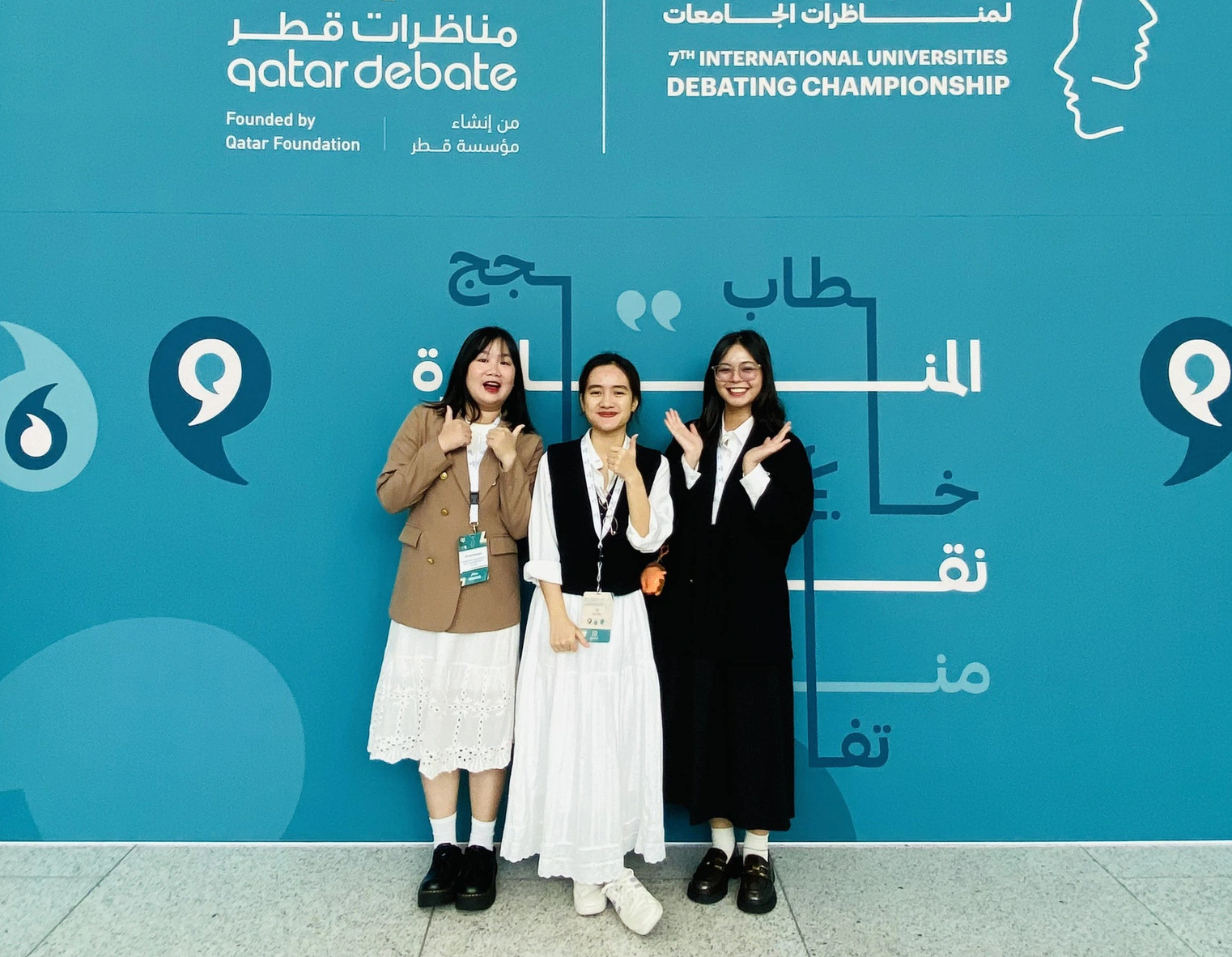
A group of students from the Arabic Studies department participate in an Arabic debate competition in Qatar - Photo: Provided by the interviewee.
The trend of traveling internationally during the summer has been incredibly vibrant since the COVID-19 pandemic.
Student Nguyen Thi Van Anh
From sandy lands to snowy lands
This summer, three female students, Nguyen Thi Van Anh, Duong Huynh Nguyet Anh, and Nguyen Thi Hoang Kim, from the Arabic Studies department of the University of Social Sciences and Humanities (Vietnam National University Ho Chi Minh City), traveled to Qatar to compete in the International Universities Arabic Debating Championship.
Taking place at the end of May 2024, the tournament brings together teams from 100 universities in 50 countries around the world that offer Arabic language programs.
Each round of the competition takes place in a direct confrontation format, debating on the same topic. One side will present arguments in support of the topic, while the other will present arguments in opposition.
The student group stated that, in addition to language skills, each team would have to apply their knowledge and understanding to argue and persuade the judges with their reasoning and evidence.
The presentation style and logical organization of ideas were also graded. As a result, the team of students from the University of Social Sciences and Humanities won two matches against their opponents from Khartoum University (Sudan) and the Islamic University of Maldives (Maldives).
Summer trips abroad to compete in international competitions and events are not uncommon for students majoring in Arabic Studies, including Van Anh.
In 2023, Van Anh was also part of the Asian Arabic debating team held in Oman, which included participants from 20 universities. Last year, Van Anh's team also won two victories against universities from Azerbaijan and Malaysia.
According to Van Anh, each competition is an opportunity for students to learn more practical experiences when learning and using Arabic.
You'll learn where your language proficiency stands compared to your international peers, understand the differences in how the language is used in various countries, and develop a strategy for self-improvement. Additionally, Van Anh can make new international friends.
Also this summer, Huyen Chau, a 21-year-old student from the University of Social Sciences and Humanities (Vietnam National University Ho Chi Minh City), received a Russian government scholarship to participate in a short-term (10-month) Russian language internship program at the Pushkin Institute of Russian Linguistics. This is a valuable opportunity for Chau to improve her Russian language skills, learn about Russian culture, and make international friends.
"I did some research beforehand on Russian study abroad groups to learn from the experiences of those who had gone before me."
I was very worried and anxious during the scholarship application process because the cost of preparing the necessary documents (medical examination, document translation, etc.) was quite high, so redoing them if I wasn't careful could be very expensive.
"Only when the final results were announced, the list of passengers boarding the plane to Russia was finalized, and I received my plane ticket, did I dare to breathe a sigh of relief," Huyen Chau shared.
You only need to pay for the plane ticket and visa fee.
According to Ms. Nguyen Hoang Oanh, Head of the Chinese Language Department at Lac Hong University, this summer, many groups of students from the university will be going abroad to participate in various study trips.
A group of 30 students will participate in a two-week summer camp and a two-month summer internship at Guilin University of Technology (China). Another group of 10 students will participate in a 2024 summer Chinese-language cultural exchange program at Chihlee University of Science and Technology (Taiwan).
Another group of 15 students will attend a summer camp for video shooting and editing practice and Chinese cultural experiences in 2024, organized by a partner media company in Fujian.
Ms. Oanh stated that most trips were sponsored by partners. For example, Guilin University of Technology sponsored tuition and dormitory fees (total sponsored cost was 955 million VND), and Chihlee University of Science and Technology waived tuition, dormitory fees, travel expenses, lunch in Taiwan, and a one-way air ticket (total 152 million VND).
Meanwhile, media companies in Fujian also waive tuition fees, cover food and accommodation, and provide experiential tour fees (totaling 550 million VND). Typically, students only have to pay for airfare and visa fees.
According to Ms. Oanh, universities and partner organizations providing financial support will enable many students to experience summer without incurring excessive costs.
To achieve this, at the faculty level, universities will need to establish connections and work with partners beforehand. Units from Vietnam can proactively raise issues to ensure the best interests of students.
Similarly, Ms. Vo Thi My Van, Principal of Saigontourist Tourism and Hotel Vocational School, believes that many student exchange programs will be based on a two-way relationship.
For example, three students and two lecturers from the school will soon be going to the Békéscsaba Vocational Training Center in Hungary to participate in an exchange program.
For a full month, students will learn and experience life as if they were local students in Hungary, with tuition and accommodation costs covered by the partner school.
Visa risks
This summer, TT, 20 years old, a student at a member university of the Vietnam National University Ho Chi Minh City, registered to participate in a summer program in Kobe (Japan) with the goal of improving her Japanese language skills.
However, T. encountered numerous problems during the application process. To date, T. is experiencing visa issues and will likely have to cancel her participation in the program.
A study abroad consultant stated that the risk of visa rejection is always present when students participate in activities and competitions abroad. Many students, despite having excellent academic abilities, have had to sadly miss out on attending simply because they couldn't obtain a visa.
According to this expert, students should start with programs in Southeast Asia or countries that offer visa-free entry to Vietnamese citizens. This will serve as a foundation, making it easier for them to participate in programs in countries with stricter visa requirements.
Source: https://tuoitre.vn/hoc-tu-nhung-chuyen-xuat-ngoai-mua-he-20240622010212303.htm


![[Photo] Prime Minister Pham Minh Chinh holds a phone call with the CEO of Russia's Rosatom Corporation.](/_next/image?url=https%3A%2F%2Fvphoto.vietnam.vn%2Fthumb%2F1200x675%2Fvietnam%2Fresource%2FIMAGE%2F2025%2F12%2F11%2F1765464552365_dsc-5295-jpg.webp&w=3840&q=75)


![[Photo] Closing Ceremony of the 10th Session of the 15th National Assembly](/_next/image?url=https%3A%2F%2Fvphoto.vietnam.vn%2Fthumb%2F1200x675%2Fvietnam%2Fresource%2FIMAGE%2F2025%2F12%2F11%2F1765448959967_image-1437-jpg.webp&w=3840&q=75)






































![[OFFICIAL] MISA GROUP ANNOUNCES ITS PIONEERING BRAND POSITIONING IN BUILDING AGENTIC AI FOR BUSINESSES, HOUSEHOLDS, AND THE GOVERNMENT](https://vphoto.vietnam.vn/thumb/402x226/vietnam/resource/IMAGE/2025/12/11/1765444754256_agentic-ai_postfb-scaled.png)





































Comment (0)