

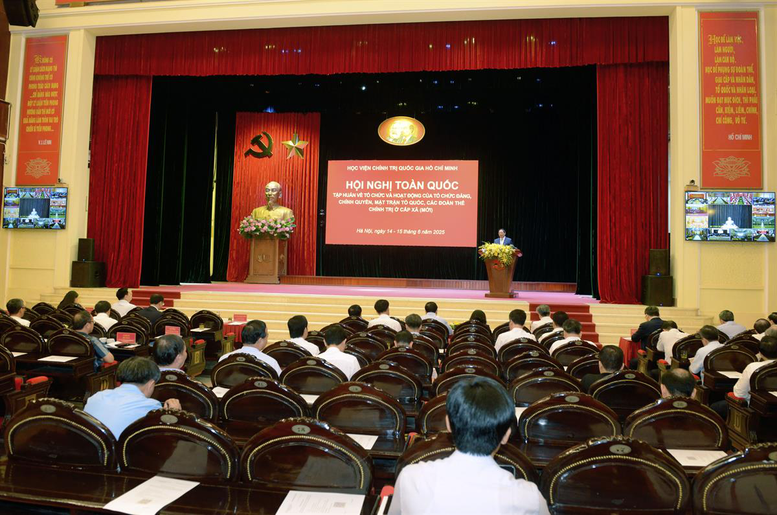
The National Conference on Training on the Organization and Operation of Party Organizations, Government, Fatherland Front, and Political Organizations at the (new) Commune Level will be held over two days, June 14th and 15th, 2025.
At the National Conference on Training on the Organization and Operation of Party Organizations, Government, Fatherland Front, and Political Organizations at the (new) Commune Level, the leaders of the Ministry of Finance reported on the basic contents regarding the implementation of decentralization, delegation of power, and delineation of authority in the financial sector; and the handling of assets when rearranging administrative units under the two-tier local government system.
Expand financial decentralization in a substantive and proactive manner.
In implementing the Politburo 's Conclusions 155-KL/TW and 160-KL/TW in May 2025 on organizational restructuring, the Ministry of Finance has reviewed, compiled, and proposed amendments to a series of 253 legal documents (including 17 laws, 65 decrees, and 143 circulars…), aiming to promote decentralization and delegation of power in conjunction with the two-tiered local government system.
The review results show that 412 tasks were proposed for decentralization and delegation of authority. Of these, 58 tasks have already been implemented through documents approved by the National Assembly. The remaining 354 tasks are proposed for decentralization at various levels: 13 tasks fall under the authority of the National Assembly or the Standing Committee of the National Assembly and are delegated to the Government; 92 tasks are delegated from the Government/Prime Minister to ministers and localities; 187 tasks are transferred from the district level to the commune level; and 20 tasks are transferred from the district level to the provincial level.
In particular, the Ministry of Finance has spearheaded the amendment of 13 laws, issued 5 decrees and 7 specialized circulars to align with the two-tiered government governance model. The content focuses on the state budget, public assets, taxes, public investment, and issues related to local financial management.
Reviewing the authority and guidelines for financial implementation at the local level.
According to the guidelines in Document 4205/BTC-NSNN dated April 2, 2025 and Document 7284/BTC-NSNN dated May 27, 2025, the Ministry of Finance has requested ensuring the stability of revenue sources and expenditure tasks after the reorganization of administrative units.
Regarding the budget, the current State Budget Law clearly defines the authority between the central and local governments, assigning the provincial People's Councils the power to decide on the decentralization of local budgets. The draft amendment to the State Budget Law continues to include this provision.
In public investment, the Ministry of Finance proposes transferring five tasks from the district level to the provincial level, such as: deciding on investment policies, adjusting medium-term plans, and decentralizing authority to communes.
In the field of land finance, requisition and appropriation, and public asset management, there are 101 assigned tasks, including: 8 tasks transferred from the district to the province; and 93 tasks transferred from the district to the commune.
Regarding the bidding sector, 8 tasks were transferred to the commune level; fees and charges included 3 tasks; social policy credit included 5 tasks; state-owned enterprise development included 2 tasks; insurance included 3 tasks; management of household businesses and cooperatives included 38 tasks; national target programs included 18 tasks; PPP investment included 5 tasks; price management included 3 tasks; and taxation included 13 tasks.
In addition to the budgetary sector, the Ministry of Finance proposes specific areas for decentralization.
Regarding public investment, there are four tasks delegated from the National Assembly to the Government, and from the Prime Minister to ministries, sectors, and localities. The new mechanism helps shorten investment procedures, simplify project processes, and reduce the content of appraisal.
Regarding public assets, there are 82 decentralized tasks, of which 58 are assigned by the Prime Minister to ministers and localities, and 24 are transferred from ministers to provincial/commune governments. In addition, the remaining tasks are handled through the Law amending and supplementing 8 laws, Decree 77/2025/ND-CP, and decrees amending and supplementing standards for office buildings and official vehicles.
Regarding planning, there are five tasks delegated from the National Assembly and the Prime Minister to local levels, such as organizing the appraisal and adjustment of provincial planning.
Regarding bidding, there are five tasks, three of which empower the investor to decide on the form of bidding: direct contracting, competitive bidding, and contract modification.
Regarding public-private partnerships (PPP), there are five assigned tasks from the National Assembly, the Prime Minister, ministers down to all levels.
Regarding investment, there are 7 major project groups such as airports, urban areas, oil and gas, housing, etc., which are decentralized to local authorities. At the same time, the Provincial People's Committee has the right to announce investment incentive areas within 5 days of the establishment of a new commune.
Regarding taxation, the Government and the Prime Minister have delegated nine responsibilities to the Ministry of Finance concerning tax declarations, documentation, deadlines, electronic invoicing services, and APA negotiations.
Regarding state reserves, the Minister of Finance is delegated six responsibilities, including the authority to decide on the import and export of reserve goods, as well as the destruction and disposal of damaged goods.
Regarding state-owned enterprises, there are six tasks assigned to the Board of Members and the Chairman of the company to perform instead of reporting to the owner.
In terms of statistics, there are six tasks, including organizing surveys and assigning responsibilities to agencies, which are delegated from the Prime Minister to the Minister, and from the Minister to the statistical agency.
Notably, at its 9th session, the National Assembly authorized further decentralization to Hai Phong City under a special mechanism, including the transfer of four tasks from the National Assembly, the Prime Minister, and the Standing Committee of the National Assembly to the City People's Council and the City People's Committee.
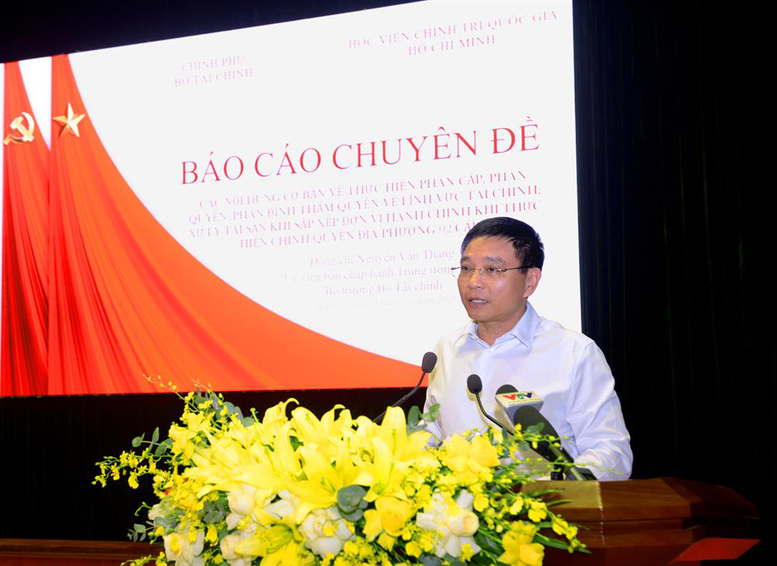
Mr. Nguyen Van Thang, Minister of Finance, presented the topic "Report on the basic contents of implementing decentralization, delegation of power, and delineation of authority in the financial sector when implementing a two-tiered local government" - Photo: Ho Chi Minh National Academy of Politics.
Handling public assets during administrative unit reorganization must be synchronized with the reform of the administrative apparatus.
Notably, regarding office buildings and operational facilities, the Ministry of Finance has instructed that priority be given to allocating office buildings and operational facilities of district-level agencies, organizations, and units (after the district level is abolished) to the local administrative unit where the office is located, or to other state agencies, organizations, and units (including central government agencies, organizations, and units in the area) that need them for office buildings and operational facilities. It is possible to allocate one office building for multiple agencies, organizations, and units to use. Furthermore, an agency may maintain operations at multiple office buildings during the initial phase of administrative unit reorganization to ensure effective state management in the merged areas and to alleviate difficulties in commuting and daily life for officials, civil servants, and employees; thus preventing disruptions to the provision of public services to citizens.
Implement the exchange (transfer) of headquarters and operational facilities between provincial, district, and commune-level agencies, organizations, and central agencies in areas with surplus, excess, or insufficient space compared to standards and norms, in order to ensure maximum utilization of existing facilities and operational premises in the area.
For surplus office buildings and operational facilities after rearrangement, asset disposal will be carried out according to the regulations of the law on the management and use of public assets; in which, priority will be given to converting their function to serve medical facilities, educational institutions, or other public purposes of the locality (libraries, parks, cultural and sports facilities, etc.) as directed by General Secretary To Lam and Prime Minister Pham Minh Chinh; reclaiming them to be managed and exploited by local organizations with the function of managing and operating housing (managing to serve the long-term goals of the State; preserving and protecting assets; allocating them to agencies and units for temporary use; leasing houses with land;...), and assigning them to local land fund development organizations for management, development and exploitation according to the law,...
The Ministry of Finance leadership requested that the restructuring of administrative units into a two-tier model necessitates the synchronized and efficient handling of public assets. Public assets are fundamental to state operations and the provision of public services; therefore, their allocation should be appropriate to the number of staff and the functions and tasks of each unit. From the end of 2024 to the present, the National Assembly has enacted Law 56/2024/QH15 amending the Law on Management and Use of Public Assets; the Government has issued 11 decrees and 1 related decision.
Notably, the Prime Minister also issued two directives instructing on the arrangement and handling of public assets, assigning specific responsibilities to ministries, sectors, and localities. The Ministry of Finance submitted a report to the Politburo and the Party Committee, and also sent documents to the Provincial and City Party Secretaries for unified guidance.
In addition, the Ministry of Finance has issued numerous guiding documents on handling assets after restructuring, noting the following: prioritizing the reuse of offices and facilities that are still in good condition; converting their intended use to a more reasonable purpose if they are no longer being used for their intended function; and limiting new purchases if the need is unclear, to avoid wasting budget resources.
According to the Ministry of Finance leadership, with unified direction from the Politburo, the Secretariat, and guiding documents from the Ministry of Finance, localities need to urgently review and complete the decentralization and arrangement of public assets before the deadline of June 30, 2025, as planned.
Mr. Minh
Source: https://baochinhphu.vn/huong-dan-xu-ly-tai-chinh-va-tai-san-cong-khi-sap-xep-don-vi-hanh-chinh-102250615180114248.htm





















































































Comment (0)