

Abundant potential
While culture was previously viewed primarily from a spiritual perspective, the cultural industry represents the intersection of culture and economics , simultaneously preserving national identity and creating material value, jobs, and brands for the nation and its regions. This is an inevitable direction of development in the context of globalization and the Fourth Industrial Revolution, where creativity is becoming a new competitive force.
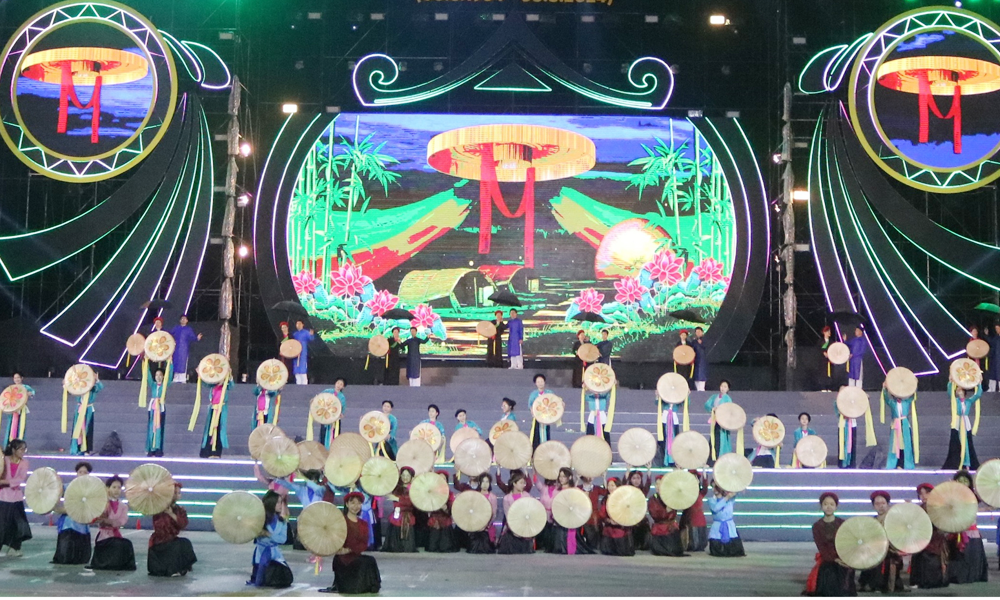 |
Performing arts is one of the areas in Bac Ninh with great potential for development. |
Strategically located at the northeastern gateway to Hanoi, Bac Ninh has favorable conditions for spreading cultural products and services to a wider market. Modern transportation infrastructure connects Bac Ninh with industrial and tourism centers such as Quang Ninh, Hai Phong, Hung Yen, Lang Son, and Thai Nguyen, creating a solid foundation for the development of the cultural industry.
More importantly, Bac Ninh is known as the "land of heritage," boasting one of the largest and most unique collections of tangible and intangible cultural heritage in the country. The province currently has 6 intangible cultural heritage sites recognized by UNESCO; 2 sites within the Yen Tu - Vinh Nghiem - Con Son - Kiet Bac complex of historical and scenic sites are recognized by UNESCO as World Cultural Heritage sites; 11 special national monuments, 24 artifacts and groups of artifacts recognized as national treasures; and 36 intangible heritage sites included in the National List. Alongside these, the unique customs, beliefs, folk games, festivals, and culinary culture of the communities from the plains to the mountainous regions are still preserved and promoted.
Many famous historical sites and scenic spots have become popular tourist destinations, such as: the mausoleum and temple complex of King Kinh Duong Vuong, the ancient citadel of Luy Lau, Dau Pagoda, Do Temple, Vinh Nghiem Pagoda, Bo Da Pagoda, But Thap Pagoda, Phat Tich Pagoda, and the Tay Yen Tu spiritual and ecological tourism area... These are valuable resources for developing cultural and spiritual tourism, film, and performing arts.
In particular, Quan Ho folk songs of Bac Ninh – a representative intangible cultural heritage of humanity – are the most brilliant symbol of Kinh Bac culture. With hundreds of melodies and unique performance styles, Quan Ho is not only the pride of the people of Bac Ninh but also a source of creative inspiration for music, film, fashion, and cultural product design.
Alongside the heritage are hundreds of famous traditional craft villages such as: Phu Khe wood carving; Dong Ky fine art wood carving; Dai Bai bronze casting; Phu Lang and Tho Ha pottery; Chu noodles; Van village wine... In particular, the Dong Ho folk painting craft, a unique cultural symbol, has completed its dossier to propose to UNESCO for inscription as an Intangible Cultural Heritage in need of urgent protection. In the context of the knowledge economy and digital economy, these centuries-old craft village brands are gradually transforming, participating in the cultural industry value chain through design products, souvenirs, decorative items, and craft village experiential tourism.
Unleashing the flow of creativity
It can be affirmed that Bac Ninh has abundant and diverse potential for developing its cultural industry, encompassing fields ranging from cultural tourism, performing arts, music, handicrafts to design, advertising, film studios, and entertainment games. Highly appreciating Bac Ninh's efforts in promoting the role of culture as a development resource, Associate Professor Bui Hoai Son, a full-time member of the National Assembly's Committee on Culture and Society, once affirmed that Bac Ninh possesses many potentials and advantages to become a bright spot in the development of its cultural industry if it has a well-structured strategy and a long-term vision.
| The cultural industry, also known as the "creative industry," is a specialized economic sector based on the creation, production, distribution, and consumption of products and services with cultural value. According to UNESCO's definition, the cultural industry encompasses 12 fields: performing arts; publishing; advertising; crafts; design; film; architecture; cultural tourism; software and entertainment games; fashion; television and radio; fine arts, photography, and exhibitions. |
In recent years, Bac Ninh has paid much attention to implementing the strategy for developing cultural industries, issuing several related documents, most notably Resolution No. 71-NQ/TU dated September 28, 2022, of the former Bac Ninh province, which set the goal of increasing investment in culture to at least 4% of the total state budget expenditure. Along with that, priority is given to developing cultural products and services that have advantages for the province, striving to have the revenue from cultural services in the province contribute 3% to 5% of the GRDP by 2030.
Similarly, Resolution No. 355-NQ/TU dated August 1, 2024, of Bac Giang province also emphasizes the task of disseminating information and raising social awareness about the role of the cultural industry; issuing mechanisms to encourage creativity and attract high-tech enterprises operating in the fields of culture, sports, and tourism; developing unique and professional cultural products; linking heritage preservation with tourism development; and aiming to effectively utilize cultural and sports facilities to serve the needs of the people and create a sustainable economic foundation.
Nevertheless, among the 12 cultural industry sectors, Bac Ninh still lacks a breakthrough area, even performing arts and tourism remain relatively weak. For example, a single "Bac Bling" music video seems like a phenomenon, not a reflection of the true development. Furthermore, research and policy planning in the cultural sector still face bottlenecks, failing to attract significant cultural investors and businesses.
Hopefully, in the next phase, with a long-term vision, the province will clearly define the strategic role of cultural industry development as a pillar of sustainable growth. Based on this, it will build strong policies and flexibly apply public-private partnership mechanisms to unlock the flow of creativity, mobilizing intellect, technology, and social resources to participate in building attractive cultural products and services that reflect the unique identity of Kinh Bac - Bac Ninh.
Source: https://baobacninhtv.vn/huy-dong-nguon-luc-phat-trien-nganh-cong-nghiep-van-hoa-dam-ban-sac-kinh-bac-postid429424.bbg

















![[Photo] Prime Minister Pham Minh Chinh holds a phone call with the CEO of Russia's Rosatom Corporation.](/_next/image?url=https%3A%2F%2Fvphoto.vietnam.vn%2Fthumb%2F1200x675%2Fvietnam%2Fresource%2FIMAGE%2F2025%2F12%2F11%2F1765464552365_dsc-5295-jpg.webp&w=3840&q=75)











































Comment (0)