


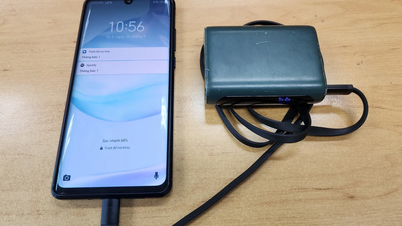
The user is charging their phone using a wireless charger.
In recent years, wireless charging has become increasingly common on phones, headphones, and smartwatches. Tech companies are competing to introduce charging pads, charging stations, and even work desks capable of transmitting power.
But even after nearly a decade, wireless charging remains a secondary option. Users continue to carry charging cables to work, school, and while traveling . Why is that?
Wireless charging still can't surpass traditional wired charging.
Compared to traditional cables, wireless charging is still noticeably slower. A current wired fast charger can reach power from 30W to over 60W, fully charging a phone battery in about 30 minutes. Meanwhile, most common wireless charging pads still operate at 5W-15W, only enough to sustain battery life while sleeping or working at a desk.
The main reason lies in the energy transmission mechanism. Wireless charging works on the principle of electromagnetic induction ; the current in the coil creates an oscillating magnetic field, which in turn induces a current in the receiving device. However, the transmission efficiency is typically only 60-75%, significantly lower than direct transmission through copper wires.
As a result, the lost energy is converted into heat. Users will easily notice the device heating up significantly during prolonged wireless charging, which not only slows down charging but also affects battery life.
Furthermore, wireless charging consumes more power. Some technical tests show that the total amount of power consumed to fully charge a device wirelessly can be 30-50% higher than with wired charging. In the context of technology moving towards energy saving and emission reduction, this is clearly a significant obstacle.
Many promises, but a long way to go.
Despite its promise of convenience, wireless charging has yet to completely replace traditional charging cables. Besides its slow charging speed, this technology also faces obstacles related to standards.
The Qi standard is being adopted by many manufacturers, but the compatibility isn't absolute. A charging pad might be incompatible or charge slowly with other devices, reducing flexibility – a factor that users care deeply about.
Furthermore, the ability to charge multiple devices simultaneously remains limited. Most charging pads only support one device at a time in a fixed position, and if placed incorrectly, the charging process may be interrupted. These inconveniences mean the wireless experience is not yet truly "wireless" as expected.
At the research level, many companies are developing remote charging technologies using radio waves, lasers, or ultrasound. Some prototypes can transmit electricity over distances of a few meters, but the efficiency remains extremely low, the cost is high, and, more importantly, there is a risk of health problems if not carefully controlled.
If wireless technology truly wants to replace charging cables, it needs to overcome three major hurdles: speed, flexibility, and compatibility. Currently, that goal is probably still a long way off.
Wireless charging has been around for over a hundred years.
In 1899, scientist Nikola Tesla attempted to transmit electricity through the air using radio waves at the Wardenclyffe Tower. Although unsuccessful at the time, this experiment is considered the foundation for modern wireless charging technology.Today, the principles of magnetic resonance and high-frequency waves are turning that dream into reality, although it is still far from the convenience Tesla once envisioned.
Source: https://tuoitre.vn/khi-nao-cong-nghe-sac-khong-day-thay-duoc-day-sac-truyen-thong-20250704103935769.htm








































































Comment (0)