

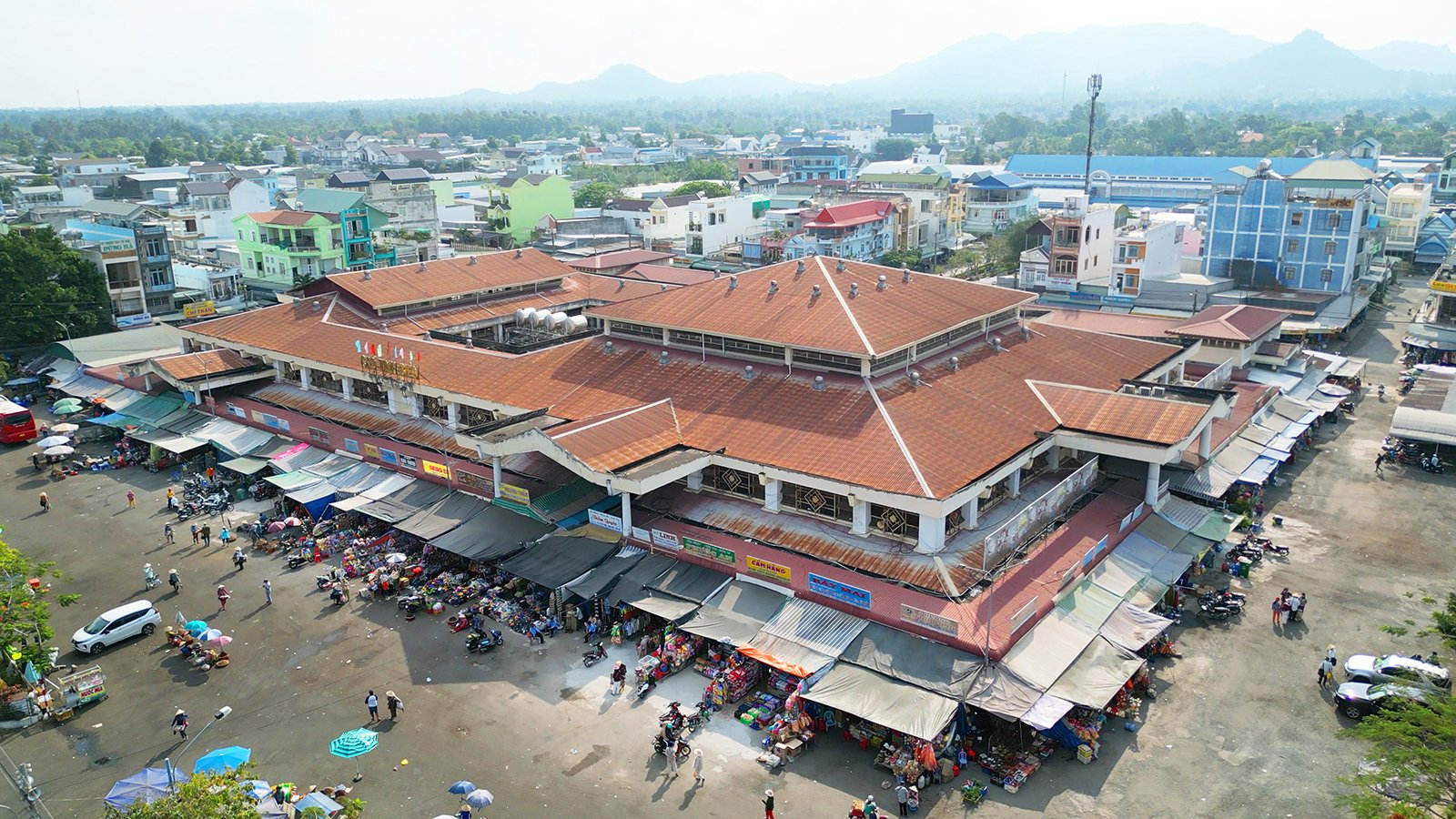
Tinh Bien border market. Photo: THANH TIEN
Along with the border gate system, border markets such as Vinh Xuong, Tinh Bien, and Long Binh are important links, contributing to spreading the vitality of border trade and promoting the development of the province's border trade economy .
Upon arriving at the Vinh Xuong border market in Vinh Xuong commune, our first impression was that most shop signs, from grocery stores and restaurants to electronics shops, were bilingual in Vietnamese and Khmer. This bilingual approach not only facilitates trade for the local Khmer community but also makes it easier for traders and customers from Cambodia to conduct business. While arranging his goods, Mr. Le Minh Ngoc, owner of the Ngoc Thua oil and electronics store, shared: “I’ve been selling here since the market was built, earning an average of over 15 million VND per month. Some goods are imported from Cambodia, and some are exported to Cambodia. Thanks to the Vinh Xuong International Border Gate and the support from relevant authorities and local government, cross-border trade is becoming increasingly convenient.”
Mr. Ngoc is one of hundreds of small traders whose livelihoods are tied to the border region. Every day, Vinh Xuong market welcomes hundreds of people, including many Cambodian residents. They come to buy dried fish, rice, vegetables, and other produce. Conversely, many consumer products, fabrics, and imported goods from Cambodia have also found a place in the daily lives of Vietnamese people. "Many Cambodian customers have become long-term business partners; some have been my regulars for over a decade," Mr. Ngoc said with a smile.
Unlike the bustling Tinh Bien border market, Long Binh market, located near the Khanh Binh national border gate, has its own unique, intimate, and unpretentious atmosphere. The air is filled with the scent of dried fish and fruit, and the sounds of vendors calling out their wares mingled with the friendly conversations of the small traders. The market is small but diverse, as alongside the Kinh people, there are also Khmer, Cham, and Hoa people trading and interacting in an open and harmonious atmosphere. Ms. Chau Sary, a Khmer fruit vendor, happily shared: “Before, I only sold small items in the neighborhood, sometimes I had work, sometimes I didn’t. Since the border gate expanded and more people came across, I have established connections and a stable income, enough to provide for my children’s education.”
According to Ta Van Khuong, Chairman of the People's Committee of Khanh Binh commune: "For many years, trading activities at Long Binh market have made a significant contribution to creating jobs and increasing income for the people. Many small traders rely on the market for their livelihood, closely associated with the exchange of goods and services, agricultural products, and food. The market has become an essential distribution channel, promoting trade with neighboring regions and even with Cambodia."
Promoting the development of border trade.
Leaving Khánh Bình and following National Highway 91, we arrived at Tịnh Biên ward – home to the international border gate bordering Takeo province (Kingdom of Cambodia). The Tịnh Biên border market appeared as a bustling trading complex, renowned for many years as the main wholesale market of the Mekong Delta. With 618 stalls, the market offered a wide variety of goods, from local specialties like dried fish, fish sauce, and palm sugar to imported goods from Thailand and Cambodia. The sounds of vendors hawking their wares mingled with the lively chatter and laughter of the locals.
At a corner of the market, Mrs. Tran Thi Huong, a vendor with over 15 years of experience selling fermented fish paste made from snakehead fish, briskly invited customers: "This fish paste is fragrant and delicious; you can buy it to eat raw or steam it – it's absolutely fantastic!" Mr. Nguyen Van Nam, a tourist from Ho Chi Minh City visiting the market for the first time, smiled and replied: "I've heard about the fermented fish paste from the border region for a long time, but now I finally see it in person. I'll buy a few jars to give to relatives and friends."
According to the Party Committee of Tinh Bien Ward, the Tinh Bien border market annually attracts nearly 300,000 visitors for sightseeing and shopping, with an average spending of over 930,000 VND per person. Thanks to trading at the market, many residents have achieved stable livelihoods. The average household income in the ward is estimated to reach 69.65 million VND per person in 2025, an increase of 25.85 million VND compared to 2020.
Preliminary surveys show that the province currently has more than 10 active border markets, forming an on-site border trade "ecosystem," from goods collection, loading, transportation to buying and selling, contributing to maintaining the flow of goods. According to the Department of Industry and Trade, the consumer market in rural and border areas still has much potential. From now until the end of the year, the province will review public land to invest in bonded warehouses and border markets, while also supporting businesses to expand convenience store chains and mini-supermarkets to serve the people. Economic experts believe that if there is synchronized investment in infrastructure and effective attraction of private resources associated with tourism development, border markets will be more effective, potentially becoming regional trade centers and contributing to promoting border economic growth.
As evening falls, vendors begin packing up their stalls. The sounds of engines, vehicles, and calls gradually fade away. In the fading sunlight, the weary laughter still resonates, genuine and hopeful. Each market day is a day when people can secure a warm meal, nurture their education, stay rooted in their homeland, create a future, and contribute to the sustainable development of this border region. Along the border, the people's hearts are the strongest bulwark.
(To be continued)
Source: https://baoangiang.com.vn/khoi-thong-diem-nghen-but-pha-kinh-te-bien-mau-an-giang-bai-2-nhon-nhip-cho-bien-gioi-a462850.html


































































Comment (0)