

The amended Trade Union Law stipulates that the trade union contribution rate will remain at 2%; it also adds the responsibility of the State Audit Office to conduct audits of the management and use of trade union finances every two years.
With 443 out of 456 attending delegates voting in favor, the National Assembly passed the amended Trade Union Law on the morning of November 27th. One of the notable provisions is the continued maintenance of the 2% trade union fee contribution rate.
In addition, the new law also amends and supplements regulations to clarify the principles of managing and using trade union finances; amends and supplements the expenditure tasks of trade union finances; and adds regulations for the Vietnam General Confederation of Labor to implement the decentralization of collecting and distributing trade union funds.
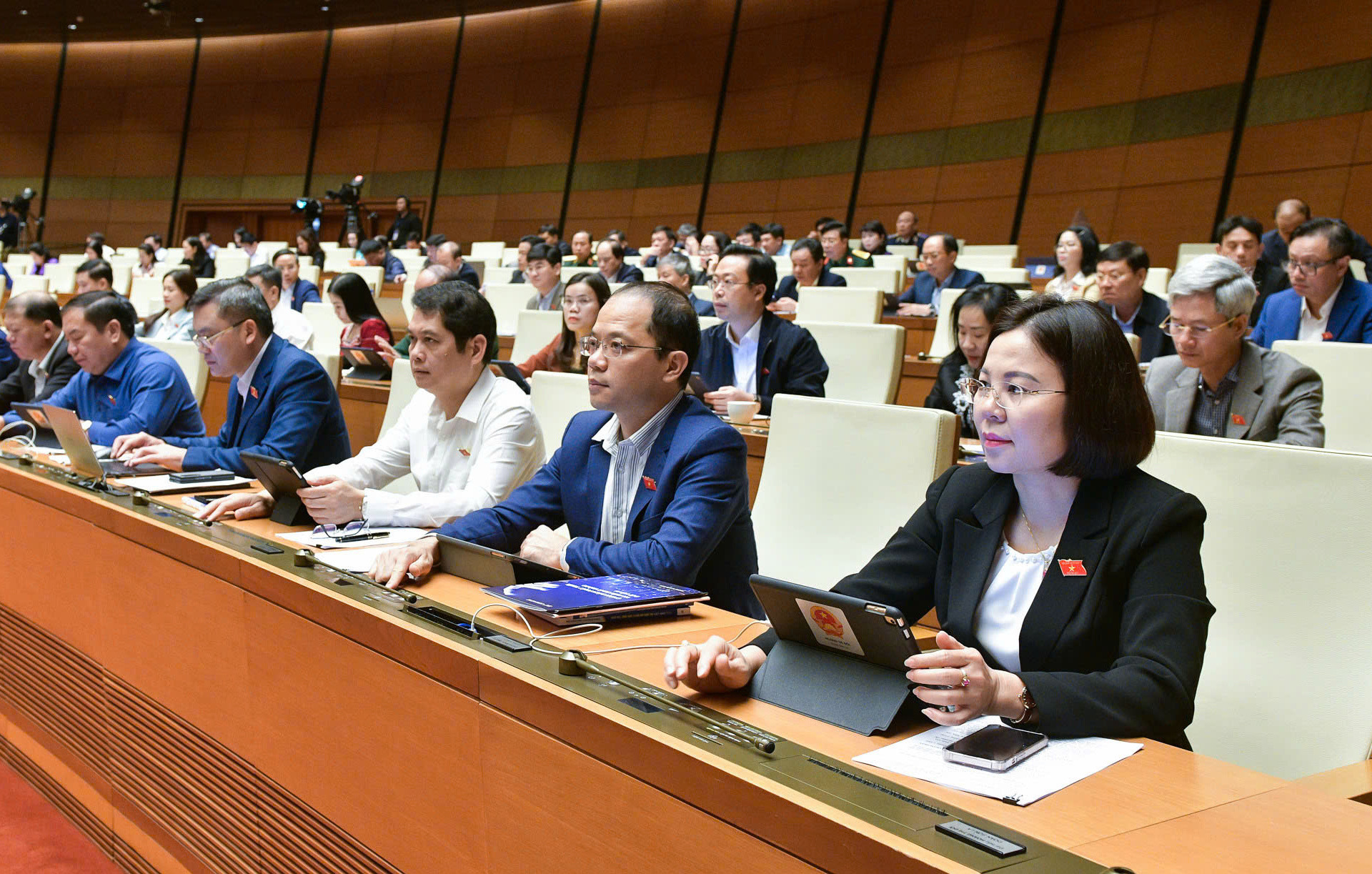
The Vietnam General Confederation of Labor issues standards, norms, expenditure regulations, and the management and use of trade union finances after consultation with the Government .
Notably, the new law adds the responsibility for the Vietnam General Confederation of Labor to report to the National Assembly every two years on the situation of revenue, expenditure, and management and use of trade union finances.
At the same time, the responsibilities of the State Audit Office are supplemented to include conducting audits of the management and use of trade union finances every two years, and carrying out ad hoc audits at the request of the National Assembly and the Standing Committee of the National Assembly.
Cases eligible for exemption, reduction, or temporary suspension of trade union fee payments.
Regarding trade union fees, the amended Trade Union Law has added cases for exemption, reduction, and temporary suspension of contributions in Article 30.
Specifically, businesses, cooperatives, and cooperative unions that are dissolved or go bankrupt according to the law may be considered for exemption from unpaid trade union fees. Businesses, cooperatives, and cooperative unions facing difficulties due to economic reasons or force majeure may be considered for a reduction in their contribution level.
In cases where enterprises, cooperatives, or cooperative unions face difficulties and have to temporarily suspend production and business operations, resulting in their inability to pay trade union fees, they may be considered for a temporary suspension of fees for a period not exceeding 12 months.
After the suspension period ends, businesses, cooperatives, and cooperative unions will resume paying fees and make up for the period of suspension.
The deadline for making the retroactive payment is the last day of the month following the month in which the suspension ended. The amount to be paid retroactively will be equal to the amount due for the months of suspension.
The government will regulate these cases after consultation with the Vietnam General Confederation of Labor.
Enhance the supervisory and social critique powers of trade unions.
In the report on the acceptance, explanation, and revision of the draft law before the National Assembly's vote, the Chairwoman of the Social Affairs Committee, Nguyen Thuy Anh, stated that compared to the current law, the amended Trade Union Law has seven fundamental new points.
Specifically, the new law expands its scope to include Vietnamese workers employed without a formal employment relationship within Vietnam, granting them the right to establish, join, and operate within Vietnamese trade unions.
At the same time, the right to join and participate in trade union activities at the grassroots level (without the right to establish or become a trade union official) is added for foreign workers working in Vietnam under labor contracts with a term of 12 months or more.
According to Ms. Thuy Anh, this is to ensure consistency with the 2019 Labor Code, meet the requirements of international integration, and guarantee equality between Vietnamese workers and foreign workers working in Vietnam.
The next new feature is the addition of the right for workers' organizations within enterprises to join the Vietnam Trade Union.
The new law also clearly defines and distinguishes "Vietnam Trade Union" from "Vietnam General Confederation of Labor," specifying four levels of trade unions. At the same time, it affirms that "Vietnam Trade Union is the sole organization representing workers at the national level in labor relations."
Compared to the current law, the law supplements the principles of organization and operation of the Vietnam Trade Union and clarifies the principles and content of international cooperation on trade unions.
In particular, the law has added the right of trade unions to monitor and provide social feedback.
The amended Trade Union Law will come into effect on July 1, 2025.

Mr. Nguyen Dinh Khang: 84% of trade union funds are directly disbursed to workers.
Source: https://vietnamnet.vn/kiem-toan-dinh-ky-hai-nam-mot-lan-viec-quan-ly-va-su-dung-tai-chinh-cong-doan-2346077.html


![[Image] Close-up of the newly discovered "sacred road" at My Son Sanctuary](/_next/image?url=https%3A%2F%2Fvphoto.vietnam.vn%2Fthumb%2F1200x675%2Fvietnam%2Fresource%2FIMAGE%2F2025%2F12%2F13%2F1765587881240_ndo_br_ms5-jpg.webp&w=3840&q=75)











































































Comment (0)