

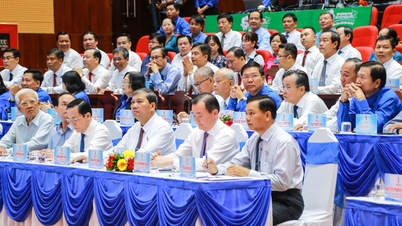
Speaking at the discussion in the Group on the afternoon of December 3, National Assembly delegate Trinh Minh Binh - full-time delegate of the National Assembly Delegation of Vinh Long province highly agreed with the National Assembly's resolution on approving the investment policy of the national target program on new rural construction, sustainable poverty reduction and socio -economic development in ethnic minority and mountainous areas for the period 2026-2035.
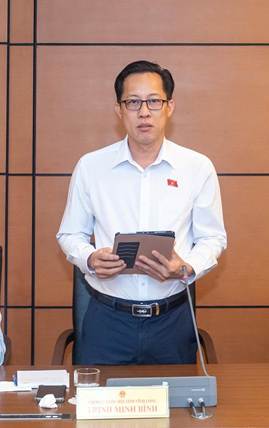 |
| Delegate Trinh Minh Binh spoke at the discussion group on the afternoon of December 3. |
Delegate Trinh Minh Binh emphasized that if the resolution is passed, it will bring many positive impacts: contributing to improving people's quality of life; sustainably reducing poverty and limiting re-poverty; enhancing rural economic development and domestic consumption; promoting the shift in rural labor structure; improving farmers' production capacity and integration; contributing to social stability, maintaining national defense and security; increasing local budget revenue and community financial strength; and at the same time contributing to the goal of "leaving no one behind".
Delegates also highly agreed that the draft resolution sets out a target system by 2030 consisting of 6 target groups and 4 specific targets by 2035. However, to complete the draft resolution, delegates raised some detailed comments as follows:
On rural income targets
Regarding the first goal of the draft: By 2030, the average income of rural people is expected to increase 2.5 - 3 times compared to 2020; and similarly, by 2035, the average income per capita in rural areas is expected to increase at least 1.6 times compared to 2030, the delegate suggested that the drafting agency (CQST) remove the phrase "strive".
According to the delegate, if only using the word "strive" will create many limitations in implementation:
Lack of legal binding and accountability: “Strive” is encouraging, not mandatory, so it is difficult to determine specific responsibilities when the target is not achieved. Agencies and units may explain that this is just a “trying” target, leading to reduced pressure to complete.
Leading to a tendency to do things for the sake of it - not decisively: When targets are not mandatory, localities easily implement them in an "average" way, lacking breakthrough solutions; lacking strong commitment and creative motivation, and resource mobilization.
Difficult to evaluate and measure results: "Strive" indicators often do not have clear evaluation criteria, easily leading to formal reporting, making it difficult to determine the actual level of completion.
It is easy to develop a mentality of dependence or avoidance of responsibility: Some units can "pull back" the target, using objective reasons for not completing it; when the results are low, it is also difficult to handle responsibility because the target is not binding.
Reduced operational effectiveness and determination in the political system: Subordinates are unlikely to be motivated to allocate resources and organize drastic implementation if superiors only state "strive", reducing synchronization between ministries, branches, and localities.
Do not create pressure on resources to complete: “Strive” is often not associated with a specific budget, human resources, or time; it is easy to fall behind schedule, miss goals, or lack resources to implement.
Therefore, delegates proposed replacing "strive" with "achieve", ensuring the goal is more mandatory, effective and feasible.
Solutions to achieve the target of increasing income 2030-2035
Regarding the content of implementing the target of increasing average rural income by 2.5-3 times compared to 2020 by 2030, and increasing by at least 1.6 times compared to 2030 by 2035, delegates said that the Government , ministries, branches and localities must resolutely and synchronously implement many solutions to be able to achieve the target by 2035.
To contribute to the successful implementation of this goal, delegates suggested that when the Government issues a decree guiding implementation, it should pay attention to the following key contents:
Firstly, strongly restructure agriculture towards modernity, high technology, and high added value. Shift from small-scale production to large-scale production, specialized cultivation, regional linkages, and value chain linkages. Promote the application of digital technology, biotechnology, smart irrigation, traceability, and deep processing; focus on developing key national production areas, ensuring quality standards to meet international markets.
Second, strongly develop rural industry and services, creating non-agricultural income sources. To increase sustainable income, farmers need many sources of livelihood. The State prioritizes the development of processing industry, industrial clusters - rural handicrafts, agricultural logistics, community tourism, high-quality trade and services; supports traditional craft villages to innovate technology, standardize OCOP, and participate in domestic and international markets.
Third, breakthrough in vocational training, labor transition and rural human resource development. Income only increases when labor productivity increases. Organize vocational training linked to business needs; support short-term training for workers; foster digital skills, e-commerce, safe production, international standardization; promote innovative startups in agriculture, and build rural innovation centers.
Fourth, improve infrastructure and investment environment in rural areas. Synchronously invest in transportation, smart irrigation, electricity - water - telecommunications, broadband internet, logistics, cold storage, agricultural product distribution centers, etc.; reform administrative procedures, reduce costs for businesses, encourage private investment and public investment in agriculture and rural areas.
Fifth, prioritize market development and international integration for agricultural products. Support the building of national brands for key agricultural products; increase negotiations on market opening; apply EU, US, and Japanese standards; strongly develop agricultural e-commerce, considering open markets as a direct driving force to increase farmers' income.
Sixth, perfecting institutions and policies to ensure farmers' rights and production capacity. Focusing on land accumulation and concentration; preferential credit, agricultural insurance; developing new-style cooperatives; supporting farmers to participate in value chains, transparent market information; considering farmers as the central subject of advanced, exemplary new rural areas.
Central support mechanism
In Article 3 of the draft, assigning the People's Council and People's Committee of the province and centrally-run city to develop plans and balance and arrange local budgets, mobilize other legal resources to implement the 10 goals of the resolution in the locality, delegates assessed that the goal of increasing rural income by 2.5-3 times compared to 2020 and 1.6 times compared to 2030 is a very large and meaningful goal, contributing to narrowing regional gaps, improving people's lives and realizing the aspiration to develop the country by 2045.
However, delegates were concerned because many localities, especially mountainous provinces, remote areas, and difficult areas, are facing great challenges in terms of resources; many provinces are not capable of balancing their own budgets and must rely mainly on support from the central budget. Meanwhile, the program requires localities to develop their own plans, balance their budgets, and mobilize resources.
Without a suitable mechanism, the risk of formal implementation and "setting goals but not achieving them" is inevitable. Therefore, delegates suggested that CQST pay attention to adding the following key contents:
Firstly, there is a central support mechanism in the direction of "mandatory targets and conditional support". For poor provinces with limited budgets: The central government stipulates mandatory targets suitable for each local group; conditional support is based on feasible projects, with responses and practical solutions; creating an environment of "policy competition", promoting innovation, avoiding dependence, ensuring regional fairness.
Second, reform the allocation of the central budget from “average” to “result-based”. The budget support allocation is mainly based on output results such as increased income, increased production value, model efficiency, and structural transformation; while taking into account specific difficulties. This mechanism encourages efficiency, avoids spreading, and reduces formal planning.
Third, strongly mobilize the private sector and enterprises. The State needs to provide incentives on land, taxes, and procedures for enterprises investing in agriculture; encourage investment in agricultural infrastructure, logistics, cold storage, and processing; and attract enterprises to lead the value chain. When enterprises participate strongly, the state budget does not have to bear all the costs.
Fourth, localities must concentrate resources, avoid spreading themselves thin, and choose the right breakthroughs. Poor provinces must avoid small-scale investments; choose 4-5 key products, 3-4 concentrated production areas; and invest heavily in infrastructure, technology, and market promotion. Doing less but doing it thoroughly will create real results and significantly increase income.
Fifth, apply a flexible response mechanism for disadvantaged provinces. Allow lower responses or responses in the form of land, procedures, site clearance, and infrastructure instead of money, helping weak provinces still participate in the program and avoid being left behind.
Sixth, promote digital transformation in management and production. This is a low-cost but highly effective solution, especially for disadvantaged localities: building digital agricultural maps; managing planting and farming areas with codes; applying e-commerce; training digital skills for farmers and cooperatives; shortening regional gaps, expanding markets.
Seventh, increase the monitoring and evaluation mechanism based on results, attach responsibility to the head. Publicize the results of income increase in each commune and ward; People's Council supervises independently; reports have verifiable data; link staff evaluation, rewards and discipline to actual results, not based on formal reports.
At the end of the speech, the delegate affirmed that the goal of increasing rural income by 2.5-3 times compared to 2020 and 1.6 times compared to 2030 is a strategic goal, completely feasible if the right mechanism is applied, decentralization is strengthened with accountability, social resources are promoted and implementation is ensured. The delegate believes that with the above solutions, disadvantaged localities can also contribute to the common success, bringing the lives of rural people to develop sustainably and become more prosperous in the coming period.
Continuing the program of the 10th Session of the 15th National Assembly, on the afternoon of December 3, the National Assembly discussed in groups the investment policy of the National Target Program on new rural areas, sustainable poverty reduction, socio-economic development of ethnic minority and mountainous areas until 2035; Draft Resolution of the National Assembly on mechanisms and policies for national energy development in the 2026-2030 period; Draft Resolution of the National Assembly amending and supplementing a number of articles of Resolution No. 98/2023/QH15 on piloting a number of specific mechanisms and policies for the development of Ho Chi Minh City; Draft Resolution of the National Assembly amending and supplementing a number of articles of Resolution No. 136/2024/QH15 on the organization of urban government and piloting a number of specific mechanisms and policies for the development of Da Nang city; Investment policy of the Vinh - Thanh Thuy Expressway Construction Investment Project. |
SON NAM (written)
Source: https://baovinhlong.com.vn/kinh-te/202512/kien-nghi-co-che-nguon-luc-cho-dia-phuong-kho-khan-1ed18f2/


![[Photo] Cat Ba - Green island paradise](/_next/image?url=https%3A%2F%2Fvphoto.vietnam.vn%2Fthumb%2F1200x675%2Fvietnam%2Fresource%2FIMAGE%2F2025%2F12%2F04%2F1764821844074_ndo_br_1-dcbthienduongxanh638-jpg.webp&w=3840&q=75)





























![[VIMC 40 days of lightning speed] Da Nang Port: Unity - Lightning speed - Breakthrough to the finish line](https://vphoto.vietnam.vn/thumb/402x226/vietnam/resource/IMAGE/2025/12/04/1764833540882_cdn_4-12-25.jpeg)































Comment (0)