

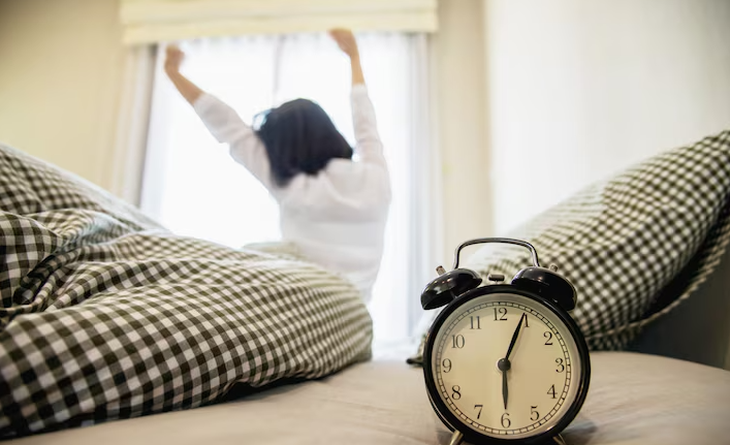
Open the curtains to let in the morning sun - a simple tip to reduce stress and sleep better - Photo: FREEPIK
Researchers at St. Hedwig Hospital and Charité University Medical Center Berlin (Germany) have issued a significant warning about modern urban lifestyles: spending mornings under dim artificial light not only makes people sleepy but also alters hormones and sleep patterns in a way similar to that seen in people with depression.
In today's urban life, many people spend most of their daytime in environments with light levels below 25 lux, a condition scientists call "living in biological darkness".
Meanwhile, depressive disorders are often closely related to the overactivity of the hypothalamic-pituitary-adrenal axis, leading to cortisol (stress hormone) levels remaining high in the afternoon and evening instead of naturally dropping to their lowest point.
In addition, the sleep patterns of people with depression also have distinct characteristics, such as changes in REM (rapid eye movement) sleep and the shifting of deep, slow-wave sleep from the early part of the night to later stages.
To verify the impact of low light on these biological mechanisms, the research team conducted an experiment on 20 young, healthy volunteers, with an average age of 24. They were randomly divided into two groups to spend six consecutive mornings (from 8 am to 12 pm) under different lighting conditions.
One group was exposed to low-intensity incandescent lighting (55 lux, warm tone), simulating a dimly lit indoor environment. The other group was exposed to higher-intensity fluorescent lighting (800 lux), closer to daylight.
Hormone analysis revealed a significant difference. Although evening cortisol levels in both groups started at similar levels, after a few days, the group living in dim light experienced a sharp increase in this hormone between 4 PM and late evening. This is a worrying biological sign, as high cortisol levels late in the day are a common characteristic in individuals at risk of or suffering from depression.
Besides affecting hormones, dim morning light also disrupts sleep at night. People in the low-light group experienced an average reduction of about 25 minutes in total sleep time each night.
More importantly, their sleep patterns were altered in a negative way. Slow-wave activity (the deep sleep phase that helps the body recover) shifted away from the early stages of sleep and became more prevalent in later cycles.
Conversely, the group exposed to bright light in the morning had longer REM sleep later in the night, a sign of healthy sleep.
Psychologically, by day 8 of the experiment, participants in the dim lighting group reported feeling more sleepy and depressed than the control group. Subjective assessments indicated that their sleepiness increased slowly and persisted throughout the evening, while the brightly lit group tended to feel sleepy more quickly and decisively when it came time to rest.
This study, published in the Journal of Psychiatric Research, concludes that low-light conditions in the morning may be "programming" our bodies to be more vulnerable to depression. Symptoms such as insomnia, reduced deep sleep time in the early evening, and increased cortisol levels late in the day are all precursors to depressive episodes.
This finding highlights the urgent need to rethink how lighting is designed in everyday life. Lighting in offices, classrooms, and homes today often mirrors the low-light conditions in the experiment.
Introducing high-intensity natural or artificial light into living spaces, especially in the morning, can be a simple yet effective way to reinforce circadian rhythms and protect mental health for the community.
Source: https://tuoitre.vn/lam-viec-duoi-anh-sang-mo-khien-noi-tiet-roi-loan-tang-nguy-co-tram-cam-20251210091327407.htm

































































Comment (0)