

(NLĐO) - The super-Earth WASP-132c, where one year is equivalent to only one day on Earth, should not exist according to traditional cosmological models.
According to Sci-News, scientists have just discovered some very strange details about the three-planet system around the star WASP-132, located 403 light-years from Earth.
Previous data has revealed that there are two planets and a potentially planetary object orbiting this orange star.
Now, a research team led by Dr. François Bouchy from the Geneva Observatory (Switzerland) has conducted in-depth observations and analyses to determine the nature of the planets. They were surprised.
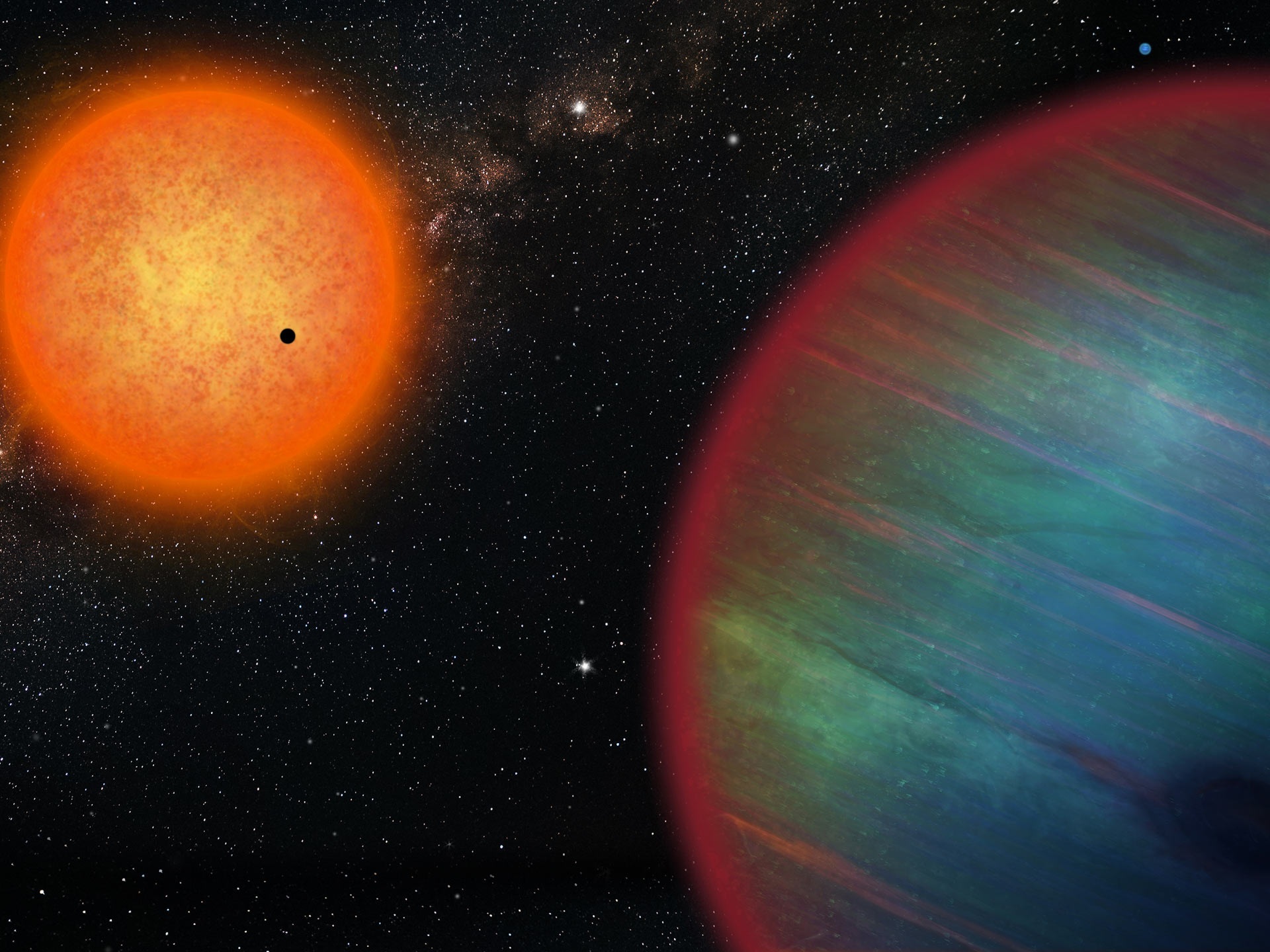
The WASP-132 star system with a super-Earth "sandwiched" between its parent star and a hot Jupiter - Graphic: UNIVERSITY OF GENEVA
The most clearly visible planet, WASP-132b, has a mass half that of Jupiter in our solar system and orbits its parent star in a 7.1-day period.
It belongs to a type of planet called "hot Jupiter," a group of gas giant planets similar in nature to Jupiter, but orbiting their parent star so closely that they are extremely hot.
Hot Jupiters found in other star systems are always solitary.
Initially, they form far from their parent star but gradually move closer. This migration destabilizes the orbits of other planets.
As a consequence, the hot Jupiter either absorbs its sister planets or hurles them out of the star system.
But for this star system, between its parent star and the hot Jupiter, a second planet called WASP-132c appeared unexpectedly.
Even more surprisingly, in-depth analysis revealed that although its mass is six times that of Earth, its density is similar. Therefore, it is a type of planet known as a "super-Earth".
Of course, despite having Earth-like characteristics, it is not expected to harbor life. Orbiting too close to its parent star would turn this planet into a terrifying "hell of fire."
Furthermore, the study, recently published in the journal Astronomy & Astrophysics , also confirms a third planet in the system, named WASP-132d, a giant icy planet orbiting its parent star with a 5-year period.
According to Dr. Bouchy, this discovery requires a re-evaluation of the theory of hot Jupiter formation, as it is clear that not all of them are cannibals—or swatters—of their sibling planets.
WASP-132b is an example of how there is a more peaceful migration pattern that some fiery giants like it may have followed, albeit in the minority.
Source: https://nld.com.vn/sieu-trai-dat-dang-so-giai-oan-cho-ke-an-thit-hanh-tinh-196250116161009787.htm

























![[Photo] Prime Minister Pham Minh Chinh holds a phone call with the CEO of Russia's Rosatom Corporation.](/_next/image?url=https%3A%2F%2Fvphoto.vietnam.vn%2Fthumb%2F1200x675%2Fvietnam%2Fresource%2FIMAGE%2F2025%2F12%2F11%2F1765464552365_dsc-5295-jpg.webp&w=3840&q=75)













































Comment (0)