

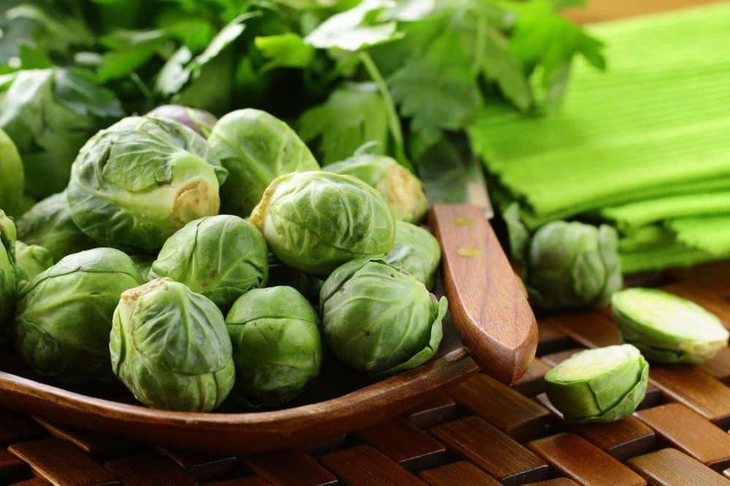
Miniature cabbages offer many unexpected health benefits - Illustration
Many surprising uses
According to doctors at the Clinical Nutrition Center of K Hospital, Brussels sprouts are a type of cabbage originating from the Mediterranean, which was introduced to Vietnam in recent years under the name miniature cabbage.
Brussels sprouts are rich in fiber, vitamin C, vitamin K, and carotenoids, which have antioxidant effects, prevent cancer, are good for the brain, have anti-inflammatory properties, and support reproductive health. Therefore, they are becoming increasingly popular and are being added to the menus of many families.
Numerous laboratory studies have shown that carotenoids found in Brussels sprouts act as antioxidants and stimulate the body's antioxidant capacity. This reduces the damage caused by free radicals to DNA, which can lead to cancer.
At the same time, they also increase enzymes that metabolize carcinogens and stimulate the self-destruction of abnormal cells. In population studies, higher blood levels of total carotenoids and beta-carotene have been shown to reduce cancer risk.
In addition, the vitamin C in Brussels sprouts is also a powerful antioxidant. Laboratory studies have shown it to protect cell DNA.
Cellular studies have also shown that vitamin C inhibits the formation of carcinogens and supports the immune system. Human studies indicate that high levels of vitamin C in the daily diet are associated with a reduced risk of lung cancer in smokers and colon cancer.
Brussels sprouts provide a significant amount of folate, which plays a role in cell growth and division, the creation of neurotransmitters in the brain, the production of healthy red blood cells, and the prevention of anemia.
In particular, folate supplementation during pregnancy helps prevent the risk of neural tube birth defects.
Brussels sprouts are also rich in fiber. 100g of Brussels sprouts contains 3.8g of fiber. Fiber plays an important role in preventing and treating diseases such as diabetes, obesity, cancer, cardiovascular disease, constipation, etc.
Notably, Brussels sprouts contain a significant amount of vitamin K. 100g of Brussels sprouts contains approximately 194mcg of vitamin K, meeting about 242% of an adult's daily requirement.
Doctors also advise patients who are taking vitamin K antagonist anticoagulants to consult their doctor or a nutritionist before using this product.
How to prepare Brussels sprouts in a way that's healthy?
Brussels sprouts can be prepared like other common vegetables such as cabbage and bok choy. However, if cooked thoroughly, the flavor of Brussels sprouts can become too strong.
The best way to preserve their flavor and nutrients is to cut them in half and steam them for 8-10 minutes or sauté them in a flavored oil such as olive oil for 10-12 minutes.
To ensure food safety when using Brussels sprouts and cabbage in general, health experts recommend washing cabbage thoroughly before preparation, washing hands with soap, and thoroughly cleaning cooking utensils and surfaces in the kitchen.
It is advisable to limit the consumption of dishes made from cabbage that have been left overnight or stored in the refrigerator for a long time to avoid potential health risks.
Source: https://archive.vietnam.vn/loai-bap-cai-co-kich-thuoc-ti-hon-nhung-mang-lai-loi-ich-suc-khoe-khong-ngo/


![[Photo] Prime Minister Pham Minh Chinh holds a phone call with the CEO of Russia's Rosatom Corporation.](/_next/image?url=https%3A%2F%2Fvphoto.vietnam.vn%2Fthumb%2F1200x675%2Fvietnam%2Fresource%2FIMAGE%2F2025%2F12%2F11%2F1765464552365_dsc-5295-jpg.webp&w=3840&q=75)

![[Photo] Closing Ceremony of the 10th Session of the 15th National Assembly](/_next/image?url=https%3A%2F%2Fvphoto.vietnam.vn%2Fthumb%2F1200x675%2Fvietnam%2Fresource%2FIMAGE%2F2025%2F12%2F11%2F1765448959967_image-1437-jpg.webp&w=3840&q=75)










































![[OFFICIAL] MISA GROUP ANNOUNCES ITS PIONEERING BRAND POSITIONING IN BUILDING AGENTIC AI FOR BUSINESSES, HOUSEHOLDS, AND THE GOVERNMENT](https://vphoto.vietnam.vn/thumb/402x226/vietnam/resource/IMAGE/2025/12/11/1765444754256_agentic-ai_postfb-scaled.png)














































Comment (0)