

Editor's Note: Greenhouses (plastic film-covered structures) have made significant contributions to high-tech agriculture in Da Lat City in particular and Lam Dong Province in general over the past few decades. However, after a period of rapid development, the negative impacts of greenhouses on the environment and landscape in Da Lat are very evident. Therefore, the local government is planning to gradually relocate greenhouses away from the city center.
Change the way production is done.
In 1994, greenhouses were introduced to Da Lat through Dalat Hasfarm Company from the Netherlands, which invested in high-tech flower cultivation. The application of dehumidification, heating, and drip irrigation systems in greenhouses initially showed that the flowers grew well, yielded high productivity, and had consistent quality, regardless of weather conditions. With an initial investment of $700,000 on an area of approximately 1 hectare, the company now operates with capital exceeding $130 million, expanding its greenhouse area to 340 hectares and providing employment for over 4,000 workers.
Following the success of Dalat Hasfarm, greenhouses gradually became widespread in Da Lat, forming flower villages within the city. Ms. Phan Thi Thuy (Thai Phien flower village, Ward 12, Da Lat City) said: “Previously, my parents built greenhouses from bamboo and rattan frames to grow roses. Although not as modern as the iron-framed greenhouses we have now, they ensured stable flower growth and protected us from damage by rain. Furthermore, roses require an average of 160 kg of fertilizer per sao (approximately 1000 square meters) per year, compared to 250 kg outdoors; pesticides were sprayed 40 times a year, while outdoor cultivation required an average of 90 times. We didn't have to worry about rain or wind during the harvesting season. Our stable finances , ability to build a new house, and even a car are partly thanks to the greenhouses.”
According to the Lam Dong Provincial Department of Crop Production and Plant Protection, if farmers cultivate crops in greenhouses in a synchronized and scientific manner, in addition to the advantage of significantly increasing productivity, they will also reduce investment costs and minimize negative impacts on the environment, especially the amount of fertilizers and pesticides. Therefore, to serve agricultural production and high-tech agriculture, the greenhouse model has been strongly applied in Lam Dong in recent years. While in 2010, the entire province of Lam Dong only had over 1,100 hectares of greenhouses, in 2015 it was about 3,100 hectares, and now the total greenhouse area in Lam Dong province has reached approximately 4,476 hectares. Of which, Da Lat City has the largest greenhouse area with 2,554 hectares, accounting for 57% of the total greenhouse area in the province; followed by Lac Duong district with 942 hectares, Don Duong with 340 hectares, Lam Ha with 280 hectares, etc.
According to the Department of Agriculture and Rural Development of Lam Dong province, approximately 65% of the area consists of simple greenhouses assembled by farmers using iron and bamboo, while only 3.8% are modern, imported greenhouses. The remaining area is produced and assembled by domestic businesses and establishments. Previously, when greenhouses were first introduced, most people only built them using bamboo frames and plastic roofing. Around 2015, with the development of agricultural supply suppliers, building greenhouses became simpler and cheaper. Currently, to build a basic iron-framed greenhouse, farmers will spend between 180-250 million VND per sao (1,000 m² ), while models involving hydroponic systems and other high-tech methods can cost up to 500 million VND per sao, or even over 1 billion VND per sao. Due to relatively low costs compared to other technological production models, greenhouses remain a preferred investment choice for farmers because of the benefits they offer.
For high productivity
In a modern greenhouse located in a valley in Ward 10, about 7km from the center of Da Lat, rows of tomatoes are stacked high, ready for harvest, their thick, heavy fruit hanging from the trellises. We didn't see any caretakers, only heard the faint buzzing sound of an electric motor installed in a water tank operating the recirculating hydroponic system. Mr. Nguyen Duc Huy, Director of the Vietnam Hydroponics Cooperative, said: "The secret lies entirely in the phone. Through applications, sensors, and signal transmission, the owner of the garden can monitor the entire growth and development process, as well as detect diseases in the plants. The entire garden covers more than 7,000 square meters, but we only maintain 2-3 workers regularly."
When asked about the basic conditions for applying the technology, Mr. Huy said: “It is mandatory to install it in a greenhouse, because equipment placed outdoors will not be able to accurately collect the indicators. In a greenhouse, users can control the temperature and humidity, isolating it from the surrounding environment.” Regarding the application of recirculating hydroponic vegetable cultivation, Mr. Nguyen Duc Huy observed that previously, drip irrigation systems were already very economical compared to traditional irrigation (but the water was often discarded afterward), requiring an average of 10-20 m³ of water per 1,000 m² per day. However, with recirculating technology, the water is reused, requiring only about 500 liters of water per 1,000 m² to be added, saving both water and reducing operating costs...
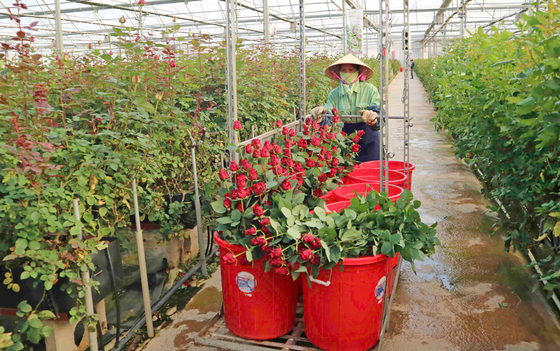 |
Dalat Hasfarm Company's greenhouse flower farm (Ward 8, Da Lat City) |
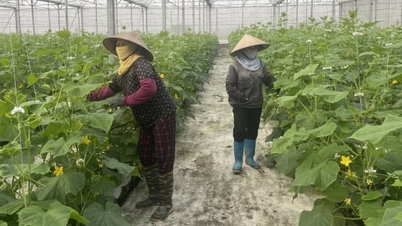
Mr. Le Van Duc's farm (Ward 8, Da Lat City), which grows sweet peppers, cucumbers, and lettuce, is also 100% covered by greenhouses, completely isolated from the outside environment through two layers of sliding doors. Mr. Duc said: “If we produce organically, we must create an environment that meets the standards required by distributors. If we grow outdoors, controlling the indicators is very difficult. If we harvest our vegetables tomorrow and our neighbor's garden is sprayed with pesticides, it will be very difficult to ensure that the chemicals don't drift over. The quality standards are increasingly demanding, so we must have strict control measures.”
Not only are vegetables and flowers grown for commercial purposes, but the seedling stage has also widely adopted the greenhouse model. "Seedling propagation is inherently difficult because the plants lack resistance, making outdoor cultivation almost impossible in the current context," shared Mr. Thai, the owner of a chrysanthemum seedling nursery in Ward 5, Da Lat City. According to Mr. Thai, each year, seedling nurseries in Da Lat supply tens of millions of seedlings locally, to neighboring regions, and for export, all depending on the availability of greenhouses.
According to the Lam Dong Department of Agriculture and Rural Development, the impressive growth figures of high-tech agriculture in Da Lat in particular and Lam Dong in general over the years are largely due to the "contribution" of greenhouses. Currently, the greenhouse model is also combined with many other smart technology applications, installing Internet of Things systems, automatic control sensor devices, LED lighting technology to optimize the growth process of cut flowers; hydroponic technology to isolate from the natural environment; building laboratories and using tissue culture technology for high-quality propagation...
In Da Lat, except for Ward 1 and Ward 2 in the city center, all other wards and communes have greenhouses, concentrated mainly in traditional flower villages such as Thai Phien, Ha Dong, and Van Thanh… While in 2005, the value of produce obtained was about 65 million VND/hectare, today Da Lat farmers earn over 350 million VND/hectare/year. Applying the greenhouse model results in 2-3 times higher yields and 1.5-2 times higher agricultural product value compared to non-greenhouse farming, depending on the type of vegetable or flower.
Source








![Looking back at the peak month of combating IUU: [Part 3] Synchronizing fisheries infrastructure](https://vphoto.vietnam.vn/thumb/402x226/vietnam/resource/IMAGE/2025/12/13/1765608279533_2109-b32-133759_237.jpeg)
























































Comment (0)