

Member of the Central Committee of the Party, Deputy Prime Minister Ho Quoc Dung attended and delivered a keynote speech at the Conference.
According to the report presented at the Conference, in 2025, the Ministry of Justice will strengthen its direction of the entire civil judgment enforcement system; strictly implement the Government's resolutions and the Ministry of Justice's Action Program, while continuing to carry out key tasks for the 2022-2026 period and the plan for preventing and combating corruption in civil judgment enforcement. The Ministry has issued a key work program and specified tasks for each locality. Ministry leaders will strengthen inspections and work in localities with many difficult cases, directly supervise the handling of large and complex cases, and guide the implementation of the new organizational model after restructuring.
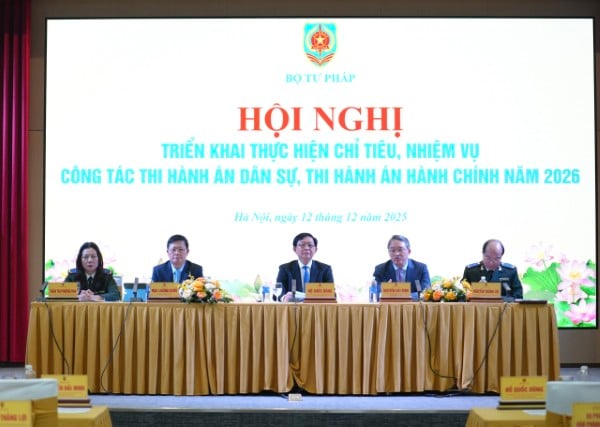
In 2025, the Ministry of Justice focused on drafting the amended Law on Enforcement of Civil Judgments to address practical obstacles and improve the efficiency of judgment enforcement; and researching the direction of socializing some civil judgment enforcement activities associated with the development of the bailiff workforce. On December 5, 2025, at the 10th session of the 15th National Assembly , the amended Law on Enforcement of Civil Judgments was passed, marking an important step in judicial reform and digital transformation in the field of civil judgment enforcement.
Regarding the enforcement of administrative judgments, the Ministry of Justice continues to strengthen monitoring, supervision, and inspection, promptly recommending disciplinary action against cases of delayed enforcement. In addition, the Ministry of Justice has coordinated with other ministries and agencies to amend relevant regulations such as laws on asset auctions, credit, banking, litigation, and bankruptcy; and has advised the Party Central Committee on a plan to strengthen the Party's leadership over the enforcement of administrative judgments in order to thoroughly address shortcomings in the handling, adjudication, and enforcement of administrative judgments.
Regarding the results of civil judgment enforcement, 576,884 cases have been completed, reaching a rate of 84.27%, an increase of 0.39% compared to 2024, exceeding the assigned target by 0.35%. In terms of monetary value, 150,060 billion VND has been collected, reaching a rate of 56.62%, an increase of 4.78% compared to 2024, exceeding the assigned target by 4.23%.
Compared to 2024, the amount collected increased by nearly 29%, demonstrating the effective enforcement of judgments, especially in large cases. Many localities achieved outstanding results, such as Ho Chi Minh City (over 81,900 cases, nearly 49,000 billion VND), Hanoi (over 39,400 cases, over 19,600 billion VND), along with Da Nang, Lam Dong, Khanh Hoa, etc.
Recovering assets lost or misappropriated in corruption and economic crime cases continues to be a particularly important task. The Ministry of Justice directed the strict implementation of Directive No. 04-CT/TW of the Party Central Committee; at the same time, it strengthened inter-agency coordination and promoted the application of information technology in organizing the execution of large cases with many victims. As a result, 27,416 billion VND was recovered, reaching a rate of 58.38%, an increase of more than 5,239 billion VND compared to 2024. Although the number of cases to be enforced decreased, the value of recovered assets increased, demonstrating the effectiveness of focusing on handling large cases that had been pending for many years.
2025 is a year of significant changes in the organizational structure of the Civil Judgment Enforcement system. In line with the policy of streamlining, on June 6, 2025, the Politburo issued Conclusion No. 162-KL/TW, unifying the model of a two-tiered Civil Judgment Enforcement system comprising the Civil Judgment Enforcement Management Department and 34 provincial-level Civil Judgment Enforcement agencies with 355 regional Civil Judgment Enforcement Offices. The Minister of Justice has issued a decision stipulating the functions, tasks, organizational structure, and leadership appointments for the entire system, ensuring the stable operation of the new apparatus.
The Ministry of Justice is stepping up administrative procedure reforms in the field of enforcement; reviewing and simplifying procedures; strengthening the digitization of records and expanding online public services. The use of digital signatures and the sending and receiving of electronic documents continues to be promoted.
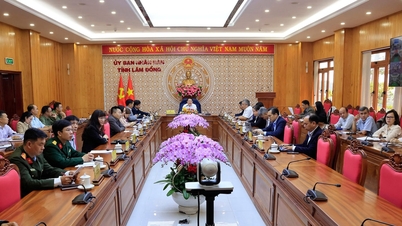
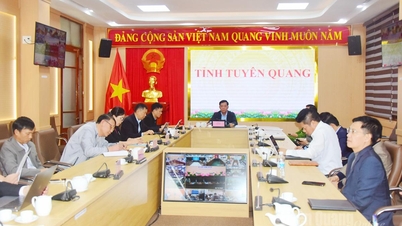
In accordance with Resolution No. 57-NQ/TW, the Ministry of Justice has built a digital platform for civil judgment enforcement; put into nationwide use important professional software such as electronic receipts and support for making judgment enforcement decisions; continued to develop software for managing case handling, organizing judgment enforcement, and receiving citizens, resolving complaints and denunciations; and directed the implementation of an online meeting project to 355 regional civil judgment enforcement offices, contributing to increased operational efficiency under the new model.

Regarding the direction and tasks for 2026, the Ministry of Justice will continue to improve the effectiveness of civil and administrative judgment enforcement; build upon the achievements of 2025 and focus on overcoming limitations. The focus will be on effectively implementing the amended Law on Civil Judgment Enforcement; perfecting guiding documents; and removing related legal bottlenecks.
The entire system will focus on fulfilling targets set forth in the National Assembly's Resolution; resolving cases that are eligible for enforcement; improving the efficiency of asset recovery in corruption and economic cases; continuing to increase the results of credit and banking enforcement; and promoting the resolution of outstanding administrative judgments. Coordination with judicial agencies and local authorities will be strengthened right from the trial and asset identification stages.
Personnel management continues to be strengthened according to the new model; recruitment, training, and professional development are enhanced; discipline and order are tightened; and inspection, prevention, and combating of corruption, waste, and negative practices in civil judgment enforcement are intensified.
Digital transformation continues to be a breakthrough, aiming to expand key business software, enhance connectivity and data sharing, expand electronic receipts, and improve system operation capabilities based on real-time data.
Source: https://baotintuc.vn/thoi-su/nang-cao-hieu-qua-cong-tac-thi-hanh-an-dan-su-hanh-chinh-trong-nam-2026-20251212102309965.htm






















![[Photo] Prime Minister Pham Minh Chinh holds a phone call with the CEO of Russia's Rosatom Corporation.](/_next/image?url=https%3A%2F%2Fvphoto.vietnam.vn%2Fthumb%2F1200x675%2Fvietnam%2Fresource%2FIMAGE%2F2025%2F12%2F11%2F1765464552365_dsc-5295-jpg.webp&w=3840&q=75)














































Comment (0)