

Ensuring that international adoptions are handled in the best interests of the child; preventing and addressing acts of non-compliance with the law in the field of international adoption.
This is one of the main contents of the Plan for the Implementation of the Toolkit for Preventing and Handling Non-Compliance with the Law in the Field of International Adoption for the period 2026-2030, which was recently signed by Deputy Prime Minister Ho Quoc Dung in Decision No. 2696/QD-TTg.
The purpose of this Plan is to effectively organize the implementation of the recommendations in the Toolkit for Preventing and Addressing Non-Compliance with the Law in the Field of International Adoption (hereinafter referred to as the Toolkit) in order to effectively implement the 1993 Hague Convention on the Protection of Children and Cooperation in the Field of International Adoption (hereinafter referred to as the 1993 Hague Convention), demonstrating Vietnam's commitment and responsibility as a member of the Convention.
Ensuring that international adoptions are handled in the best interests of children; preventing and addressing violations of the law in the field of international adoption. Simultaneously, further strengthening the effectiveness and efficiency of coordination among ministries, sectors, and localities to effectively implement adoption work in the new context.
The plan assigns specific tasks to ministries, departments, localities, and relevant agencies for implementation as follows:
The Ministry of Justice presided over the conference to implement the Decision promulgating the Plan and communication on the Toolkit. Simultaneously, it coordinated with the Ministry of Public Security, the Ministry of Foreign Affairs, the Ministry of Health, the Ministry of Ethnic Minorities and Religion, other ministries and agencies, People's Committees at all levels, and relevant organizations to communicate, disseminate, and raise awareness and responsibility among all levels, sectors, and communities regarding international adoption in accordance with the 1993 Hague Convention and the law on adoption.
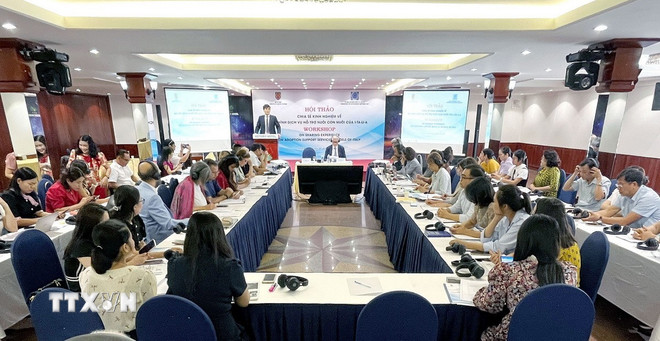
According to the approved annual plan, the Ministry of Justice is responsible for reviewing, developing, and issuing, within its authority, or submitting to competent authorities for issuance, documents and projects related to adoption, and organizing the implementation of these documents and projects.
Organize conferences and surveys; research, develop, and implement models for consulting and support services before, during, and after the adoption process for adoptive parents, adopted children, and related parties. Develop and implement mechanisms for coordination and information exchange with competent foreign authorities in reviewing, compiling, and evaluating the integration and development of Vietnamese children adopted by foreign countries.
Research, develop, and implement mechanisms and procedures to support Vietnamese citizens adopted abroad in tracing their origins, accessing information and documents related to adoption proceedings, and visiting their homeland. Strengthen efforts to ensure children's right to legal assistance during adoption proceedings. Innovate inter-agency coordination regulations in adoption work.
Simultaneously, strengthen the exchange of experiences, practice digital transformation, and application of information technology in the field of international adoption. Develop and operate information and data systems to manage international adoptions and foreign adoption offices; promote the updating, exploitation, use, connection, and sharing with the National Population Database and other specialized databases; and digitize adoption records and documents.
Strengthening international cooperation in the field of adoption, and effectively fulfilling Vietnam's role as the Central Authority for International Adoption within the framework of the 1993 Hague Convention.
The Ministry of Health, in coordination with the Ministries of Public Security, Foreign Affairs, Justice, Ethnic Minorities and Religion, other ministries and agencies, People's Committees at all levels, media outlets, and relevant organizations, will communicate, disseminate, and raise awareness and responsibility among all levels, sectors, and communities in the care and protection of children, ensuring that children live in a long-term and sustainable family environment.
Review, develop, and issue, within their authority, or submit to competent authorities for issuance, documents and projects, and organize the implementation of documents and projects on social security policies and support for children reuniting with their families.
Simultaneously, build and operate a database of children, and promote the updating, exploitation, use, connection, and sharing with the national population database and other specialized databases.
The Ministry of Public Security is strengthening its efforts to prevent and combat human trafficking in the areas of receiving, caring for, and raising children, and in handling adoptions. According to the approved annual plan, the Ministry of Public Security takes the lead in reviewing, developing, and issuing, within its authority, or submitting to competent authorities for issuance, documents and projects related to the prevention and combating of child trafficking.

The Ministry of Ethnic Minorities and Religions, in coordination with relevant ministries, agencies, and localities, will lead the communication, dissemination, and mobilization efforts to encourage religious organizations and individuals currently caring for children in special circumstances to transition to alternative care arrangements, thereby creating conditions for these children to live in a family environment.
Ministers, heads of ministerial-level agencies, government agencies, chairpersons of provincial and centrally-administered city People's Committees, and relevant agencies and organizations within the scope of state management of their respective ministries, sectors, and localities shall proactively and actively implement this Plan according to their assigned tasks, ensuring timely progress, quality, efficiency, economy, and avoiding formalism and waste.
Based on the content of this Plan and the actual situation, ministries, sectors, and localities assigned to lead the development of detailed implementation plans in their respective agencies and localities are responsible for the outputs of specific activities; and report the results of the implementation of assigned tasks to the Ministry of Justice before November 15th of each year. During the implementation process, any difficulties or obstacles should be promptly reported to the Ministry of Justice for guidance and resolution.
The Ministry of Justice is responsible for assisting the Government and the Prime Minister in monitoring, inspecting, and urging ministries, agencies, and localities to implement the tasks outlined in the Plan according to schedule.
Organize annual inter-sectoral conferences to evaluate the results of the Plan's implementation; organize a conference to summarize the Plan's implementation and make recommendations for the next phase, reporting to the Prime Minister in the second quarter of 2031.
Source: https://www.vietnamplus.vn/ngan-ngua-xu-ly-cac-hanh-vi-khong-tuan-thu-phap-luat-ve-nuoi-con-nuoi-quoc-te-post1082738.vnp















![[Photo] Prime Minister Pham Minh Chinh holds a phone call with the CEO of Russia's Rosatom Corporation.](/_next/image?url=https%3A%2F%2Fvphoto.vietnam.vn%2Fthumb%2F1200x675%2Fvietnam%2Fresource%2FIMAGE%2F2025%2F12%2F11%2F1765464552365_dsc-5295-jpg.webp&w=3840&q=75)









































Comment (0)