

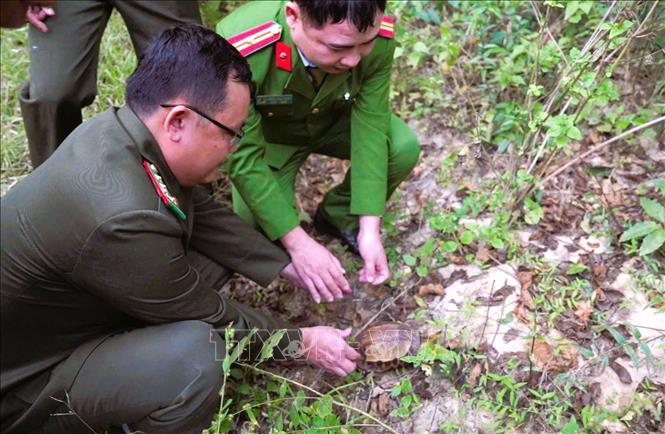
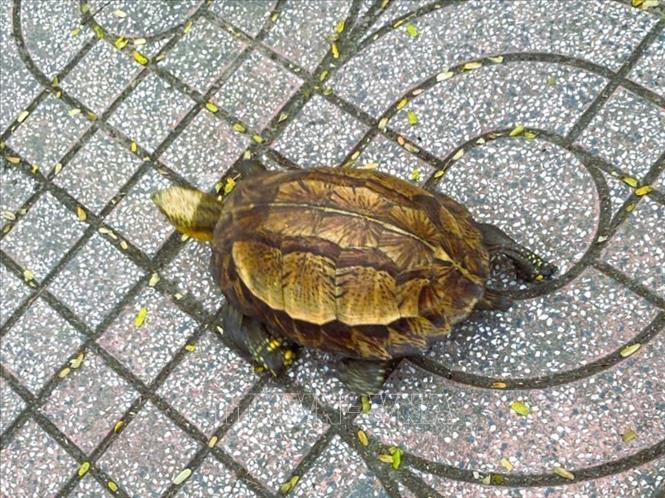
According to information from the Quy Hop Forest Protection Department, Nghe An province, this turtle was previously discovered and caught by Mr. Truong Van An (Quy Hop commune, Nghe An province) on a residential road in the area. After looking up and researching, Mr. Truong Van An discovered that the shape, color, and size of the caught turtle matched the identifying characteristics of the Northern yellow-fronted box turtle.
Identifying this turtle as an endangered and rare wild animal, on November 2, Mr. An proactively brought this turtle to the Quy Hop Commune Police to hand it over. Immediately after receiving it, the authorities contacted the Quy Hop Forest Protection Department to complete the procedures for receiving and handling it according to regulations.
The yellow-fronted box turtle belongs to the swamp turtle family, distributed mainly in Europe and Asia. In Vietnam, the yellow-fronted box turtle is distributed in 3 regions, divided into the Northern yellow-fronted box turtle, the Central yellow-fronted box turtle and the Southern yellow-fronted box turtle. The habitat of the yellow-fronted box turtle is rivers, swamps, ponds and lakes. The yellow-fronted box turtle has identifying characteristics such as the turtle's plastron consisting of two pieces, can move, the back half is fixed, the front half can close and retract the head when attacked. The turtle's shell is high, raised with the edge of the shell and is usually dark black or brown, interspersed on the back are light yellow stripes. The size of the turtle is about 280mm on average and 10-20cm wide.
The Northern yellow-fronted box turtle ( scientific name Cuora galbinifrons) has a beautiful yellow and raised shell. There are many patterns on the shell. The turtle's head has distinct black and gray spots. The plastron is dark yellow and does not mix with other colors. The Northern yellow-fronted box turtle is classified in group IB according to Circular 27/2025/TT-BNNMT, dated June 24, 2025, effective from July 1, 2025); listed in the Vietnam Red Book (2007) and the IUCN Red Book, in the critically endangered group; exploitation, hunting, trading, breeding, storage, and transportation for commercial purposes are strictly prohibited.
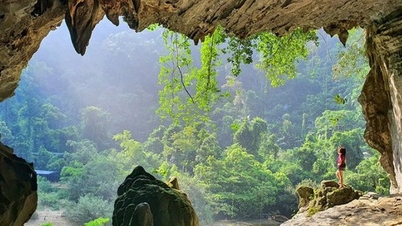
Mr. Hoang Anh Tuan, Deputy Director of Pu Huong Nature Reserve Management Board, said that as one of the system of more than 160 special-use forests in the country, Pu Huong Nature Reserve has an area of more than 46,400 hectares, is one of the three core areas of the Western Biosphere Reserve of Nghe An province, recognized by UNESCO as a World Biosphere Reserve in 2007.
Currently, the conservation area has a coverage of more than 98%. Through investigation and survey, it was determined that in the conservation area, there are more than 1,800 species of flora, subspecies belonging to more than 770 genera, 194 families of 6 vascular plant phyla; of which 130 species are at risk of extinction, including 76 species in the Vietnam Red Book, 39 species in Decree 06/2019/ND-CP of the Government and 15 species in IUCN 2020. The fauna with nearly 570 species is, of which 69 species are in the Vietnam Red Book.
The reserve is a place with diverse and rich habitats with high habitat diversity, very suitable and safe for releasing rare wildlife species back into the natural environment.
Source: https://baotintuc.vn/xa-hoi/nghe-an-tha-ca-the-rua-hop-tran-vang-quy-hiem-ve-moi-truong-tu-nhien-pu-huong-20251203200846265.htm


















![[Photo] Worshiping the Tuyet Son statue - a nearly 400-year-old treasure at Keo Pagoda](/_next/image?url=https%3A%2F%2Fvphoto.vietnam.vn%2Fthumb%2F1200x675%2Fvietnam%2Fresource%2FIMAGE%2F2025%2F12%2F02%2F1764679323086_ndo_br_tempimageomw0hi-4884-jpg.webp&w=3840&q=75)
![[Photo] Parade to celebrate the 50th anniversary of Laos' National Day](/_next/image?url=https%3A%2F%2Fvphoto.vietnam.vn%2Fthumb%2F1200x675%2Fvietnam%2Fresource%2FIMAGE%2F2025%2F12%2F02%2F1764691918289_ndo_br_0-jpg.webp&w=3840&q=75)









































![[Infographic] 3 timelines of the "Quang Trung Campaign"](https://vphoto.vietnam.vn/thumb/402x226/vietnam/resource/IMAGE/2025/12/04/1764800248456_fb_ava-2.jpeg)









Comment (0)