

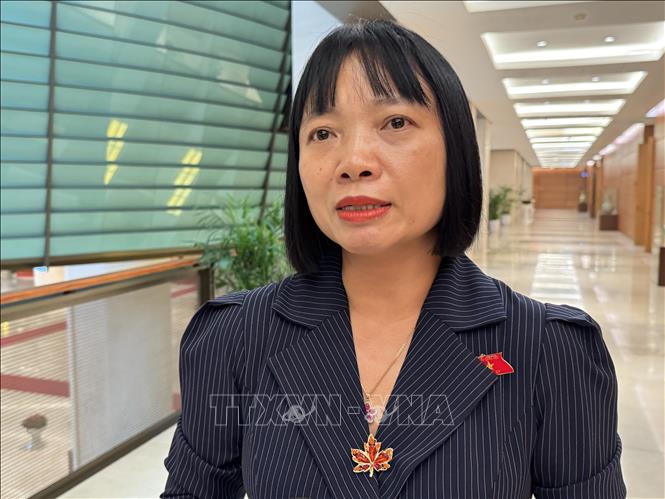
On the sidelines of the 10th Session of the 15th National Assembly , delegate Nguyen Thi Viet Nga (Hai Phong delegation) spoke with a reporter from the Vietnam News Agency about the new points and institutionalized content of Resolution 70-NQ/TW and proposals to ensure its feasibility in future implementation.
Distinguished delegates, what are the new points and breakthrough elements in the Resolution on mechanisms and policies for national energy development in the period 2026-2030?
This resolution contains many fundamental new points, creating a breakthrough in ensuring energy security in the context of rapidly increasing electricity demand, a strong shift in the energy structure, and increasingly stringent requirements for emission reduction.
The resolution establishes a mechanism for adjusting and updating power planning in a more flexible manner, shortening procedures and meeting practical requirements. This is a very new mechanism, allowing for the addition and replacement of slow-progress power generation and grid projects; the addition of BESS (battery storage system) to increase system operational capacity; and the adjustment of project names, scale, and progress… without changing the overall goals and directions of Power Plan VIII, and without having to redo the strategic environmental assessment report. This approach opens up room for faster development and avoids situations of "power waiting for procedures" and "power sources already existing but not included in the plan in a timely manner".
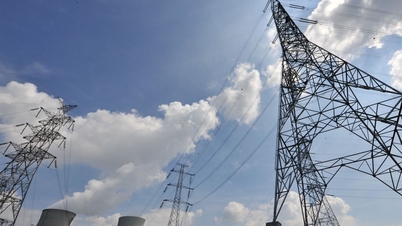
Furthermore, the Resolution strongly promotes the development of the power grid – a key link in ensuring energy security. Power grid projects included in the plan do not require investment approval procedures; land procedures, allocation of sea areas, conversion of forest land use, etc., are implemented immediately based on the planning decision or bidding results. This is a very important procedural reform, removing a major bottleneck for both power transmission and distribution.
The resolution outlines strategic steps regarding offshore wind power and small modular nuclear power (SMR). Specifically, a special mechanism is established for offshore wind power, allowing the Prime Minister to approve investors without a bidding process, provided the project is already included in the planning and meets national defense and security requirements. The power aggregation points and local responsibilities are also clearly defined. Simultaneously, research and development of small modular nuclear power are encouraged according to a suitable roadmap, opening up a more modern, safer, and economically viable technological approach compared to traditional nuclear power.
At the same time, regarding the expansion of the Direct Power Purchase Agreement (DPPA), the Resolution allows industrial parks, economic zones, high-tech zones, urban areas, etc., to directly participate in the mechanism of purchasing electricity from producers. This is a breakthrough towards a competitive electricity market, creating momentum for the development of renewable energy according to real demand, "electricity follows the market." Fifth, it creates a special mechanism for important and urgent oil, gas, and coal projects. These projects are exempt from the investment approval procedure, thereby ensuring the supply of input fuels during the energy transition phase, especially for the existing power system.
Overall, the Resolution represents a significant institutional step forward, creating a more favorable environment for ensuring energy security in the medium and long term.
How clearly have the contents of Resolution 70-NQ/TW been institutionalized in this Resolution of the National Assembly, delegates?
Resolution 70-NQ/TW of the Politburo sets forth the viewpoint that energy development must be synchronous, sustainable, and self-reliant; promote renewable energy; modernize the power grid; form a competitive energy market; ensure national defense and security; and improve mechanisms and policies to prioritize important and urgent projects.
In the Resolution recently passed by the National Assembly, those major guiding principles are institutionalized very clearly and fully.
That is, institutionalizing the requirement to "be one step ahead in energy planning and infrastructure." Adding mechanisms for adjusting and updating power plans, along with mechanisms prioritizing transmission grid infrastructure, is a powerful legal tool to ensure that plan implementation is not delayed, in line with the spirit of "planning must precede implementation."
Simultaneously, the resolution institutionalizes the policy of strongly developing renewable energy, especially offshore wind power. The resolution dedicates two independent articles (Articles 11 and 12) to regulating the mechanism for approving investment policies, electricity prices, power aggregation points, coordination mechanisms, and investor selection for offshore wind power in two phases: 2025–2030 and 2031–2035. This is a very important step in realizing the orientation of Resolution 70 on making Vietnam a strong renewable energy nation.
Furthermore, institutionalizing the policy of "diversifying new energy sources" is crucial. Including small-module nuclear power in the research and investment incentive program is a long-term preparation, ensuring strategic energy security in the context of increasing demand and increasingly stringent emission reduction requirements.
Furthermore, institutionalizing the requirement to improve and develop a competitive energy market is crucial. The Direct Power Purchase Agreement (DPPA) mechanism has been expanded in terms of scope and scale, creating "market momentum" and reducing pressure on EVN in electricity trading. This is a key aspect of Resolution 70.
Finally, there is the institutionalization of the requirement to ensure energy security and national defense security. Conditions regarding maritime security and sovereignty for offshore wind power projects, or special mechanisms for important and urgent oil, gas, and coal projects, all aim to ensure energy security in all situations.
Thus, this Resolution is truly a concrete and comprehensive step in implementing Resolution 70 into mechanisms, policies, and laws, creating a foundation for restructuring the energy sector towards a more modern, sustainable, and self-reliant direction.
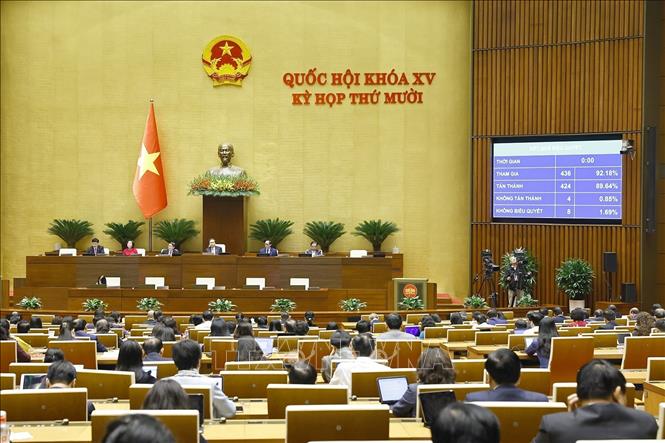
Ladies and gentlemen, to ensure the feasibility and effective implementation of Resolution 70-NQ/TW and the Government's Action Program, what groups of solutions do you think should be focused on?
I believe we need to focus on several major groups of solutions as follows: First, we need to quickly finalize the system of guiding documents using a streamlined process. This is a decisive factor in the speed of implementation in practice. Ministries and sectors must coordinate closely, minimize overlaps, and ensure consistency, especially with regard to guiding documents on offshore wind power, the direct power purchase agreement mechanism, the power grid development mechanism, and land and maritime procedures.
Secondly, prioritize resources for the development of power grid infrastructure. The transmission and distribution grid is currently the biggest bottleneck. It is necessary to accelerate the 500 kV North-South projects and renewable energy transmission lines; clearly define responsibilities and coordination mechanisms between the Ministry of Industry and Trade, the Ministry of Agriculture and Environment, and local authorities in land preparation; and allow private enterprises to participate more strongly in power grid investment in suitable areas.
Thirdly, there needs to be a diverse and flexible mechanism for mobilizing capital. Besides state capital, private capital, international green capital, and new investment funds in the renewable energy sector should be encouraged. A mechanism for allocating risk appropriately between the state, investors, and the banking system is necessary to facilitate large-scale projects such as offshore wind power and SMR (Sustainable Renewable Energy).
Fourth, perfect the legal framework for commercializing offshore wind power. This includes clearly defining the electricity pricing mechanism and the method for determining prices based on a price ceiling; establishing a transparent PPA (Power Purchase Agreement) negotiation mechanism in accordance with international practices; and ensuring policy stability to attract major investors from around the world.
Fifth, accelerate digital transformation and modernize the power system operation and dispatching. The resolution stipulates a mechanism to waive certain conditions for on-lending and government guarantees for the National Power System and Electricity Market Operator. This is an opportunity to modernize the dispatching infrastructure and enhance the integration of renewable energy at a high rate.
Finally, it is essential to strengthen supervision, transparency, and the prevention of corruption, avoiding the "request-and-grant mechanism" and preventing the emergence of new barriers. Therefore, the supervisory role of the National Assembly, the Fatherland Front, and local governments is crucial to ensuring that policies are implemented effectively and achieve their stated objectives.
Thank you very much, delegates.
Source: https://baotintuc.vn/thoi-su/nghi-quyet-moi-tao-dot-pha-bao-dam-an-ninh-nang-luong-20251211173543006.htm
![[Photo] Closing Ceremony of the 10th Session of the 15th National Assembly](/_next/image?url=https%3A%2F%2Fvphoto.vietnam.vn%2Fthumb%2F1200x675%2Fvietnam%2Fresource%2FIMAGE%2F2025%2F12%2F11%2F1765448959967_image-1437-jpg.webp&w=3840&q=75)
![[Photo] Prime Minister Pham Minh Chinh holds a phone call with the CEO of Russia's Rosatom Corporation.](/_next/image?url=https%3A%2F%2Fvphoto.vietnam.vn%2Fthumb%2F1200x675%2Fvietnam%2Fresource%2FIMAGE%2F2025%2F12%2F11%2F1765464552365_dsc-5295-jpg.webp&w=3840&q=75)






































![[OFFICIAL] MISA GROUP ANNOUNCES ITS PIONEERING BRAND POSITIONING IN BUILDING AGENTIC AI FOR BUSINESSES, HOUSEHOLDS, AND THE GOVERNMENT](https://vphoto.vietnam.vn/thumb/402x226/vietnam/resource/IMAGE/2025/12/11/1765444754256_agentic-ai_postfb-scaled.png)














































Comment (0)