

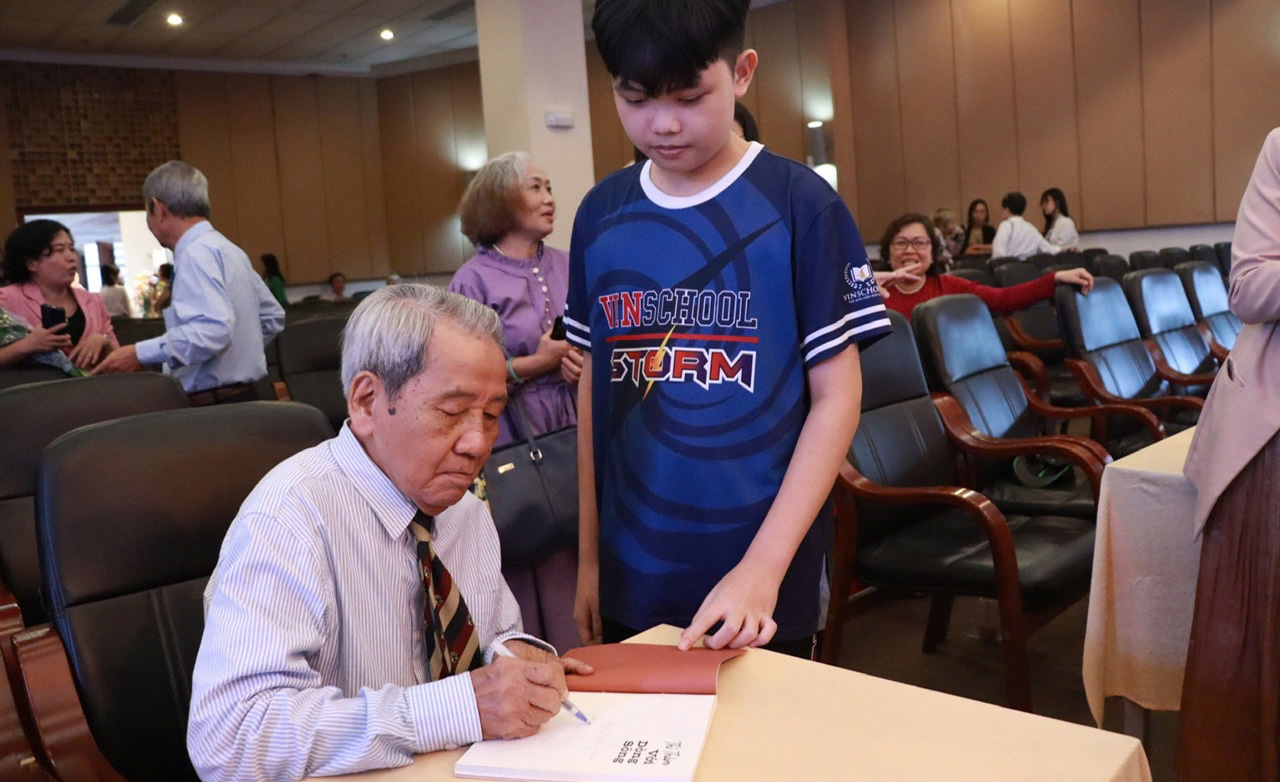
Poet Hoai Vu signs books for readers. |
• EMOTIONAL MEMORIES BY THE VAM CO DONG RIVER
Many poets and musicians have written about their hometown rivers, but poet Hoai Vu is best known for the Vam Co Dong River, the place he was closely associated with during the resistance war ?
But At the age of 11 or 12, I joined the cadet corps. To be honest, I didn't have many memories of my hometown then. I had some poems about the mountains and my hometown, but I hadn't written about the river in my hometown. And with so many memories deeply rooted in my being, the Vam Co Dong River became a defining feature in my poetry. The impression was so strong that many people thought my hometown was in the Mekong Delta, not Quang Ngai, and that my hometown river was the Vam Co Dong River. Besides the song "Vam Co Dong," I have many other songs and poems about this river, such as: "You're at the head of the river, I'm at the end," "Whispering to the river," "Walking in the scent of melaleuca trees"... Many people still think I'm from Long An , from the Mekong Delta, and they treat me like a fellow countryman even before meeting me, just by reading my poems or listening to my songs. Honestly, for a creative artist, having such empathy is very enjoyable. When I travel to Long An, Can Tho, Ben Tre, and Dong Thap for work, I am treated with the same warmth and affection as if I were a son of the Mekong Delta. This warmth, for me, is a deep sense of empathy and appreciation stemming from a shared love for a river and a region, even though many people in the Mekong Delta thank me for bringing the Vam Co River to the hearts of people across the country.
- Is "Vam Co Dong" his best poem?
But I don't think anyone would have thought of arranging their literary creations in such a way. This poem was written from a memory. In 1963, I was on a mission in Long An, right during the intense period of the war. Every night, we crossed the Vam Co Dong River, with enemy ships constantly coming and going. Crossing the river was very difficult and dangerous; we had to wait for the signal lights to flash before daring to cross, and we were very afraid of being ambushed. To guide the group across the river, there were very brave female messengers. They weaved through the water hyacinths, rowing boats to take us across the river without fear of danger. That night, when we crossed the river at 1 or 2 in the morning, I was sitting in a hut watching ducks belonging to the villagers on the riverbank. And with a powerful emotion, I wrote the poem that very night. The next day, I copied the poem into two copies. One copy I put in my pocket for safekeeping, and the other I sent. The poem was published in newspapers and on radio, and was set to music by composer Truong Quang Luc and broadcast on the radio in 1966.
It is known that when "Vam Co Dong" was set to music as a song of the same name, it became a sensation, with songs about the Vam Co River resounding from North to South – a river associated with the heroic yet warm and poetic atmosphere of the soldiers and people at that time.
This is also connected to another memory of mine. At the end of 1966, while on a business trip in Long An, I often carried a small radio with me. That night, while traveling along the Vam Co River, I happened to hear the voices of singers Tran Thu and Tuyet Nhung from the Voice of Vietnam radio station in Hanoi singing: "Do you know, far away on the Red River..." and I was deeply moved. That's an unforgettable memory from my time working in the Southern battlefield. At that time, because I was in enemy-occupied territory, even though I was very moved, I could only turn the radio up to a moderate volume, enough to hear, with emotions and feelings that were difficult to suppress. Even though I was listening to my own poem, when it was set to music and sung by singers from the distant North, I was truly deeply moved.
There's another memory I'll always remember about this song. It was when I met composer Phan Huỳnh Điểu. He told me he heard the song "Vàm Cỏ Đông" while carrying rice and working in the fields in the Zone 5 battlefield, during a program broadcast from the North. He asked his comrades, "What a beautiful river! Where is it?" Composer Phan Huỳnh Điểu was deeply moved when he learned that the river was from the South, from a fierce, painful, and heroic resistance zone. "I will write about the Vàm Cỏ Đông River," he said. And indeed, that's exactly what happened. Many years later, composer Phan Huỳnh Điểu set my poem "You're at the Head of the River, I'm at the End" to music. He said that he had liked this river ever since he heard the song "Vàm Cỏ Đông" during the war.
• LOVE STORIES, EMOTIONS FROM THE HEART
- Love in Hoai Vu's poetry is beautiful but often agonizing, unrequited, and filled with nostalgia… Are these real love stories or the poet's imagination?
- Actually, I wrote from true stories. "Walking in the Scent of Melaleuca"—mentioning this poem still moves me. The poem is about a female liaison officer named Lan, who cared for me when I was wounded during the fierce resistance war. After peace was restored, I sought out my benefactor, the former liaison officer, unaware that she had been shot dead in the Melaleuca grove during the war. Before going to find Lan, I went to buy two bottles of perfume to give her. Someone directed me to her grave. Where Lan lay, it was heartbreaking; the former liaison officer was now just a mound of earth, covered with Melaleuca leaves. At that moment, I was deeply moved and whispered: "Lan, wake up early, wash your face, and put on the perfume I bought for you from Saigon…"
Or consider the poem "Farewell at Sunset" (set to music by composer Thuan Yen), also written from a memory. That day, enemy tanks were chasing us in the strategic hamlet. We had to flee to our relatives' houses, knocking on doors. The villagers, feeling sorry for the liberation soldiers, opened their doors and let us in. The following afternoon, I left. Hanh (the girl staying at my house) bought me a white traditional Vietnamese outfit, carried a hoe, wrapped a checkered scarf around my neck, and carried a woven bag – we pretended to be a married couple going to work in the fields to deceive the enemy and pass by their outpost. Before we parted, Hanh said, "Go now, remember to come back and liberate our homeland soon!" I saw tears in her eyes. As I walked away, I could still see Hanh's white hat waving in the fading sunset light.
All my poems are written from my own moving stories. For me, poetry is my flesh and blood, drawn from my very being, not embellished or painted. I write down what I think and feel in my heart. Poetry must first and foremost truly resonate with the poet to convey emotions to the reader. It must be a story from the heart, from the soul; it cannot be merely imagined and then written down with flowery words to become poetry.
- What other elements are needed for good poetry?
- I believe that to write good poetry, besides the things mentioned above, one must also have a natural talent for poetry, or in other words, a God-given gift.
- When you wrote your first poems, did you think you would become a famous poet?
- No. At that time, I didn't even think about wanting to be a poet. In fact, I didn't write for the sake of poetry, but simply because I needed to share unforgettable stories and memories through words, through poetry. Besides poetry, I also wrote short stories and memoirs, partly due to the nature of my work and the necessary demands of the battlefield. For me, writing poetry was simply because it was an irreplaceable genre. Only poetry could fully express my heart and emotions. I wrote poetry not just for fun, but very realistically, because my heart needed to express itself, to give voice to my feelings.
Besides poetry, he was also known as a famous writer of short stories and essays from his days on the battlefield?
- I wrote short stories and essays because of my connection to the battlefield. I wrote about 50-70 essays about the war alone. At that time, news from the South sent to the North was very important. My essays were published in the People's Newspaper, the Unification Newspaper, and the Arts and Literature Newspaper. Some essays became valuable documents for some cadres, such as the essay about the girls from a locality in Long An. Thanks to the specific achievements of each person mentioned in the essay, they later had material to verify their contributions to the revolution. As for short stories, I have about seven or eight collections, both original and translated. Among them is the translated short story collection "Flowers in the Snow" - Chinese literature about the fate of Chinese people with their life tragedies, which has been well received by readers... However, many people mention Hoai Vu in his role as a poet because perhaps, his poetry has a connection with media, television, and musicians, being set to music into songs that move the public and therefore have a wide reach.
- Is poet Hoai Vu still writing at the age of 90?
- To be honest, I realize I'm getting old, so I should retire and let the younger generation rise. I'm very closely connected to the younger generation. Decades ago, wherever I had the opportunity to organize writing camps, I always held them for young volunteers, military writers, students, etc., and I placed my hopes and expectations in the young writers. When I realized my strength was limited and I could no longer write, I should temporarily stop, and the younger generation would rise to take my place.
Thank you , poet, for sharing!
Source: https://baolamdong.vn/van-hoa-nghe-thuat/202503/nha-tho-hoai-vu-voi-toi-tho-phai-duoc-viet-tu-mau-thit-tu-long-minh-5d85ee1/
![[Photo] Prime Minister Pham Minh Chinh holds a phone call with the CEO of Russia's Rosatom Corporation.](/_next/image?url=https%3A%2F%2Fvphoto.vietnam.vn%2Fthumb%2F1200x675%2Fvietnam%2Fresource%2FIMAGE%2F2025%2F12%2F11%2F1765464552365_dsc-5295-jpg.webp&w=3840&q=75)




![[Photo] Closing Ceremony of the 10th Session of the 15th National Assembly](/_next/image?url=https%3A%2F%2Fvphoto.vietnam.vn%2Fthumb%2F1200x675%2Fvietnam%2Fresource%2FIMAGE%2F2025%2F12%2F11%2F1765448959967_image-1437-jpg.webp&w=3840&q=75)






























![[OFFICIAL] MISA GROUP ANNOUNCES ITS PIONEERING BRAND POSITIONING IN BUILDING AGENTIC AI FOR BUSINESSES, HOUSEHOLDS, AND THE GOVERNMENT](https://vphoto.vietnam.vn/thumb/402x226/vietnam/resource/IMAGE/2025/12/11/1765444754256_agentic-ai_postfb-scaled.png)





































Comment (0)