

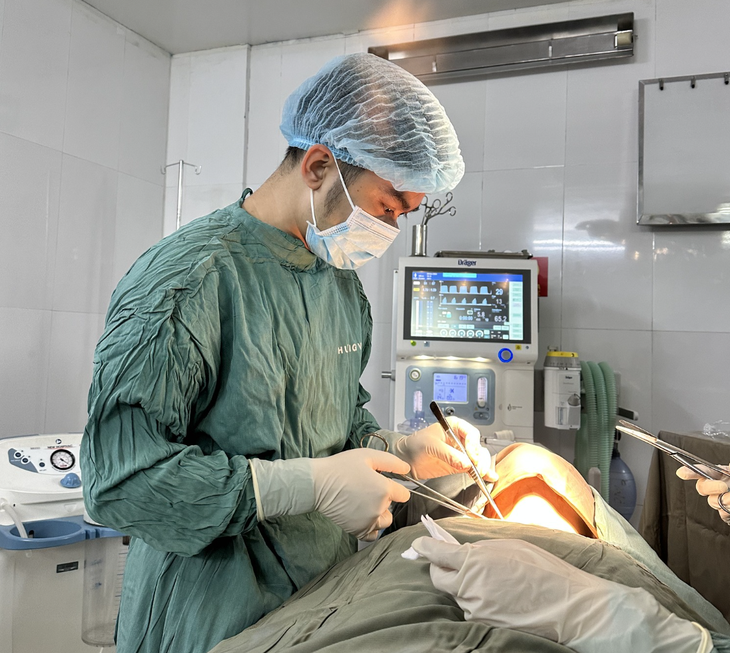
Doctor Nguyen Xuan Tuan treating a patient - Photo: BSCC
"No malignant cells detected" - does that mean we can rest easy?
Sharing his thoughts on this issue, Dr. Nguyen Xuan Tuan, a resident physician specializing in oncology, said that this is a question he frequently hears after examining patients.
"I often have to answer patients very carefully because a FNA result showing no malignant cells does not mean absolute safety. Fine-needle aspiration cytology (FNA) is a valuable diagnostic method to determine whether thyroid nodules contain malignant cells."
However, the result of a biopsy showing "no malignant cells" must be understood in the context of the Bethesda classification. For example, if the result is Bethesda II - Benign, the accuracy rate is high, but there is still a 2–5% risk of false negative, meaning there is still a possibility of cancer even if the result is "benign".
Furthermore, it is even more dangerous if the result is Bethesda I – insufficient sample. This is a group where the specimen does not meet diagnostic standards, possibly due to aspiration from the wrong location, aspiration of necrotic tissue, or the lesion being too small to conclude whether it is benign or malignant.
In other words, Bethesda I doesn't mean "no malignant cells," but rather "nothing to assess." If the patient or doctor is complacent, assuming "the biopsy was done, nothing bad was found," and then monitors the patient laxly, they may miss a potential malignant lesion," Dr. Tuan explained.
In fact, Dr. Tuan shared that he had encountered similar cases where the biopsy results showed "insufficient sample," but no further biopsy was performed. One or two years later, the nodule grew larger, began to compress surrounding tissues, and an ultrasound revealed TIRADS 5. A second biopsy then showed papillary carcinoma.
"It's important to remember that FNA is only one step in the diagnosis and must be understood correctly, according to the proper classification. After a benign or insufficient sample FNA, follow-up with regular ultrasounds is still necessary. Repeat the procedure if the nodule is large, the ultrasound features are suspicious, or it changes rapidly. Re-evaluate the entire clinical picture – not just 'look at the paper results'."
"A fine-needle aspiration biopsy is to assist doctors in making decisions, not for 'peace of mind.' True peace of mind comes from proper monitoring, ensuring no abnormalities are missed, and detecting them promptly," Dr. Tuan said.
Is thyroid cancer "terrible"?
Dr. Tuan has encountered many patients who, upon hearing the words "thyroid cancer," would turn pale and stare at him with utter bewilderment.
"It's understandable. The word 'cancer' already carries so much fear: fear of surgery, fear of metastasis, fear of prolonged hospitalization, fear of having to live with the disease for the rest of one's life."
"But if we had to choose the 'least frightening' type of cancer, thyroid cancer, especially papillary and follicular types, would be the top contender," Dr. Tuan shared.
This expert explained that , firstly , differentiated thyroid cancer (papillary and follicular types) has an extremely good prognosis. If detected and treated correctly, especially with initial radical surgery, the chances of recovery are very high.
Large studies from the US, Europe, and even data from Vietnam all show that the 10-year survival rate for papillary carcinoma can be as high as >97%, especially in young people under 55 years old.
Secondly , proper and timely treatment helps patients achieve a completely normal quality of life. Many people who have undergone thyroid surgery still go to work, go out, and live completely normally as before. No chemotherapy, no long hospital stays, and no debilitation.
Thirdly , if the disease is in its early stages, the doctor may recommend thyroidectomy (removal of a thyroid lobe or the entire thyroid gland), depending on the individual case. Afterward, based on risk stratification and histopathological results, the doctor will consider radioactive iodine treatment; not everyone needs to take oral iodine as many people mistakenly believe.
"However, just because it's 'easy to treat' doesn't mean you can be complacent. The most important condition is that it must be diagnosed and treated by a specialist doctor."
"So if you or a loved one has just been diagnosed with thyroid cancer, don't panic. Start by seeing a thyroid specialist, ask detailed questions about the type of cancer you have, the level of risk, and a clear treatment plan," Dr. Tuan advised.
Source: https://tuoitre.vn/nhan-tuyen-giap-lanh-tinh-co-phai-da-an-tam-20250929171310189.htm







































































Comment (0)