

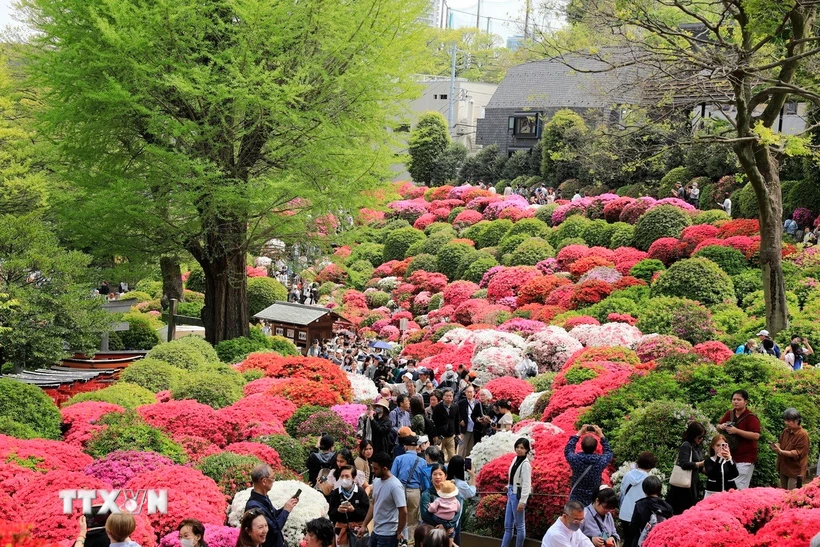
The highlight of the festival is the rhododendron hill with more than 3,000 trees belonging to over 100 different varieties. (Photo: Xuan Giao/VNA)
Azaleas (tsutsuji in Japanese) are a flower greatly loved by the Japanese people and usually bloom in the first week of April, right after the cherry blossom season ends.
In Japan, azaleas are commonly planted in parks, hedges, temple grounds, and shrines.
The ancient Nezu Shrine, nearly 1,900 years old, located in Bunkyo Ward, Tokyo, is famous for its azalea festival, one of the most anticipated spring flower festivals of the year, attracting large numbers of locals and tourists.
This year, Nezu Shrine is holding its 54th Azalea Festival from April 1st to 30th. During this time, visitors can admire the colorful beauty of the azalea hill with over 3,000 trees belonging to about 100 different varieties.
Besides their vibrant beauty with colors like pink, red, purple, and white, the colors of azalea flowers also carry special meanings, which is why this flower also appears in the art of flower arrangement - ikebana - and in ancient Japanese poetry.
Purple and pink azaleas symbolize joy and relaxation; yellow azaleas represent friendship and family; white azaleas convey a sense of purity and elegance; and red azaleas represent the unwavering love between husband and wife, romance, and passion.
Despite its humble appearance, the azalea always evokes a sense of serenity and peace, a characteristic of Japanese culture. Therefore, the azalea is not only one of the symbols of spring, but the azalea festival is also an integral part of the cultural and spiritual life of the Japanese people.
(VNA/Vietnam+)
Source: https://www.vietnamplus.vn/nhat-ban-ruc-ro-le-hoi-hoa-do-quyen-tai-thu-do-tokyo-post1033521.vnp

![[Photo] Prime Minister Pham Minh Chinh holds a phone call with the CEO of Russia's Rosatom Corporation.](/_next/image?url=https%3A%2F%2Fvphoto.vietnam.vn%2Fthumb%2F1200x675%2Fvietnam%2Fresource%2FIMAGE%2F2025%2F12%2F11%2F1765464552365_dsc-5295-jpg.webp&w=3840&q=75)


![[Photo] Closing Ceremony of the 10th Session of the 15th National Assembly](/_next/image?url=https%3A%2F%2Fvphoto.vietnam.vn%2Fthumb%2F1200x675%2Fvietnam%2Fresource%2FIMAGE%2F2025%2F12%2F11%2F1765448959967_image-1437-jpg.webp&w=3840&q=75)







































































Comment (0)