

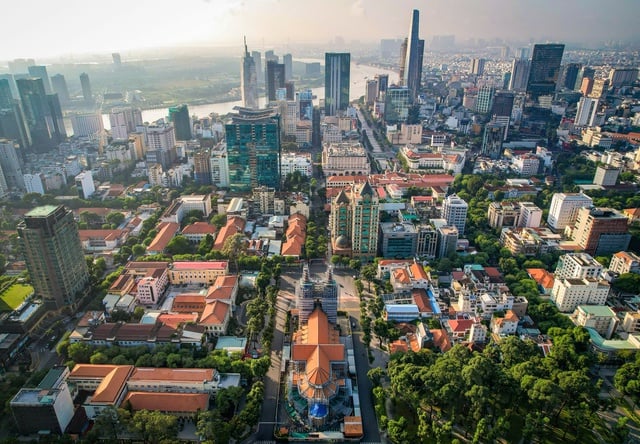
Ho Chi Minh City has many buildings and sites that face difficulties in being classified as historical relics, typically the group of urban architectural works in the central area, which occupy prime locations.
Photo: Nhat Thinh
Ho Chi Minh City has 231 structures and sites that have not yet been classified as historical relics.
According to information from the Ho Chi Minh City Department of Culture and Sports, as of now, Ho Chi Minh City has a total of 321 classified historical sites , including 4 special national historical sites , 99 national-level historical sites , and 218 city-level historical sites . These sites are distributed across 3 areas (as stipulated by the Heritage Law), spread throughout the city.
Specifically, Zone 1 has 207 relics (including 2 special national relics, 58 national relics, and 147 city-level relics); Zone 2 has 66 relics (13 national relics and 53 provincial-level relics); Zone 3 has 48 relics (2 special national relics, 28 national relics, and 18 provincial-level relics).
Furthermore, the current inventory of historical sites in Ho Chi Minh City includes 231 unclassified structures and locations. Specifically, Zone 1 (according to Decision No. 1156/QD-UBND dated August 30, 2025) has 140 structures, of which 7 have been classified, leaving 133 unclassified structures and locations. Zone 3 (according to Decision No. 3508/QD-UBND dated December 26, 2024) has 141 structures, of which 48 have been classified, leaving 98 unclassified. The inventory and approval of the list for Zone 2 is expected to be completed and published in 2026.
Many difficulties exist in the process of classifying historical sites.
According to representatives from the Ho Chi Minh City Department of Culture and Sports, some buildings and sites are facing difficulties in being classified as historical relics. This includes urban architectural structures located in the city center, occupying prime locations, under the management of central government agencies, possessing high commercial value, and facing challenges in preservation due to urban development pressures.
Religious structures such as churches and temples have unique characteristics regarding ownership and management, and concerns about classifying them as historical relics could lead to difficulties in unifying the scope of protected areas; and legal procedures for repair, renovation, or construction.
The group of historical relics, due to the fact that the witnesses from the resistance wars against France and the United States are now elderly, many of whom are no longer alive or have limited memories; original documents, materials, and artifacts have been lost over time and due to war, making it difficult to verify the source of information and supplement scientific records for the purpose of classifying the relics.
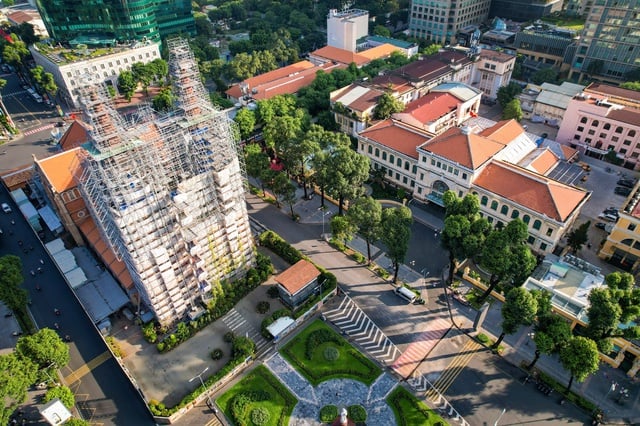
Notre Dame Cathedral and the Ho Chi Minh City Post Office are two famous architectural landmarks in Ho Chi Minh City.
Photo: Nhat Thinh
For sites that are difficult to access or do not agree to be classified as historical relics, the Ho Chi Minh City Department of Culture and Sports has implemented several solutions. These include organizing working sessions, discussions, and listening to the opinions of relevant organizations and individuals; issuing documents to promote awareness and encourage understanding of the significance and value of heritage preservation; and collaborating with scientists, the press, and media to create widespread awareness and social consensus. For historical relics, the Department organizes scientific seminars and workshops to supplement, acknowledge, and further affirm the historical, cultural, and scientific value of these structures and sites.
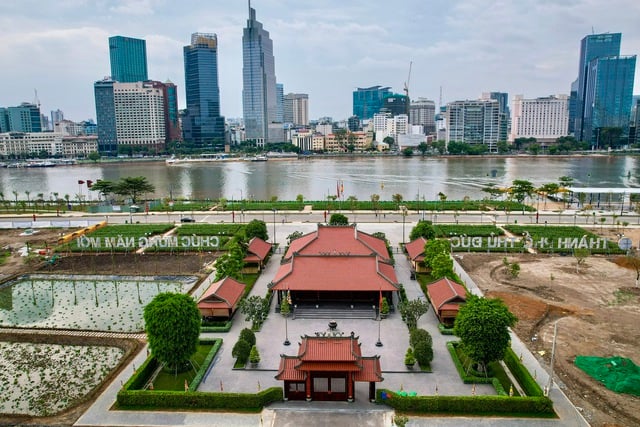
An Khánh communal house is one of the structures slated for city-level historical monument status in 2025.
Photo: Nhat Thinh
The Ho Chi Minh City Department of Culture and Sports also facilitates owners and investors in carrying out the restoration and preservation of historical sites in a way that harmonizes conservation and development, ensuring compliance with current planning and laws.
For historical sites owned by non-state entities, in addition to receiving subsidies under Decision No. 30/2011/QD-UBND dated May 19, 2011, of the Ho Chi Minh City People's Committee (the general expenditure level applied to each historical and cultural site that has been officially classified, and for those not receiving salaries from the state budget, is twice the minimum wage per month), the Ho Chi Minh City Department of Culture and Sports is researching and proposing new mechanisms and policies to strengthen support for the preservation of historical sites, such as allocating budget funds for restoration and renovation activities and establishing a Cultural Heritage Preservation Fund to promptly support deteriorating historical sites.
14 historical sites in Ho Chi Minh City will be ranked as national heritage sites in 2025.
In 2025, the Ho Chi Minh City Department of Culture and Sports advised the City People's Committee to issue 14 decisions classifying historical sites at the city level, including: Tan Dinh Market; An Khanh Temple; Long Binh Temple; Saigon University; Long Hoa Temple; Mariamman Temple; Trung Vuong High School; the base of the Cho Lon Provincial Party Committee and the Saigon - Cho Lon City Party Committee at Vuon Thom; the Truong family temple and the tomb of Mr. and Mrs. Truong Minh Thanh; Tan Phuoc Temple; Phu An Temple; Go Queo Ancient Tomb Park; Vuon Cau Do Memorial Area and Ernst Thälmann High School.
Source: https://thanhnien.vn/nhieu-cong-trinh-kien-truc-do-thi-co-vi-tri-vang-chua-the-xep-hang-di-tich-185251023162201974.htm






























![[Video] The craft of making Dong Ho folk paintings has been inscribed by UNESCO on the List of Crafts in Need of Urgent Safeguarding.](https://vphoto.vietnam.vn/thumb/402x226/vietnam/resource/IMAGE/2025/12/10/1765350246533_tranh-dong-ho-734-jpg.webp)

























































Comment (0)