

Policies exist, but many places have not fully implemented them.
In the press, the principal of Cu M'lan Primary School ( Dak Lak ) admitted: "The school doesn't know how it will repay its debts if the 'Nuoi Em' (Nurturing Children) program stops supporting us." This school has over 170 students supported by the project, with each meal costing 8,500 VND. The operating mechanism is that the school must purchase food upfront, and the project reimburses them after two months. To date, the meal budget for September and October has been approved but not yet disbursed, and the budget for November has not been approved. The school is currently in debt to its food suppliers.
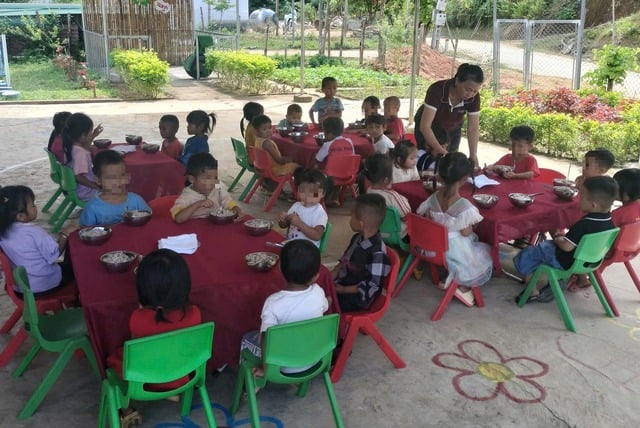
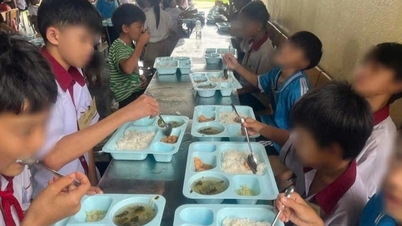
School lunch for students in the mountainous region of Nghe An.
PHOTO: THE "RAISING CHILDREN IN NGHE AN" PROJECT
This is a situation that is both ironic and worrying. A public school, funded by the state budget, has to borrow money to provide meals for its students and then wait for a private charity project to repay the debt. When the project freezes its account, the school has no contingency plan, no alternative resources, and can only worry and hope that the project will resume.
According to Decree No. 66/2025/ND-CP, effective from May 1, 2025, which stipulates policies for children in kindergartens, students, and trainees in ethnic minority and mountainous areas, particularly disadvantaged communes in coastal and island regions, boarding students will receive a monthly food allowance of 936,000 VND and 15 kg of rice for the duration of the policy. Previously, Decree No. 116/2016/ND-CP stipulated a food allowance based on 40% of the basic salary. When the basic salary was 1,800,000 VND (from July 1, 2023), the corresponding allowance was 720,000 VND; when the basic salary was 2,340,000 VND (from July 1, 2024), the corresponding allowance was 936,000 VND.
However, the reality shows that many localities have not yet fully implemented this policy. Some localities have limited budgets, some are still "waiting for guidance," and some schools do not have standard kitchens. As a result, many students fall into a loophole where they do not benefit from the state policy, or the policy arrives late, or the support level is insufficient to cover actual costs.
Current legislation does not have clear regulations on this matter.
And this is where charitable projects come in. With images of malnourished children in mountainous regions, they can easily raise tens of billions of dong in donations without needing to disclose information publicly or be subject to strict control by regulatory agencies.
What is even more concerning is the attitude of educational institutions and local authorities. When the "Nurturing Children" project faced controversy, the principal "hoped the project would continue operating." Meanwhile, the leader of Ea Súp commune stated that they would "request schools to report on the situation" so that the local authorities could understand the situation. But why wasn't there a regular monitoring mechanism in place beforehand? Why was a private charity project allowed to operate for many years in the area without any checks or assessments regarding the quality of meals, the origin of food, or the efficiency of resource utilization?
In reality, current legislation lacks clear regulations regarding the mandatory responsibility of local authorities in ensuring school meals for disadvantaged areas. Decree 66/2025/ND-CP stipulates the support level but does not specify penalties for localities that fail to fully implement it. There is no mechanism to compel provinces to allocate budget for this item. There are no regulations on a mandatory minimum standard that all students in disadvantaged areas must receive.
Regarding charitable activities, Decree 93/2019/ND-CP, amended and supplemented by Decree 136/2024/ND-CP, stipulates that charitable funds must be transparent and publicly disclosed. However, in reality, many individual charitable projects operate outside of proper oversight, failing to establish funds as required by the decree. They do not form organizations, do not register their activities, and only use personal accounts to receive donations. The law lacks clear regulations on the threshold amount of donations that necessitates the establishment of an organization, and there is no strict monitoring mechanism for large-scale projects.
It should be added that Decree 93/2021/ND-CP currently requires receiving charitable donations through a separate account, but this only applies to fundraising for disaster relief, epidemics, emergencies, and serious illnesses. It does not apply to long-term charitable activities supporting education.
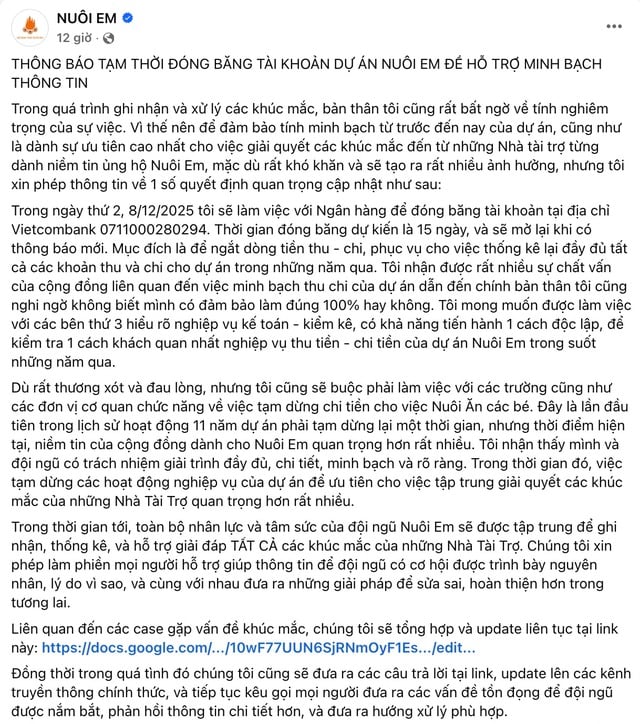
The announcement came from the homepage of the "Nurture Me" project, which has over 382,000 followers.
Photo: Screenshot
Fundamental changes are needed, from policies to monitoring mechanisms.
To break free from this vicious cycle, fundamental changes are needed, from policies to monitoring mechanisms. First, there needs to be a mandatory budget allocation for school meals in particularly disadvantaged areas, preventing local authorities from acting arbitrarily. If a locality lacks sufficient budget, there must be a mechanism for support from the central government budget; we cannot simply "open the door" for charitable activities to operate freely.
The education sector must proactively develop projects and propose resources instead of passively receiving. It must build standardized school kitchens, employ professional cooks, and implement rigorous food quality monitoring procedures. This requires a shift in mindset from waiting to being proactive, from receiving to managing.
At the same time, it is necessary to clearly stipulate that charity is only a supplementary resource, improving existing conditions and not replacing the responsibilities of the State. Charitable projects supporting school meals must operate under the supervision of local education authorities and must comply with standards for nutrition and food safety. Projects cannot be allowed to operate freely without a quality control mechanism.
Furthermore, there needs to be clear regulations on the minimum donation amount required to establish an organization, and mandatory financial transparency mechanisms for large-scale projects. Local authorities must be held legally responsible for managing and supervising charitable activities in their areas. It is unacceptable for a project raising tens of billions of dong annually to operate solely as an individual, without any oversight from any agency.
The suspicions surrounding the "Nurture Your Child" project and many similar cases serve as a wake-up call, warning against letting responsibility towards children become prey for those who exploit people's kindness.
Source: https://thanhnien.vn/nghi-van-thieu-minh-bach-du-an-nuoi-em-khoang-trong-bua-an-hoc-sinh-vung-cao-185251210152004849.htm






































































Comment (0)