


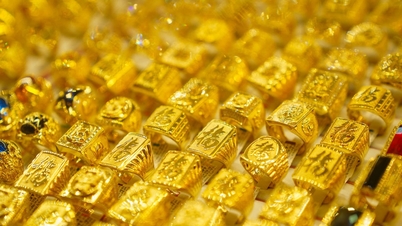
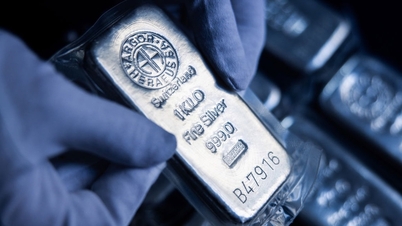
According to observations in the domestic gold market, after increasing by 800,000 VND/ounce for buying and 600,000 VND/ounce for selling on May 6th, the price of SJC gold from Saigon Jewelry Company opened on the morning of May 7th with a further increase of 1 million VND/ounce, currently listed at 85.3-87.52 million VND/ounce (buying-selling). This price has far exceeded the record of 86.5 million VND set the previous afternoon.
On the global gold market, the spot gold price closed the May 6th trading session in the US up $22.2 to $2,324 per ounce. In the Asian session on the morning of May 7th, the gold price reversed direction, falling slightly by $1.6 to around $2,323 per ounce.
Central banks are actively buying more gold.
The World Gold Council's Q1 2024 Gold Demand Trends report shows that total global gold demand (including over-the-counter (OTC) purchases) increased 3% year-on-year to 1,238 tonnes, marking the strongest first-quarter increase since 2016. Excluding the OTC market, gold demand decreased 5% to 1,102 tonnes in Q1 compared to the same period in 2023. Vietnam recorded a 12% increase in investment demand for gold bars and coins, with total consumer demand increasing 6% year-on-year in 2023.
Strong gold investment from the OTC market, continued central bank buying, and increased gold purchases from Asian customers have pushed the average quarterly gold price to a record high of $2,070 per ounce—10% higher than the same period last year and 5% higher than the same period last quarter.
Central banks have been aggressively buying more gold, adding 290 tonnes to their reserves in the first quarter. This continuous and large-scale buying by mainstream banks underscores the importance of gold in international reserve asset portfolios amidst volatile markets and rising risks.
Shaokai Fan, Regional Director for Asia Pacific (excluding China) and Global Central Bank Director at the World Gold Council, said: “Currency depreciation is a common theme in ASEAN markets as we monitor aspects of Gold Demand Trends. This fuels demand for gold as a safe-haven asset, as well as attracting investors seeking the highest returns based on local gold prices.”
Capital continued to flow out of gold exchange-traded funds (ETFs), led by North America and Europe, with global ETF holdings falling by 114 tonnes, but this was partially offset by inflows into listed products in Asia. China accounted for much of that increase, driven by renewed investor interest in gold as its currency weakened and its domestic stock market underperformed.
Additionally, demand for gold in the technology sector has recovered by 10% year-on-year thanks to the boom in AI in electronics.
In terms of supply, gold mining output increased 4% year-on-year to 893 tonnes – a record high for the first quarter. Recycled gold also reached its highest level since Q3 2020, up 12% year-on-year to 351 tonnes, as some investors saw the high prices as a good opportunity to profit.
Demand for gold bullion investment in Vietnam is growing strongly.
According to the World Gold Council, demand for gold bars and coins in Vietnam recorded its strongest growth in the first quarter since 2015. Domestic investors were attracted by the surge in gold prices in the first quarter, especially in the face of rising energy prices – which are predicted to fuel inflation – and the depreciation of the local currency against the US dollar. The price premium for gold bars reached a record high of $650 per ounce.
"To address this situation, the Vietnamese government has eased supply restrictions, and the State Bank of Vietnam plans to continue holding auctions to sell gold bars to the market at the end of April," the report stated.

Global demand for gold jewelry remained stable despite record high prices, declining only 2% year-on-year. Demand for gold jewelry in Vietnam, Thailand, and Indonesia all saw similar declines in the first quarter, falling 10-12%, as the gold price surge at the end of the first quarter limited buying demand in March.
“Demand for gold jewelry in Vietnam in the first quarter recorded its fifth consecutive decline, falling by more than 10% to 4 tons, marking the lowest first quarter demand since 2015. Despite a surge in demand in February during the Lunar New Year and the God of Wealth Day, demand for gold jewelry was still strongly influenced by high gold prices,” added Mr. Shaokai Fan.
Meanwhile, according to Louise Street, senior market analyst at the World Gold Council: “Gold prices have risen to all-time highs since March, despite common headwinds such as a strong US dollar and interest rates showing signs of ‘increasingly’ rising.”
Several factors have contributed to the recent surge in gold prices, including increased geopolitical risk and ongoing macroeconomic instability, which are driving demand for gold as a safe-haven asset. Additionally, continued and massive gold purchases by central banks, strong investment in the OTC market, and net gold buying in the derivatives market have all contributed to the price increase.
“It’s interesting that we’re seeing a shift in investor behavior between the East and the West. Typically, investors in Eastern markets are more price-sensitive, waiting for gold prices to fall before buying, while Western investors, previously attracted by rising gold prices, tend to buy when prices are high. In the first quarter, we saw those roles reversed as investment demand in markets like China and India increased significantly as gold prices surged,” said Louise Street.
Meanwhile, Louise Street stated: “2024 will deliver higher returns on gold investments than we initially expected based on gold’s recent performance. If gold prices remain flat in the coming months, some price-sensitive buyers will re-enter the market and investors will continue to turn to gold as a safe-haven asset while awaiting clearer information on interest rate cuts and election results.”
Source


![[Photo] Closing Ceremony of the 10th Session of the 15th National Assembly](/_next/image?url=https%3A%2F%2Fvphoto.vietnam.vn%2Fthumb%2F1200x675%2Fvietnam%2Fresource%2FIMAGE%2F2025%2F12%2F11%2F1765448959967_image-1437-jpg.webp&w=3840&q=75)

![[Photo] Prime Minister Pham Minh Chinh holds a phone call with the CEO of Russia's Rosatom Corporation.](/_next/image?url=https%3A%2F%2Fvphoto.vietnam.vn%2Fthumb%2F1200x675%2Fvietnam%2Fresource%2FIMAGE%2F2025%2F12%2F11%2F1765464552365_dsc-5295-jpg.webp&w=3840&q=75)






































![[OFFICIAL] MISA GROUP ANNOUNCES ITS PIONEERING BRAND POSITIONING IN BUILDING AGENTIC AI FOR BUSINESSES, HOUSEHOLDS, AND THE GOVERNMENT](https://vphoto.vietnam.vn/thumb/402x226/vietnam/resource/IMAGE/2025/12/11/1765444754256_agentic-ai_postfb-scaled.png)




































Comment (0)