


These factors could impact market trends and the performance of various sectors in the coming period. This is the assessment of Nhat Viet Securities Joint Stock Company (VFS).
VFS presented two scenarios for the stock market in January. Specifically, in scenario 1, the VN-Index will fluctuate between 1,250 and 1,300 points. This securities company recommends that investors can trade short-term within the fluctuation range; buy at the lower end and take profits when the price reaches the upper end, and avoid chasing prices. In scenario 2, the VN-Index surpasses 1,300 points. VFS recommends that investors wait for corrective developments to retest this price range before finding entry points.
Experts from Saigon - Hanoi Securities Joint Stock Company (SHS) said that last week (December 30, 2024 - January 3, 2025), the VN-Index traded poorly, especially in the first two trading sessions of 2025, when the index faced significant downward pressure.
The VN-Index failed to hold the strong support zone around 1,260 points, corresponding to the 200-day moving average. At the end of the trading week from December 30, 2024 to January 3, 2025, the VN-Index fell 1.61% to 1,254.59 points, below the 200-day moving average and above 1,250 points, corresponding to the highest price of 2023.
Liquidity decreased in the early sessions of the week and increased sharply in the final session, reflecting sudden and strong downward pressure across many groups and stocks.
The market was mixed, with both gains and losses, and stocks fluctuating within a narrow range. Selling pressure was concentrated in the finance, insurance, and real estate sectors, while gains and losses were mixed in the oil and gas and fertilizer sectors.
SHS predicts a short-term trend: the VN-Index will correct and consolidate below the resistance level of 1,265 points, and above the support level around 1,250 points. The medium-term trend for the VN-Index continues within a wide consolidation channel in the 1,200-1,300 point range, with a equilibrium price around 1,250 points. Strong resistance is at the 1,300 point level, which represents the peaks of March-July 2024 and September-October 2024.
According to SHS, the market starts 2025 with high expectations after two consecutive years of growth in 2023 and 2024, with increases of 12.2% and 12.1% respectively. In 2025, SHS expects the VN-Index to continue consolidating within a narrow range of 1,200-1,300 points during the first one to two months of the year.
The market could improve further in late Q1 2025 and early Q2 2025. The VN-Index is expected to increase by 10-12% in 2025 compared to 2024, with a target price range of 1,400-1,410 points.
In 2024, the banking sector performed positively, experiencing strong price increases with significantly increased liquidity. Many stocks stood out, such as LPB (up 31.8%), TCB (up 59.9%), HDB (up 56.9%), and CTG (up 39.5%).
SHS views the banking sector as the "lifeblood" and driving force supporting economic growth, with credit growth of 13-15% in recent years.
In 2025, the State Bank of Vietnam also plans for credit growth of 16%, and the capital increase plans of major banks will be a good growth driver for the banking sector. This remains a good investment allocation option in 2025.
"Investors should maintain a reasonable allocation, selectively considering investing in fundamentally sound stocks with expectations of continued growth. The investment target should be leading stocks in their respective industries with strong fundamentals," SHS recommended.
According to experts from Vietnam Construction Securities Joint Stock Company (CSI), the market closed the transitional week between the old year 2024 and the new year 2025 on a rather unfavorable note. Despite only trading for 4 sessions last week, the VN-Index lost more than 20 points; including 3 sessions of decline and only 1 session closing in positive territory.
The main highlight of the past week was the lack of liquidity. Weak demand led to almost overwhelming selling pressure, resulting in a sharp market plunge in the final trading session of the week.
The stalemate was broken when sellers lost patience, and large-cap stocks and a series of bank stocks put significant pressure on the market, causing the index to plummet.
The VN30-Index fell by more than 26 points last week, with pressure from large-cap stocks making it difficult for mid-cap and small-cap stocks to reverse the trend. At the close of the trading week from December 30, 2024 to January 3, 2025, the VN-Index stood at 1,254.59 points, down 20.55 points.
Cautious behavior led to a sharp decline in liquidity last week. Market trading volume was only 63.8% of the average of the past 20 trading weeks. By the end of the trading week, the average trading volume on the HOSE reached 459 million shares (down 22.14% from the previous week), equivalent to 11,883 billion VND, a decrease of nearly 20% in trading value.
Twenty out of 21 stock sectors declined last week. Sectors such as insurance (down 4.12%), consumer goods (down 3.8%), securities (down 3.41%), and seafood (down 3.09%) exerted significant pressure on the market and trading sentiment. Conversely, the plastics sector was the only sector to successfully buck the trend, rising 1%.
Foreign investors net sold 771 billion VND on the HOSE exchange. The focus of net selling by foreign investors last week was on large-cap stocks such as:FPT (453 billion VND), VCB (158 billion VND), CTG (137 billion VND)...
CSI's market outlook for the coming week suggests that the uptrend is likely to have reversed. Currently, the company's recommended buy positions at the 1,260 support level are facing increased risk, so investors should exercise caution and limit further purchases.
Although the trading volume at the end of last week exceeded the 20-day average, it is not yet a cause for alarm as it remains lower than the two previous surge sessions. Therefore, investors should not rush to sell off after the sharp decline at the end of last week and should only consider gradually selling and reducing their holdings in stocks that violate risk management thresholds if the market worsens in the coming sessions.
According to CSI, a correction could bring the VN-Index back to the support zone around 1,248 points in the next session. In fact, the Vietnamese stock market declined amidst a global downturn last week.
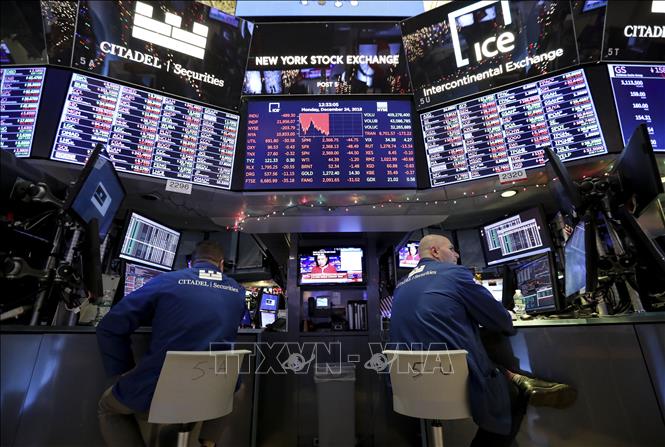
US stocks are in a downward trend.
Last week, the S&P 500 index fell 0.48%, the Nasdaq Composite index fell 0.51%, and the Dow Jones index fell 0.6%.
Looking specifically at the last trading session of the week (January 3rd), the Dow Jones index rose 0.8% to 42,732.13 points; the S&P 500 index rose 1.26% to 5,942.47 points; and the Nasdaq Composite index rose 1.77% to 19,621.68 points.
In this session, the USD index, which measures the value of the greenback against a basket of currencies, fell 0.29% to 108.9. However, for the week as a whole, the greenback rose for the fifth consecutive week, after reaching a two-year high of 109.54 in the previous session.
The US dollar appreciated towards the end of 2024 as investors believed that the policies of President-elect Donald Trump would boost growth and inflation, leading the Federal Reserve to cut interest rates less frequently and US government bond yields to rise, while central banks in Europe were expected to continue lowering interest rates.
The Fed's policy statement at its December 2024 meeting prompted investors to revise down their forecasts for both the number and size of Fed interest rate cuts in 2025.
Richmond Fed President Tom Barkin believes that policy interest rates need to remain high until there is more certainty that inflation is returning to the Fed's 2% target.
Earlier, in the first trading session of the New Year (January 2nd), US stocks continued their downward trend from the end of 2024, with the S&P 500 and Nasdaq Composite indices recording their fifth consecutive day of declines, the longest losing streak since April 2024.
Source: https://doanhnghiepvn.vn/kinh-te/nhung-yeu-to-tac-dong-toi-thi-truong-chung-khoan-dau-nam-2025/20250106094051216





























































































Comment (0)