

Discussing at the hall this morning about the investment policy of the National Target Program for the period 2026-2030, National Assembly delegates emphasized the requirement to integrate the 3 programs to ensure specificity and not dissolve ethnic policies - a field of strategic significance in politics , society, national defense and security.

The National Assembly discussed in the hall the investment policy of the National Target Program on new rural areas, sustainable poverty reduction, and socio -economic development in ethnic minority and mountainous areas until 2035. Photo: National Assembly
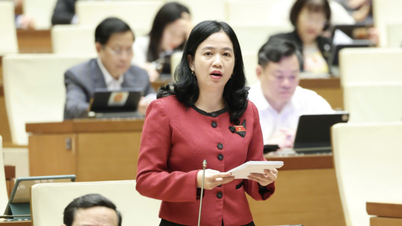
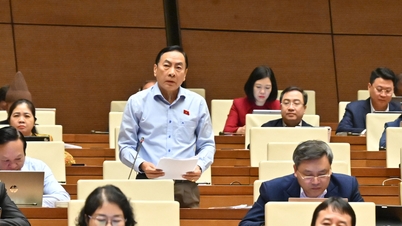
Delegate Ho Thi Minh ( Quang Tri delegation) and delegate Mai Van Hai (Thanh Hoa delegation) proposed many solutions to ensure unity and consistency in direction, management and resource allocation, avoiding policy disruption right from the beginning of the new planning period.
Delegate Ho Thi Minh – a Bru-Van Kieu – said she “agrees with the Government on the policy of integrating three National Target Programs in the 2026-2030 period to reduce focal points, reduce duplication and improve operational efficiency”.
However, she emphasized that integration “does not mean dissolving, simplifying or losing the specificity of each policy area”, especially ethnic policy - a sensitive area of politics, society and national defense and security.
From the assessment of the current policy system, the results of the 2021-2025 period and related legal documents, delegates proposed to ensure 4 core contents in the design of the integrated program.
Firstly, keep component 2 as a relatively independent component. According to the delegate, the National Assembly assigned the integration of 118 ethnic policies into the National Target Program according to Resolutions 88 and 120. The Ministry of Ethnic Minorities and Religions has structured it into 5 pillars and 23 key contents.
"Separating or mixing will distort the spirit of the resolution and cause policy disruption," the delegate emphasized.

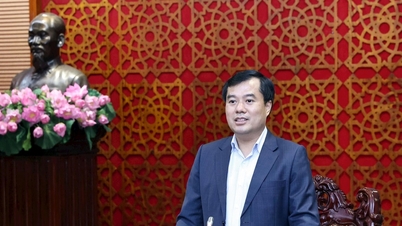
Delegate Ho Thi Minh (Quang Tri delegation). Photo: National Assembly
Second, the delegate proposed that the Ministry of Ethnic Minorities and Religions take the lead in component 2. The female delegate analyzed that this is a special field, implemented throughout many terms. The national target program has the most direct impact on ethnic minorities and mountainous areas. If the Ministry of Ethnic Minorities and Religions is not assigned to take the lead, it is likely that there will be "a lack of unified focal point, dispersion of resources and a decline in the effectiveness of ethnic policies".
The third content is to clearly define the resource structure of each component right from the step of proposing the investment policy. According to the delegate, component 1 uses seed capital, prioritizing socialization; component 2 must be based on the state budget - in accordance with the spirit of Resolution 120/2020/QH14. Therefore, the capital structure must be separate and clear in implementation and supervision.
The fourth content is to ensure that the program is not interrupted and can be implemented from the beginning of 2026. She stated: “If the current structure is maintained, the area, subjects, and system of guiding documents are all complete. However, if the structure is divided or changed, the program will have to wait for a new set of criteria, causing slow implementation and affecting the trust of the people.”
Delegate Ho Thi Minh proposed that the Government accept the conclusions in Notice 4665/TB-VPQH dated November 27, 2025; and at the same time clearly state in the National Assembly resolution that the Ministry of Ethnic Minorities and Religions preside over component 2 to "ensure continuity and promote the highest effectiveness of ethnic policies".
Proposal to increase investment capital from the central budget
Delegate Mai Van Hai (Thanh Hoa delegation) also basically agreed with the program's goals: Building modern new rural areas, sustainable poverty reduction, narrowing regional gaps, improving people's material and spiritual lives. However, he suggested that it is necessary to clarify the basis for determining indicators such as the multidimensional poverty rate or the target of new rural communes and modern new rural areas by 2035, especially when "the poverty standards and the set of new rural criteria for the 2021-2025 period are about to end, the set of modern new rural criteria has not been built yet".

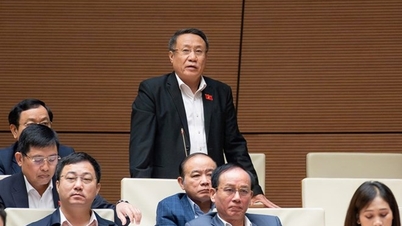
Delegate Mai Van Hai (Thanh Hoa delegation). Photo: National Assembly
Regarding the management and operation mechanism, the delegate reiterated the difficulties in the initial stages of implementing the National Target Program for Socio-Economic Development in Ethnic Minority and Mountainous Areas. Therefore, he suggested that this resolution only stipulates framework principles; the detailed mechanism should be assigned to the Government. The delegate agreed with the plan: the Ministry of Agriculture and Environment is the program's governing body; the Ministry of Ethnic Minorities and Religions is in charge of component 2.
Regarding resources, delegates noted the special context of the 2026-2030 period: Merging provinces, a two-tier local government model, large infrastructure investment needs, while "many mountainous provinces do not have enough revenue to cover expenses; revenue from land, which is the main resource for new rural development, is decreasing sharply". Meanwhile, the central budget for the program is expected to be only 100,000 billion VND, a decrease of 90,000 billion VND compared to the previous period.
Delegates proposed increasing investment capital from the central budget, especially for the socio-economic development component of ethnic minority and mountainous areas; at the same time, mobilizing more businesses, cooperatives and people to ensure feasibility.
Vietnamnet.vn
Source: https://vietnamnet.vn/nu-dai-bieu-bru-van-kieu-kien-nghi-chinh-sach-cho-nguoi-dan-toc-thieu-so-2469640.html


![[Photo] Cat Ba - Green island paradise](/_next/image?url=https%3A%2F%2Fvphoto.vietnam.vn%2Fthumb%2F1200x675%2Fvietnam%2Fresource%2FIMAGE%2F2025%2F12%2F04%2F1764821844074_ndo_br_1-dcbthienduongxanh638-jpg.webp&w=3840&q=75)










































































Comment (0)