

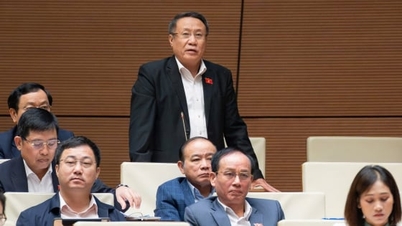
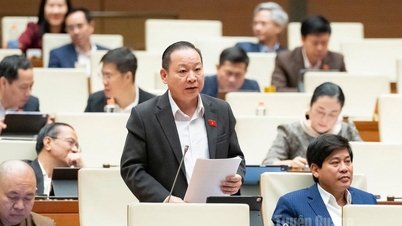
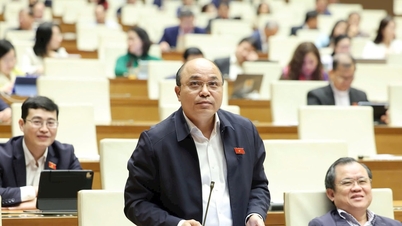
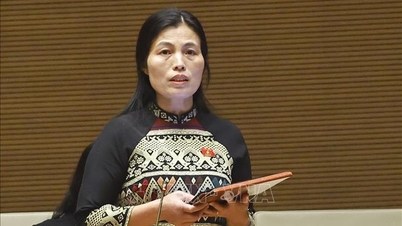
On the morning of December 5, continuing the program of the 10th session of the 15th National Assembly, under the direction of Vice Chairman of the National Assembly Vu Hong Thanh, the National Assembly discussed in the hall the investment policy of the National Target Program (NTP) on new rural areas, sustainable poverty reduction and socio -economic development in ethnic minority and mountainous areas until 2035.
At the discussion session, many delegates were interested in the plan to integrate the three national target programs and requested clarification of related contents. On behalf of the Government, Minister of Agriculture and Environment Tran Duc Thang reported and explained a number of issues.
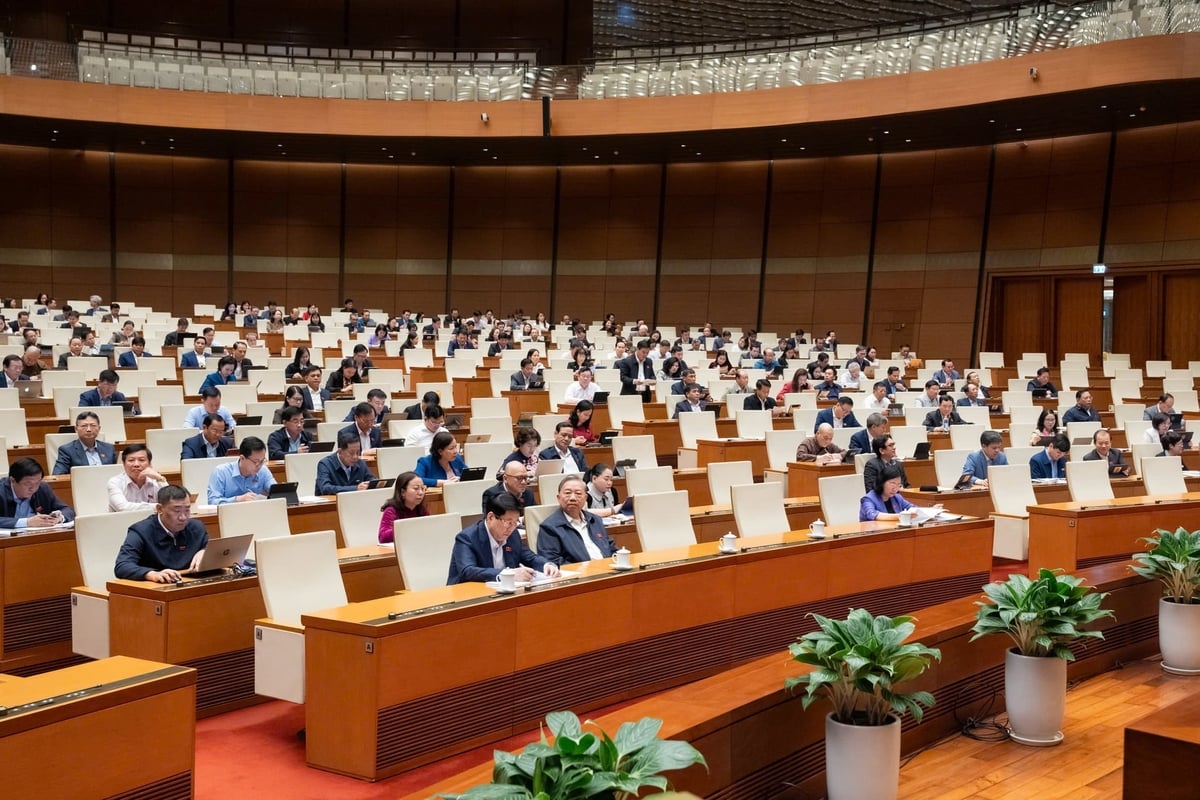
General Secretary To Lam, President Luong Cuong and National Assembly deputies discussed at the hall the investment policy of the National Target Program (NTP) on new rural areas, sustainable poverty reduction and socio-economic development in ethnic minority and mountainous areas until 2035. Photo: Nhu Y.
Integrating three programs without reducing policy
The majority of delegates agreed with the integration policy to overcome the fragmentation and overlap of the previous period. However, there were still concerns that the merger could reduce resources for ethnic minority and mountainous areas.
Discussing this content, Minister Tran Duc Thang affirmed that the integration policy demonstrates the determination to improve people's lives, especially in disadvantaged areas. In the report sent to the National Assembly, the Government clearly stated three orientations:
Prioritize new rural construction, sustainable poverty reduction, socio-economic development in ethnic minority and mountainous areas; Improve implementation efficiency, strongly decentralize to localities; Extend support period to 2035 instead of 2030 to ensure long-term resources.
Accordingly, the integration "does not reduce policies or narrow the scope of support", but also helps to focus more on the "core poor" areas of the country.
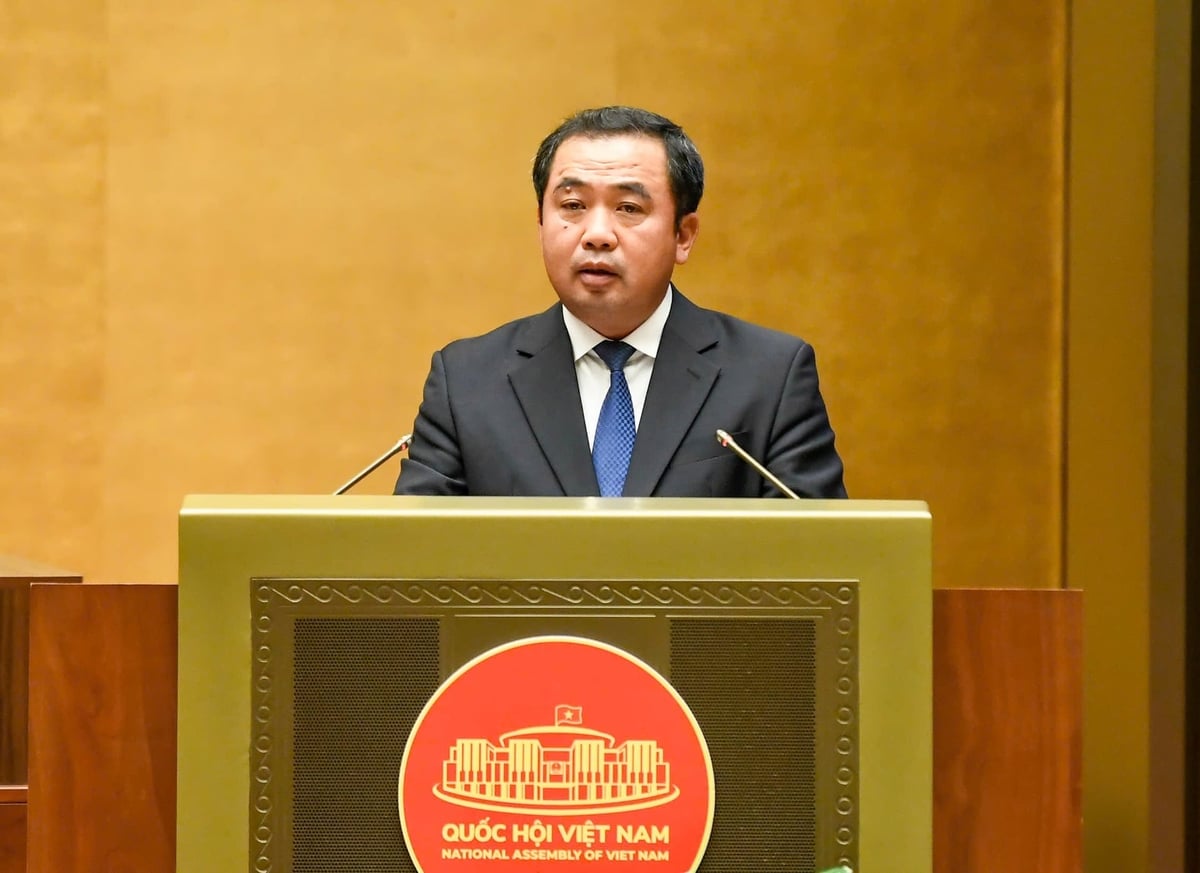
Minister Tran Duc Thang speaks at the National Assembly. Photo: Nhu Y.
The target of 65% of communes meeting new rural standards by 2030 is feasible.
Some delegates requested clarification on the basis for setting the Program's targets. Regarding the target of 65% of communes meeting new rural standards, the Government provided the following figures: In the 2021-2025 period, nearly 80% of communes have met the standards according to the National Criteria; After review, 65.6% of communes are likely to meet the standards according to the 2021-2025 criteria; The 2026-2030 criteria are expected to be issued in December 2025; about 42% of communes basically meet the standards and will be recognized in 2026-2027.
About 25% of the remaining communes, mainly in disadvantaged areas, will have resources focused on meeting the standards by 2030. From there, it is affirmed that the set target is appropriate.
Regarding the target of reducing 1-1.5% of poor households per year and 100% of poor communes from poverty, Minister Tran Duc Thang said: By the end of 2025, the multidimensional poverty rate will be 0.9-1%. Meanwhile, the average reduction in the 2021-2025 period will be over 1% per year; According to the new poverty standard for the 2026-2030 period, the poverty rate is expected to be about 9.6%.
These goals are consistent with Resolution XIII of the National Congress and Directive 05 of the Secretariat.
In addition, some delegates said that the 100,000 billion VND of central budget capital allocated for the program is low compared to the requirements. The Government admitted that this capital level is limited but emphasized:
In parallel with this program, there are 4 other national target programs with a total capital of 360,000 billion VND. Major programs such as sustainable development of the Mekong Delta or resettlement of residents in mountainous areas are also being implemented. In addition to the budget, there are also policy credit capital, commercial credit, business capital and community contributions.
The Government is committed to continuing to balance and report to the National Assembly to supplement resources when necessary.
Regarding local budget capital (VND 400,000 billion), some opinions said that this level is too high. Explaining concerns about the local budget capital level, Minister Tran Duc Thang said: This is the total capital of 34 provinces, including 7 self-balancing provinces and 27 provinces receiving support from the central government. In the 2021-2025 period, self-balancing provinces accounted for 65% of the total local capital for the three national target programs. For disadvantaged localities, the counterpart rate is only about 5%. From there, according to Minister Tran Duc Thang, the Government will review and adjust according to the conditions of each region.
Allocate capital with highest priority to mountainous areas and ethnic minorities
In principle, the criteria for capital allocation, Minister Tran Duc Thang informed, the criteria will be issued by the Prime Minister in the direction of: Giving maximum priority to ethnic minority and mountainous areas; Giving localities the right to decide in detail and take responsibility for the results; No duplication, clear in each component
To avoid duplication with other national target programs, the Program is designed according to the principles: inheritance - stability - no interruption - no abolition of effective policies.
Two components are clearly identified: General component (deployed nationwide); Specific component (ethnic minority and mountainous areas)
Minister Tran Duc Thang said that each task is only in one component, ensuring "clear content - clear resources - clear beneficiaries". The Ministry of Agriculture and Environment will preside over the issuance of all guiding documents no later than January 2026.
Regarding the transitional policy, without leaving out any subjects, the Program will fully inherit the policies of the 2021-2025 period, while at the same time: Not abolishing effective policies; People continue to fully benefit.
Accordingly, the Government has issued a decree on demarcation of ethnic minority areas for 2026-2030, is preparing to issue a decree on multidimensional poverty standards and review the new rural criteria set for 2026-2030.
Regarding the Program management model, the majority of delegates agreed to assign a unified coordinating agency in the direction of a single management focal point, decentralizing maximum authority to localities.
Accordingly: The Ministry of Agriculture and Environment is the presiding agency, responsible for synthesizing and reporting to the National Assembly and the Government. Other ministries and branches perform their tasks according to their management functions.
The Government continues to clearly define tasks between ministries, especially between the Ministry of Agriculture and Environment and the Ministry of Ethnic Minorities and Religions.
Regarding the task of decentralization, the Program is designed according to the principle: Locality decides, locality acts, locality is responsible. The Central Government unifies management and strengthens supervision. At the same time, establishes a three-level supervision mechanism: central - provincial - communal, promoting the role of the people.
Minister Tran Duc Thang said the Government "respectfully accepts all opinions of National Assembly deputies" and will direct implementation immediately after the National Assembly approves the investment policy of the Program.
Source: https://nongnghiepmoitruong.vn/chinh-phu-lam-ro-noi-dung-dau-tu-chuong-trinh-muc-tieu-quoc-gia-den-2035-d787982.html


![[Photo] Cat Ba - Green island paradise](/_next/image?url=https%3A%2F%2Fvphoto.vietnam.vn%2Fthumb%2F1200x675%2Fvietnam%2Fresource%2FIMAGE%2F2025%2F12%2F04%2F1764821844074_ndo_br_1-dcbthienduongxanh638-jpg.webp&w=3840&q=75)



































































Comment (0)