

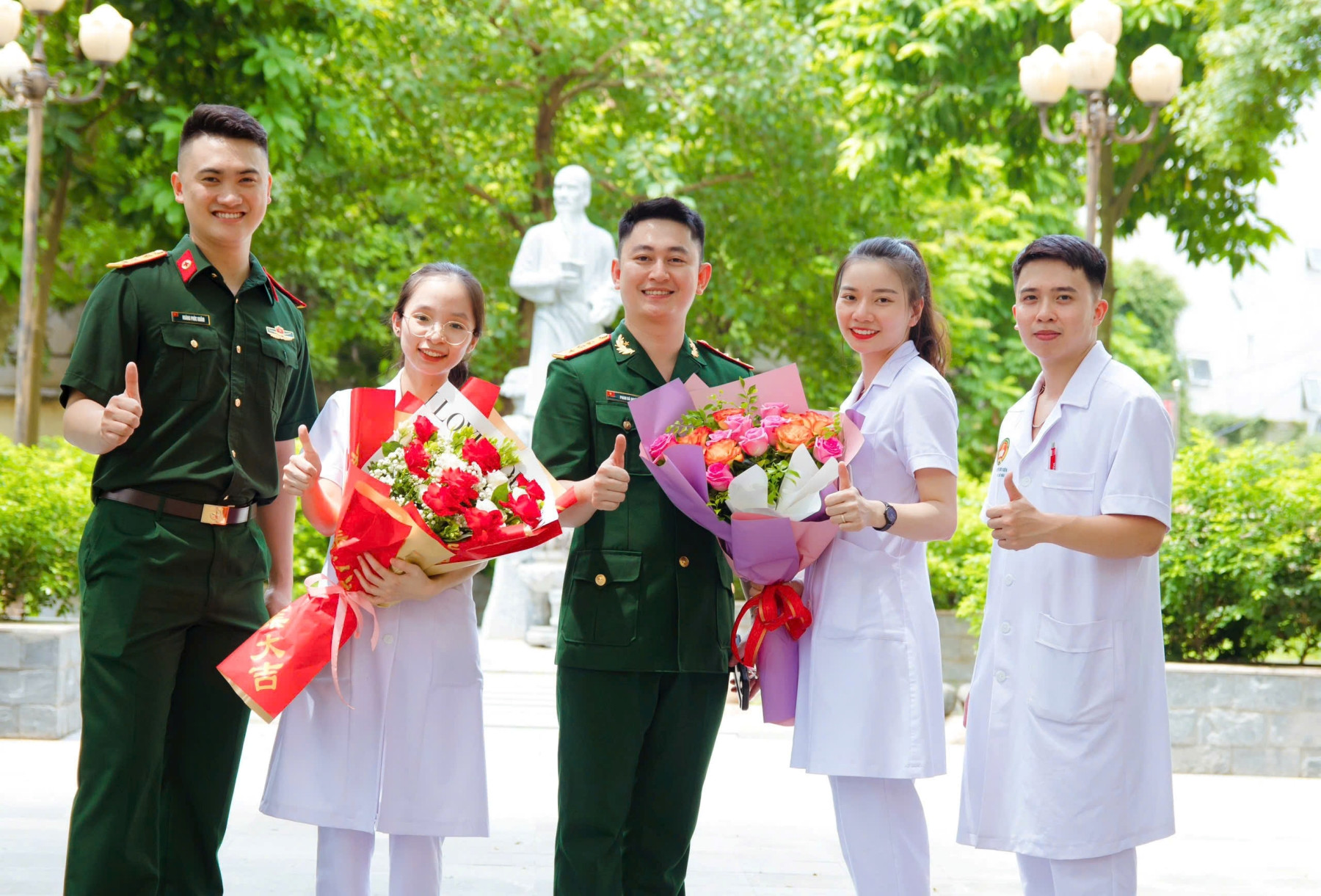
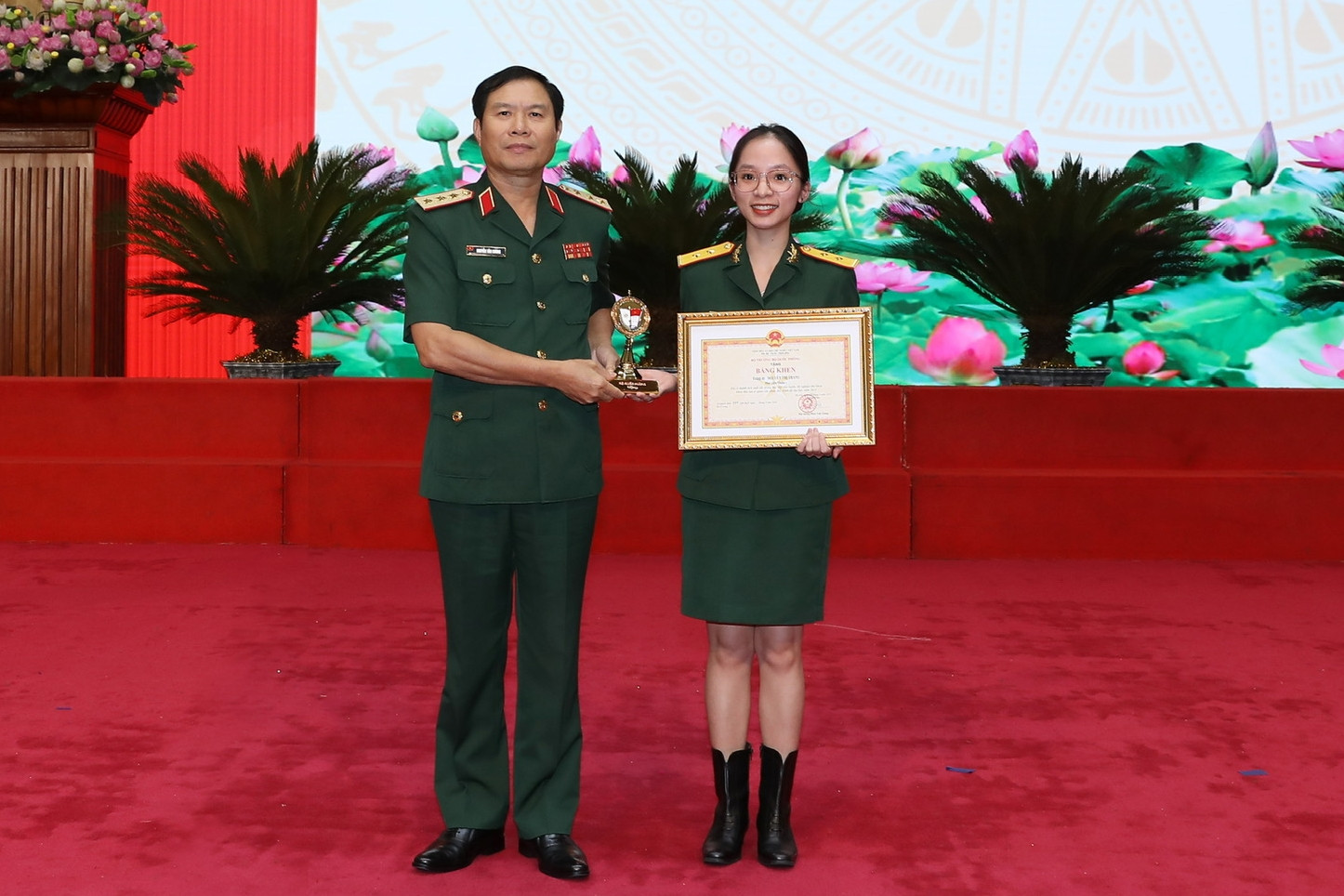
Nguyen Thi Trang, born in 1999, is a medical student at the Military Medical Academy. With an average GPA of 8.5/10, Trang became the valedictorian of her graduating class and was promoted to the rank of Lieutenant. After graduation, Trang continued to prepare for the residency exam and achieved the highest entrance score in internal medicine.
"These results are something I never thought I would achieve when I first entered the school. But with effort and determination, everything becomes possible," Trang said.

As a former student of the Biology specialized class at Vinh Phuc High School for Gifted Students (Vinh Phuc province), immediately after winning second prize in the national excellent student competition, Trang decided to pursue a career in medicine. Born into a not-so-well-off farming family, and with two younger siblings, Trang thought at the time, "If I study medicine in Hanoi, my two siblings won't have the opportunity to get an education."
Therefore, the female student decided to apply directly to the Military Medical Academy to avoid tuition fees and receive a monthly allowance, easing the burden on her parents. Trang's grandfather supported this decision. "He wanted me to attend a military school to further develop myself and become more mature," Trang recalled.
However, upon entering the school, weighing only 42kg, Trang did not meet the health requirements to participate in the 6-month basic training in Son Tay. It took her nearly half a month at the school before she was allowed to join the training with her classmates.
Throughout these six months, the new students had to participate in military and political training. The training mainly took place on the training ground. Trang and her classmates participated in marches, shooting practice, and tactical training...
“There were times when students had to march 5-6km, carrying a backpack full of sand on their shoulders. Even though it was tiring, there were moments when breaking a piece of dried ration into ten pieces made me feel more mature and appreciate the camaraderie,” Trang recalled.
After completing six months of training and returning to school, Trang continued to study politics and her specialized subjects concurrently. Military medical students typically study from morning until night, and even queuing for lectures and meals is necessary. Outside of class, students participate in general cleaning, learn military regulations – one of the basic exercises in the army – and stand guard.
Besides physical training and national defense subjects, according to Trang, the specialized program here is not too different from other medical schools. In the first year, students will study basic science subjects such as Mathematics, Physics, Chemistry, Biology... By the second year, students begin to learn foundational subjects such as Anatomy, Physiology, Histology and Embryology, Biochemistry...
Having always been a top student in high school and receiving attentive guidance from her teachers, Trang was disappointed when she entered university because everything was so different from what she had imagined.
“In the beginning, I didn't know how to connect the subjects, so the knowledge felt quite vague and overwhelming. Meanwhile, the class was too crowded, with 120 students, and the teachers lectured very quickly. Therefore, there were times when, even after the class ended, I still didn't understand what I had just learned. During the first two years, there were periods when I would often fall asleep in class and couldn't take notes.”
Trang admitted that her studies were quite unstable at the time, falling further behind, and she even doubted her own choices at times. Fortunately, thanks to the support of senior students, Trang sought advice on note-taking, preparing materials in advance from the beginning of the school year, and finding study groups, which helped her grades gradually improve.
By her third year, when she started studying her major and working in hospitals, Trang gradually became more interested in her subjects because she had learned better study methods. In addition, she improved her memory and note-taking skills, which helped her consistently win scholarships from the university.
These results motivated Trang to set a goal of passing the residency exam. “Once I had a specific goal, throughout my studies, I focused on collecting materials and taking notes so that by the end of my sixth year I would have a diverse range of review materials,” Trang said.
In addition, the conditions for students to participate in the residency exam were that they had to have a GPA above 7 in all years, not have to retake any subjects, and not have violated any disciplinary rules. "I didn't dare to be careless for a single moment and set high goals from the start," the female student recalled.
Trang's entire graduating class had about 100 students taking the residency exam, but the school only accepted 20. For the Nephrology and Dialysis department that Trang chose, nearly 20 people applied, but only 2 were selected. Wanting to study this specialty in more depth after graduation, Trang was determined to prepare and subsequently passed the residency exam with the highest score in Internal Medicine, achieving over 27 points.
Trang decided to continue her studies for another three years, meaning she would spend approximately 9.5 years at the school, but she said it was "completely worth it."
“While working in the Nephrology and Dialysis Department, seeing patients who have to spend the rest of their lives on dialysis machines, I felt that what I was doing was insignificant. Dialysis patients all have very difficult lives and often come from disadvantaged families. When they have kidney disease, they also suffer from many other diseases such as cardiovascular disease, endocrine and metabolic disorders... Therefore, I wanted to do something, especially for patients who are in the precarious stage of kidney failure but not yet at the point where they need dialysis.”
There was a time when Trang regretted her choice because she didn't have much time for her family, but looking back, Trang believes that the military environment has given her so much. "I've improved my health, become more resilient, and now I can adapt to any situation. Therefore, I have no regrets," Trang said.
The top-scoring female student at the Military Medical Academy hopes to successfully complete her three years of residency and then remain at the hospital to further develop her professional skills.

Source: https://vietnamnet.vn/nu-thu-khoa-hoc-vien-quan-y-42kg-ke-chuyen-vac-bao-cat-hanh-quan-2331549.html


![[Photo] Closing Ceremony of the 10th Session of the 15th National Assembly](/_next/image?url=https%3A%2F%2Fvphoto.vietnam.vn%2Fthumb%2F1200x675%2Fvietnam%2Fresource%2FIMAGE%2F2025%2F12%2F11%2F1765448959967_image-1437-jpg.webp&w=3840&q=75)



















































![[OFFICIAL] MISA GROUP ANNOUNCES ITS PIONEERING BRAND POSITIONING IN BUILDING AGENTIC AI FOR BUSINESSES, HOUSEHOLDS, AND THE GOVERNMENT](https://vphoto.vietnam.vn/thumb/402x226/vietnam/resource/IMAGE/2025/12/11/1765444754256_agentic-ai_postfb-scaled.png)















































Comment (0)