

Mr. Truong Gia Binh believes that India, like Vietnam, possesses a technology workforce that many countries can only dream of having. He also stated that it's no coincidence that the CEO of Nvidia chose Vietnam as his second home.
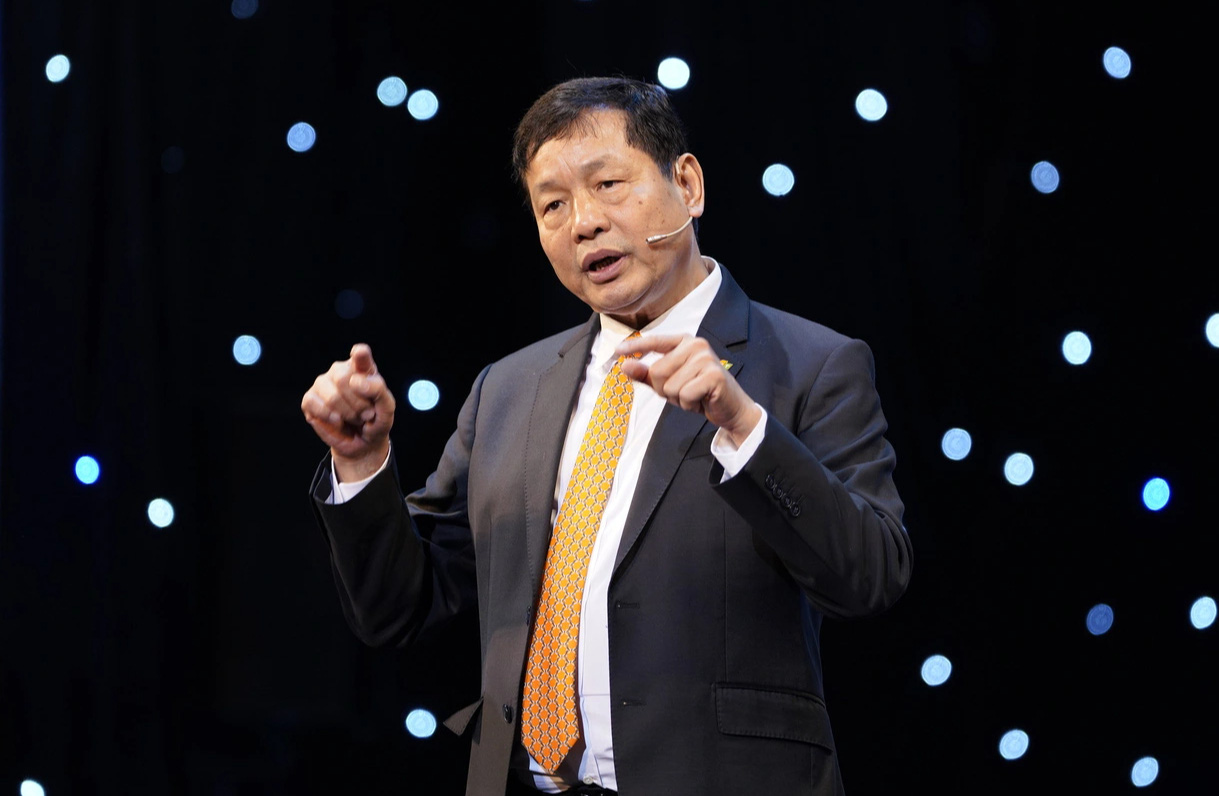
Mr. Truong Gia Binh speaking at the conference - Photo: HN
What should we do when 75% of the jobs we currently do could disappear by 2030?
Speaking at the Vietnam Technology Impact Conference 2024 organized by SSI Digital on December 3rd, Mr. Truong Gia Binh - Chairman of the Board of Directors ofFPT Group - addressed the impacts of artificial intelligence (AI), data, etc.
"Our world is entering a historical phase of unprecedented change. Never before has the world been so unstable and unpredictable. A new world is gradually emerging," Mr. Binh began, posing the question: "How should we deal with the future when 75% of the jobs we currently do could disappear by 2030?"
According to Mr. Binh, artificial intelligence (AI) is having a profound impact on the labor market, and people need to adapt to this change by learning and improving their skills, mastering AI and technology in their work.
Vietnam has developed diplomatic relations with major world powers, connecting with markets through open trade agreements. Moreover, Vietnam holds a prominent position and is shining on the world technology map.
"Mr. Narayana Murthy, founder of Infosys Technologies, said: India and Vietnam already have software export businesses with revenues exceeding $1 billion. India, like Vietnam, has a workforce of technology professionals that many countries can only dream of having," Mr. Binh emphasized.
According to Mr. Binh, it is no coincidence that Jensen Huang, CEO of Nvidia, chose Vietnam as his second home at this time.
"I believe that in the era of artificial intelligence, many more companies will continue to choose Vietnam as their home," Mr. Binh expected, adding that not many places like Vietnam have a workforce of software engineers who can learn and participate in any new technology.
Finally, Mr. Binh mentioned what he considered the most important thing: data. Because all technology develops around data.
"Data is a valuable resource for Vietnam and the whole world. So how do we obtain enough data, ensure clean data, and what are the rights of data ownership? We need to think thoroughly about this," Mr. Binh pondered.
Vietnamese blockchain and digital asset businesses are losing their competitive edge compared to Singapore or Thailand.
Mr. Nguyen Duy Hung, chairman of SSI Securities, also stated that blockchain, cryptocurrencies, etc., are no longer unfamiliar concepts.
While tangible assets can be managed through customs, digital assets have no borders and can be taken to any country if Vietnam lacks the legal basis to safeguard, develop, and ensure their existence within the country.
According to the SSI chairman, having a legal framework would also limit the situation where Vietnamese businesses fly to developed countries like Singapore and the US to set up businesses, and then return to Vietnam to recruit people.

Mr. Nguyen Duy Hung - Photo: HN
"Businesses in the blockchain and digital asset sector in Vietnam are still operating without clear direction, causing them to lose their competitive advantage compared to neighboring countries like Singapore or Thailand," Mr. Hung lamented.
Meanwhile, Long Nguyen, CTO of Aura Network, acknowledged that applying blockchain technology to businesses remains challenging. For example, many companies' data must be secure and stored in Vietnam, but transferring it to a blockchain is a different story.
"Overall, if there is trust, blockchain offers many advantages, but otherwise, there are many difficulties," Mr. Long said, adding that currently, blockchain is mainly applied in the financial sector and efforts are needed to promote its expansion to many other fields.
At the conference, technology experts pointed out that in the financial sector, blockchain has supported cryptocurrency transactions, smart contracts, and decentralized financial services without the need for traditional intermediaries such as banks; helping to reduce transaction costs and increase processing speed.
However, alongside the advantages and opportunities, the development of blockchain in Vietnam is facing numerous challenges, such as a shortage of high-quality human resources, limited market awareness, and inadequate legal regulations.
Source: https://tuoitre.vn/ong-truong-gia-binh-an-do-va-viet-nam-co-luc-luong-cong-nghe-nhieu-nuoc-mo-khong-co-duoc-2024120316435017.htm

















![[Photo] Prime Minister Pham Minh Chinh holds a phone call with the CEO of Russia's Rosatom Corporation.](/_next/image?url=https%3A%2F%2Fvphoto.vietnam.vn%2Fthumb%2F1200x675%2Fvietnam%2Fresource%2FIMAGE%2F2025%2F12%2F11%2F1765464552365_dsc-5295-jpg.webp&w=3840&q=75)












































Comment (0)