

The "bottlenecks"
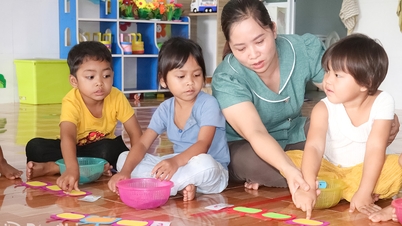
Identifying the "bottlenecks" of preschool education, the report of the Ministry of Education and Training at the scientific conference "Developing preschool education in the new era" stated that the shortage in quantity and staff management is the biggest and longest-lasting challenge. To meet the demand for universal preschool education for children aged 3-5, there is a shortage of about 34,612 teachers that need to be recruited by 2030. The national teacher/class ratio (about 1.86 teachers/class) is still lower than the standard prescribed by the Ministry of Education and Training (2.2 teachers/class).
Compensation policies and working conditions are the biggest "bottlenecks". Accordingly, the starting salary is low, the allowance regime is not enough to compensate for the high labor intensity and is not commensurate with the professional characteristics of preschool teachers. Regarding facilities, preschool education still lacks about 28,000 classrooms; there are still temporary classrooms and classrooms in difficult areas. The rate of solidification of schools and classrooms reaches 88.3% (difficult areas only reach 61.5%); minimum equipment only reaches 49.65% of the demand; the average number of children per class or group of classes is 25.9.
As a large city, Hai Phong currently has 594 kindergartens (465 public schools, 129 private schools); there are 452 private independent preschool educational facilities with 9,139 groups/classes.
Sharing the difficulties, Mr. Vu Tri Quang - Deputy Director of the Department of Education and Training of Hai Phong, said: Public kindergartens are under the management of the People's Committee at the commune level, in which the Department of Culture and Society is in charge of consulting, but many civil servants do not have expertise in education. Some localities have civil servants specializing in education, but most of them do not have deep understanding of preschool education... The staff in charge of preschool education at the Department of Education and Training is thin.
Facilities and teaching equipment in many kindergartens are still very difficult. Many classrooms built many years ago do not have enough space to meet new regulations, lack toilets, and lack modern equipment.
Regarding the staff, the current average number of teachers per group or class in the whole city is 1.99. The number of teachers per group or class in public schools is 2.03; in non-public schools it is 1.83. The average number of nursery school teachers per group is 2.02, 0.48 less than the regulation. The average number of kindergarten teachers per class is 1.98, 0.22 less...

Building a creative learning ecosystem
According to Associate Professor Dr. Nguyen Anh Tuan - Chairman of the University Council of Hanoi Capital University, to meet the breakthrough requirements of Resolution 71-NQ/TW, the Creative Learning Ecosystem model is a strategic solution.
To realize the Creative Learning Ecosystem model at preschool level, Associate Professor, Dr. Nguyen Anh Tuan said that it is necessary to focus on three strategic pillars: Integrating technology, selective digital transformation; creating an innovative and flexible learning environment; implementing child-centered education.
Applying technology not only digitizes but also optimizes the process of caring for, nurturing, and educating children in a smart way. Accordingly, implementing smart management through building a database of child characteristics and school resources to plan education, health care, and manage menus that are forecasted and optimized. Using connection tools (Zalo, Facebook, email, camera...) increases the accountability of educational institutions and shares information with parents in a timely manner.
Apply online educational games, STEAM activities, interactive software to help children become familiar with basic digital skills, develop logical thinking, and problem-solving skills in a controlled environment. Technology is a means to support creativity and real-life interaction, but does not completely replace traditional play activities.
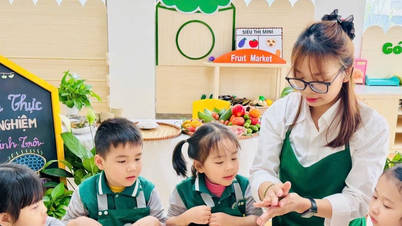
Regarding the physical environment, Associate Professor Dr. Nguyen Anh Tuan suggests designing functional areas (STEAM area, art area, library, water/sand area...) inside and outside the classroom according to the principle of openness, easy access, encouraging children to choose and use. Comply with standards on area, safety, aesthetics, while making the most of natural and recycled materials to enrich learning materials.
Regarding the social environment, build a friendly, open, and cozy classroom culture, where teachers' behavior and gestures are always exemplary in the spirit of "teachers are teachers, students are students". Create conditions for children to regularly communicate, cooperate, share, and form important social and emotional skills.
Affirming that the child-centered principle is the core strategy to activate the Creative Learning Ecosystem, Associate Professor Dr. Nguyen Anh Tuan emphasized the focus on personalizing learning, learning through play and experience. Teachers observe and listen deeply to determine the needs, interests, and passions of each child; from there, personalize the activity plan, allowing children to freely explore and learn at their own pace.
Shift from traditional teaching to learning through practical experiences (small projects, community visits, simple experiments); promote creativity by allowing children to ask questions, explore, and come up with solutions to problems that arise.
To successfully apply the Creative Learning Ecosystem, Associate Professor Dr. Nguyen Anh Tuan recommends that the Government, ministries and branches specify outstanding preferential policies for preschool teachers, along with building a flexible legal framework for quality management of private preschool education and planning clean land funds for preschool education.
Invest heavily in training and coaching programs to transform the thinking of preschool teachers on the Creative Learning Ecosystem model, focusing on children and integrating controlled technology. Promote the construction of open learning environments (inside and outside the classroom) in preschool education facilities, valuing the role of games and real-life experiences as the main means to nurture creativity.
From local practice, Mr. Vu Tri Quang shared Hai Phong's solutions, emphasizing the decentralization and clear delegation of educational management; organizing working groups to visit localities; advising on investment in facilities, recruiting teachers; innovating professional activities; establishing professional clusters and training core professional support staff; promoting the application of information technology in management and operation.
The Department of Education and Training directs schools to promote internal resources, accelerate digital transformation in administration and improve the quality of education; increase the use of digital communication channels, invest in digital equipment and apply AI tools... Information technology and digital transformation are included in the competition criteria.
The industry also mobilized groups and individuals to support investment in facilities and equipment such as computers, smart TVs, etc.; organized schools to visit and learn effective models in applying information technology in management and organization of teaching and learning activities. In addition, inspection work for educational institutions was strengthened.
According to Dr. Bui Hong Quan - Ho Chi Minh City University of Education, developing preschool education in the new era needs to consider policy as the pillar, people as the core, training facilities as an important resource, and coordination between related parties as strength. Only then can preschool education develop sustainably and breakthroughly.
Source: https://giaoducthoidai.vn/phat-trien-dot-pha-giao-duc-mam-non-pha-diem-nghen-chuyen-doi-toan-dien-post759135.html














![[Photo] Parade to celebrate the 50th anniversary of Laos' National Day](/_next/image?url=https%3A%2F%2Fvphoto.vietnam.vn%2Fthumb%2F1200x675%2Fvietnam%2Fresource%2FIMAGE%2F2025%2F12%2F02%2F1764691918289_ndo_br_0-jpg.webp&w=3840&q=75)
![[Photo] Worshiping the Tuyet Son statue - a nearly 400-year-old treasure at Keo Pagoda](/_next/image?url=https%3A%2F%2Fvphoto.vietnam.vn%2Fthumb%2F1200x675%2Fvietnam%2Fresource%2FIMAGE%2F2025%2F12%2F02%2F1764679323086_ndo_br_tempimageomw0hi-4884-jpg.webp&w=3840&q=75)






























![[Infographic] 3 timelines of the "Quang Trung Campaign"](https://vphoto.vietnam.vn/thumb/402x226/vietnam/resource/IMAGE/2025/12/04/1764800248456_fb_ava-2.jpeg)










Comment (0)