
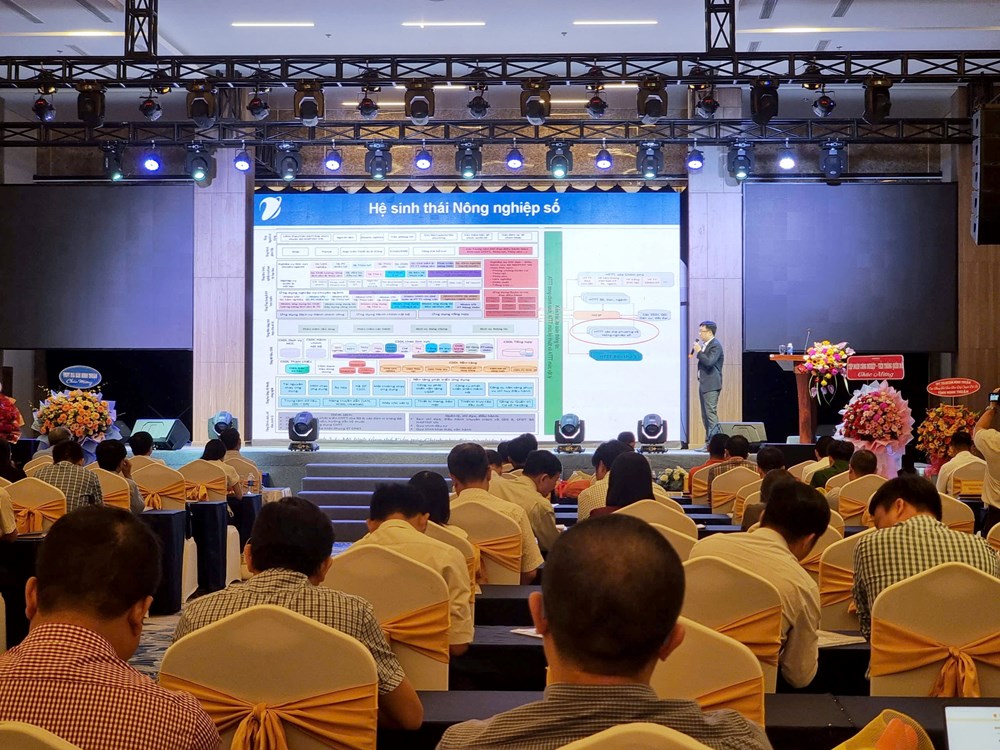
Developing the digital economy in the digital transformation of Dong Thap province.
 Việt Nam•15/10/2024
Dong Thap is a predominantly agricultural province, so it can be said that the digital economy , especially the ICT digital economy, is not its strong point. Recognizing this, the province's action slogans for the past two years have focused on digital transformation: in 2023: "Green economy, lotus breakthrough - Dong Thap pioneers digital transformation"; in 2024: "Creative government, digital citizens; Circular economy, green growth".
Regarding the goals of developing the digital economy, which involve using digital technology and data as the main input factors, utilizing the digital environment as the primary operating space, and using information and communication technology to increase labor productivity, innovate business models, and optimize the economic structure, the ICT digital economy refers to the information technology industry and telecommunications services; the platform digital economy refers to the economic activities of digital platforms and online systems connecting supply, demand, and online services; and the sectoral digital economy refers to digital economic activities within various industries and sectors. Accordingly, by 2025, Dong Phap aims for the digital economy to reach 5% of GRDP, the digital economy to reach at least 10% in each industry and sector, e-commerce to exceed 10% of total retail sales, the percentage of businesses using electronic contracts to exceed 80%, and the percentage of small and medium-sized enterprises using digital platforms to exceed 50%. 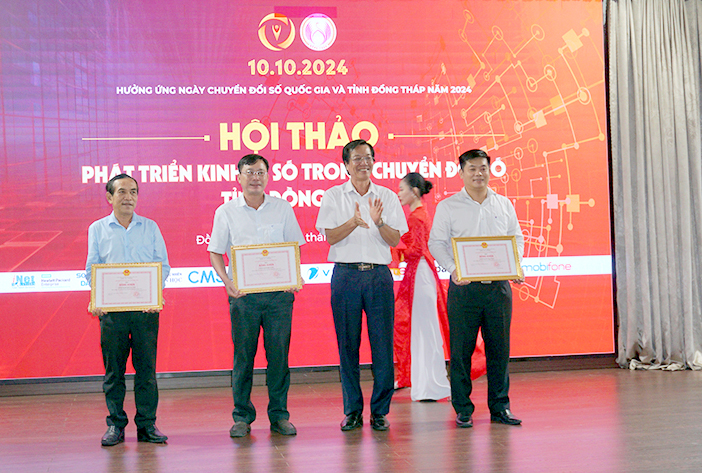
Awards presented for achievements in digital economic development within the digital transformation of Dong Thap province (illustrative image, source: Dong Thap Newspaper)
The proportion of the workforce in the digital economy reaches over 1%, and over 55% of small and medium-sized enterprises conduct business on e-commerce platforms. Over 60% of the population participates in online shopping. 100% of products under the "One Commune One Product" (OCOP) program are available on e-commerce platforms. Over 60% of farmers know how to apply Internet of Things (IoT) technology to their production processes, exploit supply and demand information via the internet, and conduct online buying and selling. 70% of transactions on e-commerce websites/applications have electronic invoices. The goal is for 50% of communes and equivalent administrative units in the province to have businesses conducting online sales of goods or services. 100% of electricity, water, telecommunications, and pay-TV service providers implement cashless payment methods. For the development of a digital society, which involves the natural and default integration of digital technology into all aspects of life, people are connected, able to interact, and proficient in digital skills to use digital services. This leads to the formation of new relationships in the digital environment, the development of digital habits, and a digital culture. Digital connectivity and digital culture. Digital citizens are characterized by digital identity, digital means, digital skills, and digital accounts. Digital connectivity is characterized by the people's ability to connect to networks, including the percentage of the population covered by fiber optic networks, broadband mobile networks, and the percentage of internet users. Digital culture is characterized by the level of online public service usage, the level of digital service usage on the internet, the level of digital healthcare and digital education usage by the people, with the goal of achieving by 2025 over 80% of households having fixed broadband internet connection, 80% of the adult population owning smartphones, 70% of the population having basic digital knowledge and skills, over 70% of the population having basic internet security, 90% of the population having electronic health records, 100% of the population having digital identities with QR codes, and 100% of medical examination and treatment facilities implementing telemedicine consultations. Specifically, establish community-based digital technology teams in every hamlet and village, comprised of part-time officials and enthusiastic local members trained in digital skills to disseminate guidance and support to people in using digital technology and platforms, forming a widespread network for technology deployment throughout the province. Strengthen cooperation between state agencies and digital platform businesses in researching and developing high-quality digital platforms; promote, disseminate, and train people in digital skills through the use of digital platforms. Promote research, development, and application of new digital technologies such as artificial intelligence, digital mirroring technology, blockchain, virtual reality/augmented reality, big data, combined with open technologies and open source to develop digital platforms serving the development of the digital economy and digital society. Develop exemplary digital transformation businesses, model examples, and digital transformation application models suitable to the characteristics of each industry, sector, and locality, then rapidly replicate them to localities and units of similar scale and nature, along with dissemination, awareness raising, measurement, and monitoring of implementation.Kim Oanh
![[Image] Close-up view of the interchange connecting the two expressways and Long Thanh Airport.](https://vphoto.vietnam.vn/thumb/1200x675/vietnam/resource/IMAGE/2026/05/25/1779703378210_ndo_br_z7863716673926-224453a31600126cce10622af6290afd-4549-jpg.webp)




![[Image] Hanoi's urban life under the challenge of a "scorching hot" environment](https://vphoto.vietnam.vn/thumb/1200x675/vietnam/resource/IMAGE/2026/05/25/1779706979265_nang-nong-t5-2026-minh-duy-7-4636-jpg.webp)





























































































Comment (0)