

According to the National Center for Meteorological and Hydrological Forecasting, a strong cold front will cause widespread severe cold weather in the mountainous and midland areas of Northern Vietnam. The period of low temperatures will be concentrated on December 13-14.
A reporter from the Agriculture and Environment Newspaper interviewed Mr. Hoang Phuc Lam, Deputy Director of the National Center for Meteorological and Hydrological Forecasting, about this cold spell.

Mr. Hoang Phuc Lam, Deputy Director of the National Center for Meteorological and Hydrological Forecasting. Photo: Trung Nguyen.
What are the characteristics of this cold spell, and what is the lowest temperature in degrees Celsius it will cause?
The latest information indicates that around December 13th, a strong cold air mass from the north will affect the Northeast region, then the North Central region, the Northwest region, and the Central region.
The cold air mass coincides with the appearance of a convergence zone of winds from 1,500 m to 5,000 m over the Northern region and Thanh Hoa. Therefore, this area will experience widespread moderate to heavy rain and thunderstorms, accompanied by extreme weather phenomena such as squalls, tornadoes, and even hailstorms.
The cold air accompanied by rain will cause a sudden change in weather from dry and cold to freezing due to high humidity in the air. The mountainous and midland areas of Northern Vietnam are likely to experience widespread severe cold. According to the National Center for Meteorological and Hydrological Forecasting, this cold spell will be concentrated over two days, December 13-14.
Specifically, from December 13th, the weather will turn cold throughout the Northern region and the provinces from Thanh Hoa to Hue City. Some areas in the Northern delta and Thanh Hoa will experience intense cold on the night of December 13th and the day of December 14th. The lowest temperatures will generally range from 11-14 degrees Celsius in the Northern delta provinces and Thanh Hoa, around 8-11 degrees Celsius in mountainous areas, and below 5 degrees Celsius in high mountainous areas. From December 15th, temperatures will gradually increase.
At sea, the strong cold air mass will also cause strong winds of force 6-7, gusting to force 8-9 across most sea areas stretching from north to south. From the Gulf of Tonkin to the sea area from Lam Dong to Ca Mau , the northern South China Sea (including the Hoang Sa special zone), the central South China Sea and the western part of the southern South China Sea (including the western part of the Truong Sa special zone), sea waves will reach 4-6 meters, causing rough seas.
Could you please tell us about the impacts of this cold spell on production and daily life?
As previously reported, this strong cold front will bring moderate to heavy rain and thunderstorms over a wide area, accompanied by extreme weather phenomena such as squalls, tornadoes, and hailstorms in the Northern region and Thanh Hoa.
Depending on when the cold front occurs during winter, the accompanying dangerous weather conditions will vary. At the beginning and end of winter, when cold fronts affect the area, they are often accompanied by strong thunderstorms, hailstorms, and sometimes frost when there are clear skies during the day and night. Mid-winter brings severe cold, frost, and sometimes prolonged periods of light rain or drizzle, causing dampness...

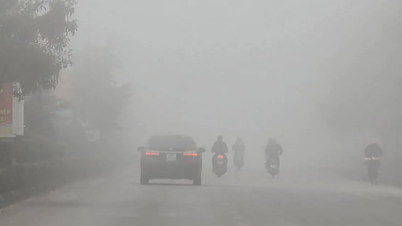
During this cold spell, there is a possibility of thunderstorms, moderate to heavy rain, and possibly hail and frost, affecting production and daily life of the people. (Illustrative image: TC Marketing and Life Magazine)
This cold spell, accompanied by widespread moderate to heavy rain and possibly hail, will cause significant damage to crops, livestock, and poultry. The severe cold also has a major impact on human and animal health. Therefore, the first priority in responding is to protect crops and keep people and animals warm. Avoid going outside during strong thunderstorms, as these thunderstorms may carry hail.
Activities at sea, marine recreational areas, and coastal regions should be aware of the impact of strong northeasterly winds and gusts.
Another important point is to regularly check for official information from media outlets, newspapers, radio, and the websites of forecasting agencies to get the latest information on the impact of this cold front.
What is the weather forecast for the winter of 2025-2026, sir?
Regarding winter weather this year, from December 2025 to May 2026, the average temperature nationwide will generally be close to the multi-year average (MYA), except for the Northern region in January-February 2026, which will generally be about 0.5 degrees Celsius higher than the MYA for the same period.
Cold air masses are likely to be active during the main winter months (December, January, and February), causing severe cold spells. There is a need to be prepared for the possibility of severe cold spells with sharply low temperatures, especially in the northern mountainous regions, accompanied by frost and ice during this time.
From around the second half of February 2026, light rain or drizzle is likely to occur in the northern provinces/cities, but less than the multi-year average.
It should be noted that during the 2026 dry season, the southern provinces are likely to experience unseasonal rainfall.
Thank you very much, sir!
Since the beginning of winter, the northern mountainous provinces have only experienced one period of intense cold, with severe cold in high mountainous areas on November 18-19, 2025. The lowest temperatures in the region were generally 9-11 degrees Celsius, with high mountainous areas experiencing temperatures below 8 degrees Celsius, such as: Sapa (Lao Cai) 7.1 degrees Celsius; Pha Din (Dien Bien) 6.9 degrees Celsius; Mau Son (Lang Son) 3.2 degrees Celsius…
Source: https://nongnghiepmoitruong.vn/ret-dam-ret-hai-kem-nguy-co-mua-da-de-doa-bac-bo-va-thanh-hoa-d788942.html

























































































Comment (0)