

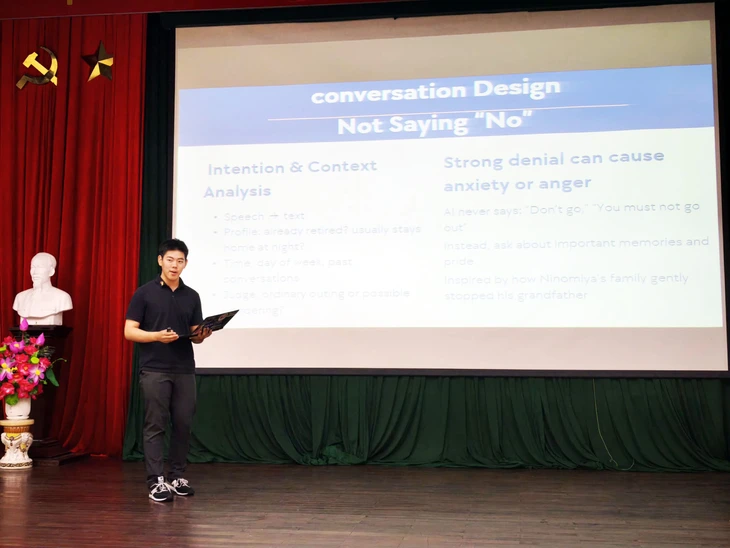
Japanese students present an AI model to assist elderly people who get lost - Photo: TRONG NHAN
This AI model is one of many interesting research topics by Japanese and Vietnamese students in the KOSEN network of universities, presented at the Student Research Symposium 2025 at Cao Thang Technical College on December 11-12.
AI applications for elderly care.
A group of Japanese students from Anan KOSEN and Tokyo KOSEN universities impressed the public by developing an AI system called Caretalker, which has the ability to recognize and intervene psychologically to prevent elderly people with dementia from getting lost.
The team began by asking how to protect dementia patients from getting lost while still respecting their feelings? Monitoring devices often involve locking doors and alarms, which can be damaging to patients.
Ryusei Kido said Caretalker is designed to talk and reassure. The AI must understand the true intentions of the elderly. The system analyzes speech in relation to personal profiles, past occupations, time of day, and chat history.
For example, when an AI hears an elderly person say, "I'm going to work," in the middle of the night, the system interprets it as a sign of senility rather than a genuine plan.
In identifying risks, the AI doesn't say "don't go" or "you mustn't" because that could stress the patient. Instead, the AI asks gentle questions: How are you feeling today? What kind of work did you do in the past? Could you tell me more about that?...
According to student Ishitaro Ninomiya, positive dialogue helps patients calm down and gradually reduce the impulse to leave home. This is the psychological breakthrough that the group of students is aiming for.
In addition to its ability to intervene early, Caretalker also records instances of communication disorders at home that doctors often miss during examinations. This provides families and healthcare professionals with comprehensive information about daily progress, allowing for more accurate adjustments to medication and care.
The compact device, designed by the team, comprises numerous components including a microprocessor, voice sensor, user-tracking camera, and a simple display interface. Data is partially processed directly within the device to minimize latency, while the remainder is synchronized to a server and continuously updated in the family's application.
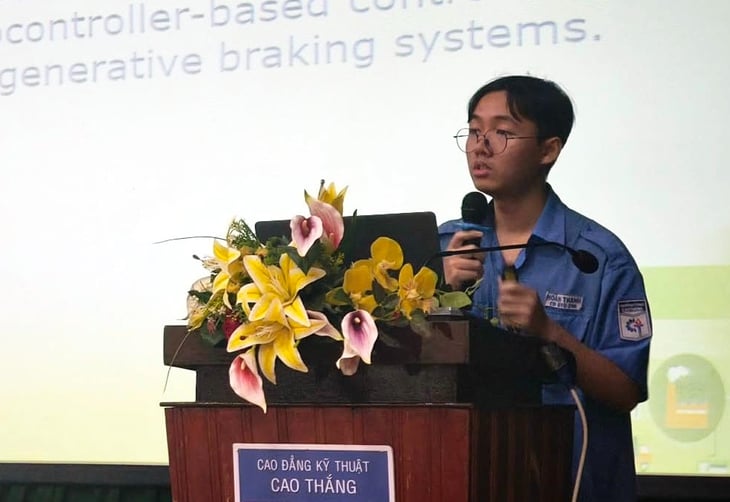
Students from Cao Thang Technical College present their research in English at the program - Photo: TRONG NHAN
Multiple models optimize accuracy.
In addition to Caretalker, the conference also featured many topics showcasing the practical thinking of Japanese and Vietnamese students.
Students Hayata Mori, Shota Hayashi, and Rui Tajima (Gifu KOSEN High School) presented a set of programming simulation cards for elementary school students. Each card illustrates a programming concept such as iteration, branching, incrementing variables, sequential processing, etc., with simple colors and illustrations.
Two players must arrange the cards to achieve the highest score, much like writing optimal code. After playing, students move on to programming using blocks of code and then run the program on a small controller.
100% of the students in the test class said the game was fun, while over 85% felt their understanding of programming had improved significantly.
Meanwhile, the PLG_GROUP student group (Cao Thang Technical College) presented a greenhouse automation model that allows for real-time control of irrigation, fertilization, lighting, humidity, temperature, and pH.
The system, utilizing sensors and fully automated controllers, reduces water, fertilizer, and labor costs by 30-50%, meeting the needs for increased productivity and standardized quality according to VietGAP/GlobalGAP standards.
Another group of students from Cao Thang Technical College developed a device for testing alcohol concentration using high-precision sensors combined with fingerprint recognition.
The device synchronizes data in real time, has backup storage, and is designed as a safety solution for the factory. The control algorithm and alarm module were fully developed by the students as a complete industrial device, demonstrating a fairly solid level of application skills.
What is KOSEN?
KOSEN is a practical engineering training model that has existed for over six decades and is considered the "backbone" of Japan's industrial development strategy.
KOSEN recruits students from grade 10 and provides continuous 5-year training, combining fundamental knowledge with practical engineering skills, aiming to create young engineers capable of working immediately in a manufacturing environment.
The KOSEN network currently has over 50 schools spread across Japan, including Ariake, Anan, Tokyo, Gifu, and Kochi…
This system is also collaborating extensively with many vocational schools in Vietnam in training high-tech human resources.
Source: https://tuoitre.vn/sinh-vien-lam-ung-dung-ai-ngan-nguoi-gia-di-lac-20251211131336874.htm

![[Photo] Prime Minister Pham Minh Chinh holds a phone call with the CEO of Russia's Rosatom Corporation.](/_next/image?url=https%3A%2F%2Fvphoto.vietnam.vn%2Fthumb%2F1200x675%2Fvietnam%2Fresource%2FIMAGE%2F2025%2F12%2F11%2F1765464552365_dsc-5295-jpg.webp&w=3840&q=75)

![[Photo] Closing Ceremony of the 10th Session of the 15th National Assembly](/_next/image?url=https%3A%2F%2Fvphoto.vietnam.vn%2Fthumb%2F1200x675%2Fvietnam%2Fresource%2FIMAGE%2F2025%2F12%2F11%2F1765448959967_image-1437-jpg.webp&w=3840&q=75)













































![[OFFICIAL] MISA GROUP ANNOUNCES ITS PIONEERING BRAND POSITIONING IN BUILDING AGENTIC AI FOR BUSINESSES, HOUSEHOLDS, AND THE GOVERNMENT](https://vphoto.vietnam.vn/thumb/402x226/vietnam/resource/IMAGE/2025/12/11/1765444754256_agentic-ai_postfb-scaled.png)




































Comment (0)