

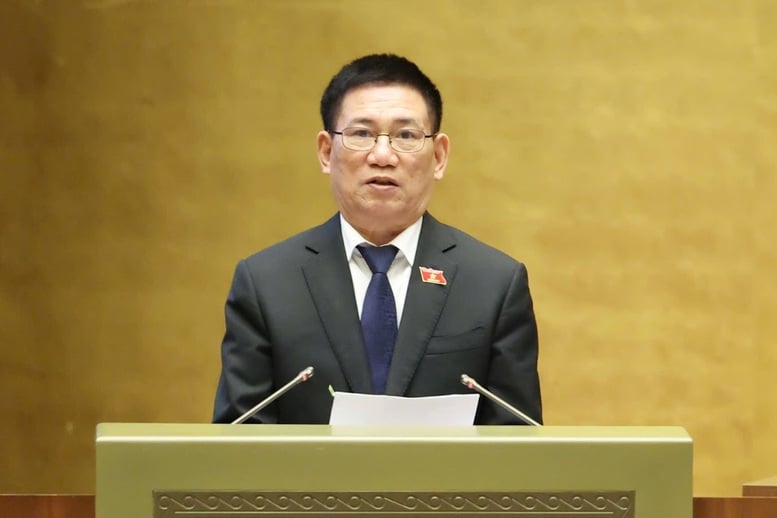
Deputy Prime Minister Ho Duc Phoc presents a summary report assessing the situation and results of the 5-year implementation of Resolution No. 31/2021/QH15 dated November 12, 2021, of the National Assembly on the Plan for restructuring the economy in the period 2021-2025 - Photo: VGP/Nhat Bac
On the afternoon of October 20th, on behalf of the Government, Deputy Prime Minister Ho Duc Phoc presented a summary report assessing the situation and results of the 5-year implementation of Resolution No. 31/2021/QH15 dated November 12, 2021, of the National Assembly on the Plan for restructuring the economy in the period 2021-2025.
Firstly, regarding the context of implementation and the impact on the execution of the Economic Restructuring Plan for the period 2021-2025, according to the Government's report, the plan is being implemented in a context where the global and regional situation is undergoing rapid, complex, unpredictable, and unprecedented changes.
Intense and comprehensive trade and strategic competition among major powers across various sectors, coupled with escalating armed conflicts and geopolitical tensions in several countries and regions, have significantly impacted global economic growth and the macroeconomic environment.
In particular, the COVID-19 pandemic has had a prolonged, severe, and profound impact on all aspects of socio-economic life.
Natural disasters and climate change are occurring with increasing frequency; new non-traditional security issues are emerging, including national and transnational crimes, and high-tech crimes… all continue to strongly impact many countries.
Domestically, alongside the advantages of a stable political foundation, continued strengthening of the macroeconomic environment, improved investment and business environment, and a gradually shifting and rational economic structure, the economy faces many difficulties and major challenges from both external factors and internal issues.
However, thanks to the decisive involvement of the entire political system and the collective efforts and outstanding endeavors of the entire Party, people, army, and business community, as well as the support of international friends, our country has overcome difficulties and challenges, continuing to achieve important and fairly comprehensive development results with many outstanding highlights.
Secondly, the situation and results of implementing key tasks.
Regarding the 27 targets set out in Resolution No. 31/2021/QH15, to date, assessment information is available for 23 out of 27 targets. Of these, 10 out of 23 targets are likely to be achieved; 9 out of 23 targets are unlikely to be achieved; and 4 out of 23 targets are projected not to be achieved.
Several indicators, such as increased labor productivity; the number of enterprises; the number of agricultural cooperatives applying high technology; the percentage of agricultural cooperatives linked with enterprises along the value chain; and the proportion of spending on science and technology, face difficulties and challenges in implementation, requiring significant efforts to achieve.
Regarding the five key tasks outlined in Resolution No. 31/2021/QH15 of the National Assembly for the period 2021-2025, the Government has issued Resolution No. 54/NQ-CP with 102 tasks that have been implemented and yielded many important results. To date, 86 out of 102 tasks have been completed (84.3%); 16 out of 102 tasks (15.7%) have been or are continuing to be implemented.
Summary of the progress in implementing key tasks:
Regarding the focus on completing the restructuring objectives for public investment, the state budget, and credit institutions and public service units.
Restructuring the state budget: Institutional and legal reforms related to the restructuring of the state budget will continue to be implemented in the direction of strengthening the leading role of the central budget, the autonomy and initiative of local budgets; and enhancing the role of fiscal policy in mobilizing, allocating, and effectively utilizing resources.
The tax policy system continues to be improved towards synchronization, comprehensive coverage of revenue sources, expansion of the tax base, and an increase in the proportion of domestic revenue.
Restructuring public investment : Institutional reforms in investment, including public investment, have been emphasized; decisive leadership and management have resolved many difficulties and obstacles in the implementation of public investment projects, contributing to accelerating the disbursement of public investment capital, thereby promoting economic recovery.
Restructuring state-owned enterprises: The improvement of the system of legal and policy mechanisms focuses on removing difficulties and obstacles to accelerate the equitization and divestment process and limit the loss of state capital and assets during the restructuring of state-owned enterprises.
This facilitates the restructuring of state-owned enterprises, ensuring strictness, transparency, and maximizing the benefits for the State.
The leading role of state-owned enterprises in a number of key sectors and geographical areas has been strengthened, contributing to the restructuring of the economy associated with the innovation of the growth model.
Restructuring credit institutions: The restructuring of the credit institution system, coupled with the handling of bad debts, will continue to be implemented during the 2021-2025 period, focusing on improving institutions in accordance with market principles, aiming to create a clear and substantive transformation.
Specifically, the focus is on implementing directives from competent authorities regarding the restructuring and handling of weak credit institutions, ensuring operational stability and supporting their gradual recovery; directing credit institutions to finalize and aggressively implement restructuring plans associated with bad debt resolution for the 2021-2025 period; accelerating the resolution and recovery of bad debts; improving credit quality, and preventing and limiting the emergence of new bad debts.
Restructuring public service units: Institutions and policies on restructuring public service units continue to be reviewed, supplemented, and newly issued to ensure consistency and uniformity among legal regulations, meeting the practical requirements of operations in various sectors and fields.
Public non-business units will continue to be reviewed, reorganized, and restructured in order to streamline their internal organizational structure , improve operational capacity and the effectiveness of state management; reducing the number of public non-business units by at least 10% in accordance with Resolution No. 19-NQ/TW and Conclusion No. 62-KL/TW dated October 2, 2023 of the Politburo, and Resolution No. 38/NQ-CP dated April 2, 2024 of the Government.
Developing various types of markets and improving the efficiency of resource allocation and utilization.
Numerous legal documents, policies, and administrative solutions to overcome difficulties and obstacles, especially the recent issuance of key and breakthrough resolutions by the Politburo (Resolutions No. 57, 59, 66, 68, 71, 72,...), have laid the groundwork for the country to enter a new era.
Digital technology is being promoted in market development, leading to the formation of centralized exchanges and ensuring that the market operates transparently, safely, and healthily.
The legal framework for markets— financial markets; land use rights markets, real estate markets; labor markets; and science and technology markets—is being gradually standardized. State management is being implemented synchronously, overcoming shortcomings and obstacles, and creating a foundation for the overall development of the economy.
Regarding the development of the business sector; promoting connections between businesses of different economic sectors; and innovating and developing the collective economy and cooperatives: The completion of the system of mechanisms, policies, and laws focuses on removing difficulties and obstacles to accelerate the restructuring of state-owned enterprises, removing difficulties and obstacles to promote the development of the private economy ( Resolution No. 68-NQ/TW of the Politburo ), and innovating and developing the collective economy and cooperatives.
Investment promotion policies and methods have been reformed to be more effective and in line with the new global minimum tax context, creating a strong shift in the contribution structure of economic sectors to overall growth during the 2021-2025 period.
Regarding urban economic development, strengthening regional linkages, urban-rural linkages, and effectively promoting the role of key economic regions and major cities : The work of developing national, regional, sectoral, and provincial planning has been actively implemented.
To date, 108 out of 110 (98.2%) plans have been decided or approved by competent authorities; 2 out of 110 plans have not yet been approved ( the Plan for the development of the network of press, radio, television, electronic information, and publishing facilities for the period 2021-2030, with a vision to 2050 and the Master Plan for the national reserve warehouse system for the period 2021-2030, with a vision to 2050 ).
Urban infrastructure, digital infrastructure, and infrastructure connecting intra-regional and inter-regional transport, as well as urban-rural connections, have received focused investment, achieving outstanding results.
Mechanisms and policies promoting regional linkages, along with specific mechanisms for certain cities and localities, have been implemented, fostering the shift of resources, more effectively exploiting the advantages of regions and localities, promoting the leading role in innovating the growth model of key economic regions and large cities, and strengthening urban-rural linkages.
Promoting the restructuring of economic sectors towards digitalization, greening, application of scientific and technological advancements, and innovation : The economic structure continues to shift positively, with the contribution of industrial and service sectors to GDP continuing to increase (from 78.5% in 2020 to 80.33% in 2025).
The application of digital technology and digital transformation has become widespread across industries, sectors, and localities, contributing significantly to economic growth through increased participation in daily life, production, and business activities.
The structure between industries and within industries is shifting towards modernization, promoting a green economy, strengthening the application of science and technology, improving productivity, quality, efficiency, competitiveness, and maximizing potential and advantages.
Some shortcomings and limitations exist: The progress in building institutions and policies to promote economic restructuring has not kept pace with development requirements; while the economic structure and growth model have improved, they have not created many significant changes.
The development of the business sector still faces certain limitations; economic sectors have not yet seen a strong shift in productivity growth, especially in the industrial and service sectors.
The restructuring of state-owned enterprises and public service units is still slow and has not met the requirements ; restructuring in some key sectors still faces many difficulties and challenges; various types of markets are not yet operating effectively enough to ensure sustainable development.
The causes of existing shortcomings and limitations include : the global economic context constantly presenting risks and instability, negatively impacting our country's sustainable growth; the legal system still has many shortcomings and limitations, while the progress of amending, supplementing, and perfecting legal documents has not kept pace; administrative procedures remain cumbersome; and decentralization and delegation of power in some areas still face many obstacles.
Promoting business development and accelerating the restructuring of state-owned enterprises.
The government has identified several key priorities in directing and implementing tasks and solutions for restructuring the economy as follows:
Firstly, continue to focus on improving institutions and the legal system to remove obstacles and promote the restructuring of the economy. Expeditiously issue documents to implement the laws recently passed by the National Assembly.
Secondly, accelerate progress and complete the restructuring goals in key sectors. Boost the disbursement of public investment capital and national target programs, striving to achieve a 100% disbursement rate for the 2025 plan.
Thirdly, effectively implement solutions to promote enterprise development and accelerate the restructuring of state-owned enterprises. Actively implement the development of a digital government and policy solutions to improve and upgrade the quality of the investment and business environment.
Fourth, focus on promoting the leading role of major cities and growth poles in innovating growth models.
Fifth, promote the shift of industries towards the use of modern technology; develop the green economy, circular economy, and digital economy.
Sixth, develop various types of markets, strengthen the application of digital technology with breakthrough solutions, and implement strong, comprehensive, synchronized, and far-reaching reforms to promote economic restructuring.
Creating a transparent, equitable, and favorable investment environment to promote the development of businesses and cooperatives.
Based on the assessment of the situation and the results of the implementation of the Economic Restructuring Plan for the period 2021-2025, the international and domestic context, and the proposed solutions for the remaining months of 2025, the Government will continue to implement:
Firstly, closely supervise the ministries, agencies, and localities assigned as the lead agencies in implementing the goals and targets, focusing on monitoring, supervising, and evaluating the feasibility of achieving the goals, while promptly proposing and supplementing necessary solutions to strive to complete the important goals and targets set by the end of 2025.
Secondly, direct ministries and agencies to continue focusing on implementing and completing programs and projects serving the restructuring of the economy in the 2021-2025 period to create tangible results in economic restructuring; continue creating a transparent, equitable, and favorable investment environment to promote the development of enterprises and cooperatives; focus on promoting the leading role of large cities and growth poles; organize the realization of institutional breakthroughs and remove difficulties for businesses, especially recent Politburo resolutions (such as Resolutions No. 57, 59, 66, 68, 71, 72,...).
Thirdly , continue researching and developing a new economic development model associated with the high-growth phase to exploit and leverage new growth drivers, utilize the achievements of the Fourth Industrial Revolution; apply science and technology, innovation, digital transformation; develop the digital economy, green economy, circular economy, data economy, etc.
This model requires quantifying the performance indicators; ensuring macroeconomic stability; identifying internal dynamics within each region and economic sector; improving labor productivity; facilitating deeper participation in global value chains; and controlling unpredictable risks and fluctuations.
Tran Manh
Source: https://baochinhphu.vn/tap-trung-hoan-thien-the-che-thao-go-nhung-rao-can-thuc-day-qua-trinh-co-cau-lai-nen-kinh-te-102251020184319918.htm

![[Photo] Prime Minister Pham Minh Chinh holds a phone call with the CEO of Russia's Rosatom Corporation.](/_next/image?url=https%3A%2F%2Fvphoto.vietnam.vn%2Fthumb%2F1200x675%2Fvietnam%2Fresource%2FIMAGE%2F2025%2F12%2F11%2F1765464552365_dsc-5295-jpg.webp&w=3840&q=75)


























































Comment (0)