

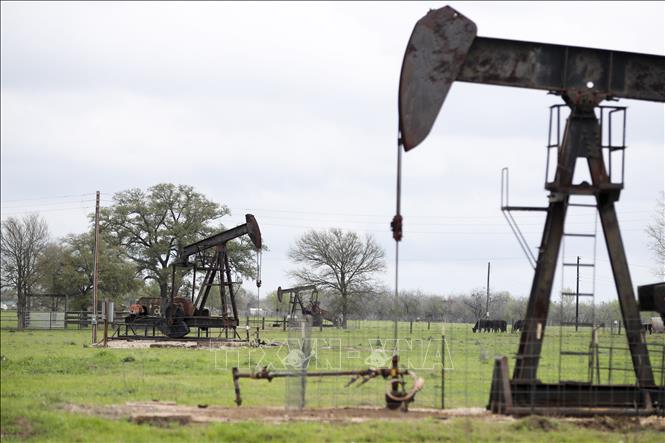
However, oil prices continued their downward trend this week due to cautious market sentiment and optimism about the prospect of Russia and Ukraine reaching a peace agreement.
Brent crude futures rose 0.52%, or 32 cents, to $61.60 a barrel at 2:18 PM (Vietnam time), while West Texas Intermediate (WTI) crude rose 0.59%, or 34 cents, to $57.94 a barrel. Both crudes had fallen about 1.5% on December 11.
This week, the US seizure of an oil tanker raised concerns about supply disruptions. According to Hiroyuki Kikukawa of Nissan Securities Investment, buying pressure quickly emerged to mitigate losses. Previously, investors had sold off in anticipation of improved supply due to the prospect of a peace agreement between Russia and Ukraine. Kikukawa believes that peace talks between Russia and Ukraine will continue to be a key focus of the market, warning that if an agreement is actually signed, WTI oil prices could fall to $55 per barrel.
Since the beginning of the week, both types of oil have fallen by more than 3%, indicating market instability. Analysts at ANZ Research believe the recent drop in oil prices stems from risk aversion and a gloomy outlook for the oil market.
According to a December 2025 report by the Paris-based International Energy Agency (IEA), global oil supply will exceed demand by 3.84 million barrels per day, down from a surplus of 4.09 million barrels per day in November 2025. However, the Organization of Petroleum Exporting Countries (OPEC) has just announced that global oil supply will equal demand in 2026, contrary to the IEA and other organizations' forecasts of a large oversupply.
The U.S. Energy Information Agency (EIA) reported that U.S. crude oil inventories fell less than expected, while fuel inventories rose sharply last week.
Source: https://baotintuc.vn/thi-truong-tien-te/gia-dau-tang-do-lo-ngai-gian-doan-nguon-cung-tu-venezuela-20251212162100742.htm
















![[Photo] Prime Minister Pham Minh Chinh holds a phone call with the CEO of Russia's Rosatom Corporation.](/_next/image?url=https%3A%2F%2Fvphoto.vietnam.vn%2Fthumb%2F1200x675%2Fvietnam%2Fresource%2FIMAGE%2F2025%2F12%2F11%2F1765464552365_dsc-5295-jpg.webp&w=3840&q=75)














































Comment (0)