

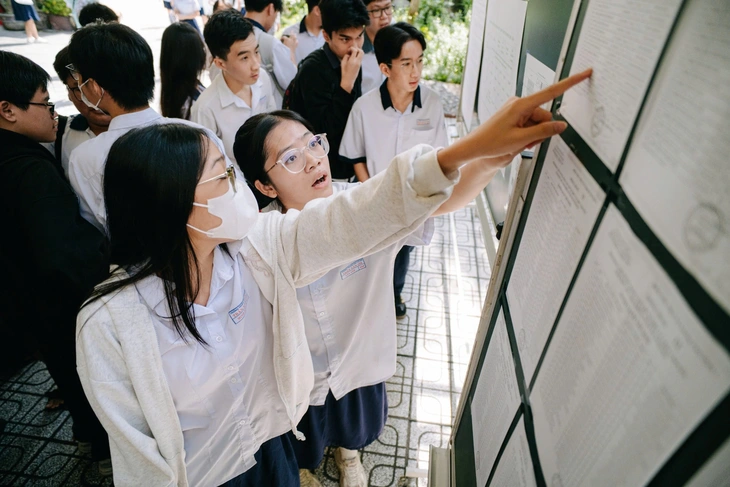
The transition to the 10th grade entrance exam is no longer a concern for many families and students, but is just a natural milestone in the schooling process - Photo: THANH HIEP
Every 10th grade admission season, tens of thousands of families enter a tense race when the number of places at public schools cannot keep up with the rapidly increasing number of students, especially in central areas and large urban areas.
Many 9th graders have to work hard to study, while their parents are worried that their children will fail just because of a few points in the decisive exam.
Faced with increasing pressure, many people believe that it is time to consider abolishing the 10th grade entrance exam and switching to a selection process to reduce stress while still ensuring the quality of input. Is this a feasible direction?
Supply and demand imbalance, pressure on one door
In fact, this exam has gone beyond the normal nature of a transfer exam. The number of 9th grade students increases steadily every year, while public high schools cannot expand accordingly due to limitations in land funds and investment speed.
This creates a significant gap between demand and supply, making entrance exams the only option for grading. Most parents still put their trust in the public school system because of its low cost, stable environment and peace of mind, leading to a situation of pent-up expectations for a door that cannot be opened quickly.
Although many localities have applied the method of selecting students for grade 10 according to one of three methods as prescribed including entrance exam, selection and combination of entrance exam and selection, in big cities the entrance exam method still plays the main role. This makes the pressure of exams become a big burden for students.
From a social perspective, the pressure of the 10th grade entrance exam is increasing, not only because of the competition but also because of the high expectations placed on students. 9th grade students have to study many extra sessions each week and solve dozens of sets of questions.
Many students live in a state of constant suspense because just one small mistake can cause them to lose the opportunity to enter the desired environment. Many students fall into a state of insomnia, anxiety or fear of exams as well as a state of prolonged stress.
Parents are also caught up in that cycle. The mentality that "my child cannot lose to his/her friends" causes the cost of extra classes to increase, while information about benchmark scores and competition rates constantly spread on social networks makes the anxiety even bigger.
The exam, which was originally designed to separate people, has now turned into an event with huge gains and losses, affecting the whole family's psychology.
Weak distribution, undiversified system
The pressure comes not only from the exam but also from the system structure. When the number of public schools cannot keep up with the actual demand, competition becomes inevitable. At the same time, the post-secondary education stream, although advocated for a long time, is still ineffective.
Many students and parents still consider vocational schools, secondary schools or continuing education as unattractive options even though these models are gradually being modernized.
The notion that "you have to go to public high school to have a future" overshadows all other paths. As a result, all students are concentrated in one direction, creating systemic pressure.
When public school opportunities are limited but alternatives are not compelling enough, entrance exams almost become an unwanted screening.
In this context, the proposal to switch to admission based on academic records and training process can significantly reduce the pressure of exams, helping to make comprehensive and long-term assessments instead of relying on the results of a short exam. Students are motivated to study all subjects and reduce psychological pressure, and parents do not have to put all their hopes on a stressful exam.
However, the feasibility of the admission process depends largely on the reliability of the value of the transcript score. If there is still a situation of loose grading or "good scores" at the secondary school level, the admission process can easily create doubts about its fairness. Therefore, to widely apply the admission process, it is necessary to standardize the assessment and evaluation according to a common level, at least within the same province/city.
Periodic tests as prescribed must have the same matrix and specifications to have similar difficulty, reliability, and validity, and apply information technology in testing and evaluation.
In addition, it is possible to use an admission model that combines an aptitude test so that students can take the test multiple times on a computer, which is easier than the traditional entrance exam, ensures input quality, avoids heavy pressure, and also familiarizes students with taking the high school graduation exam on a computer, as directed by the Government in recent times.
Regardless of whether the approach is based on exams, selection, or a combination, the most important goal is still to reduce pressure on students and expand equitable learning opportunities.
Education is not just a race to get a place in a public school, but must create many suitable paths for each student to develop their strengths. When the system is more diverse, transparent and equal, the 10th grade entrance exam will no longer be a worry for tens of thousands of families but will become a gentle and natural milestone in the learning process.
Promote career guidance
Along with the innovation in admissions, career guidance after secondary school needs to be strengthened and made more substantial. Students need to be provided with full information about the pathways after secondary school, from high-quality vocational training, intermediate level education to private schools or modern continuing education models. When the options have clear values, parents will no longer have the mentality of "only one path", and the pressure on public schools will be reduced.
In addition, the new model of vocational high schools with diplomas equivalent to high school diplomas is also a useful solution to promote the work of streaming after junior high school. Experience from many countries shows that when the streaming system operates effectively and the paths are recognized by society as equal, the high school entrance exam is no longer a stressful competition as it is today.
Drop out of 10th grade entrance exam but not in a hurry

A roadmap and standardization are needed to eliminate exams and switch to 10th grade admission, reducing pressure on students - Photo: THANH HIEP
Some countries in the world and some provinces in our country have been recruiting high school students by examination or interview without exams. This shows that the change is completely feasible.
However, to apply it in Vietnam requires serious preparation. Eliminating entrance exams means giving more assessment power to secondary schools. If this step is not standardized, the change can cause disruption and affect parents' trust.
Therefore, the roadmap needs to be cautious, piloting in low-pressure areas, perfecting the process before expanding. In particular, it is necessary to inform students early when entering junior high school so as not to affect or be unfair to different subjects in the same locality.
Source: https://tuoitre.vn/thi-vao-lop-10-qua-cang-bo-thi-chuyen-sang-xet-tuyen-duoc-khong-20251203002605525.htm

![[Photo] Parade to celebrate the 50th anniversary of Laos' National Day](/_next/image?url=https%3A%2F%2Fvphoto.vietnam.vn%2Fthumb%2F1200x675%2Fvietnam%2Fresource%2FIMAGE%2F2025%2F12%2F02%2F1764691918289_ndo_br_0-jpg.webp&w=3840&q=75)





























![[Photo] Worshiping the Tuyet Son statue - a nearly 400-year-old treasure at Keo Pagoda](/_next/image?url=https%3A%2F%2Fvphoto.vietnam.vn%2Fthumb%2F1200x675%2Fvietnam%2Fresource%2FIMAGE%2F2025%2F12%2F02%2F1764679323086_ndo_br_tempimageomw0hi-4884-jpg.webp&w=3840&q=75)



























































Comment (0)