

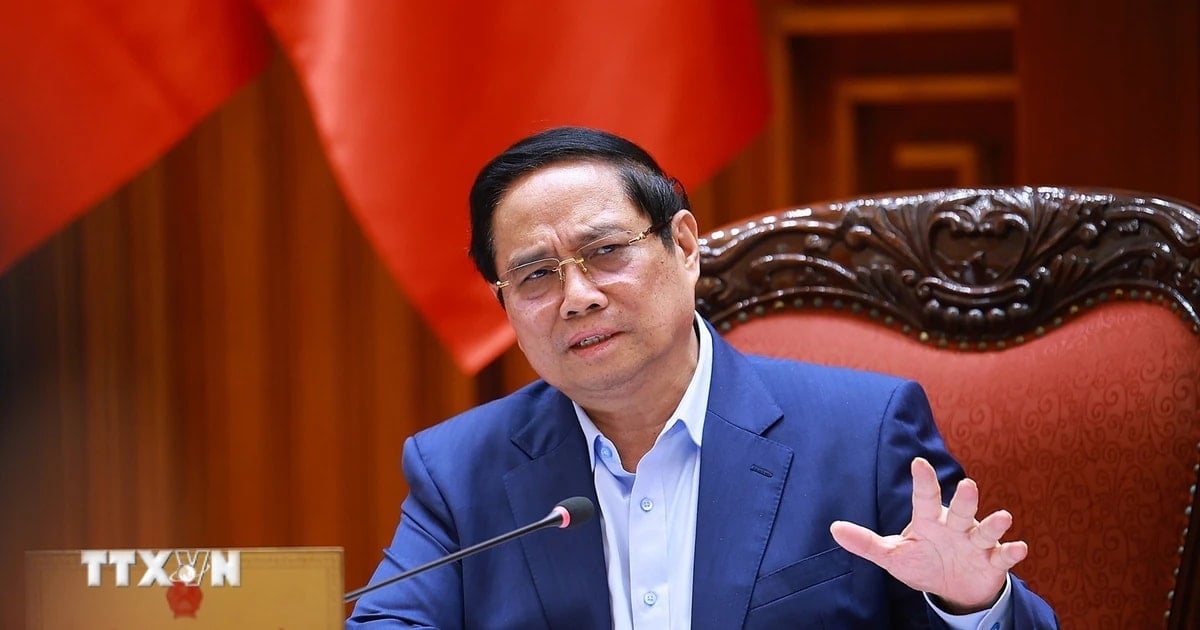
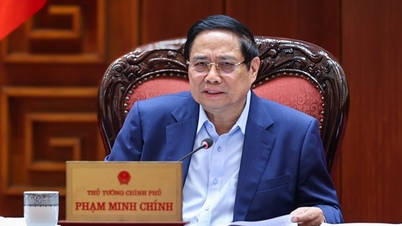
On the afternoon of December 5, Politburo member, Secretary of the Government Party Committee, Prime Minister Pham Minh Chinh chaired a meeting of the Government Party Committee Standing Committee and the Government Standing Committee on the "Project to prevent and combat subsidence, landslides, flooding, drought, and saltwater intrusion in the Mekong Delta region until 2035, with a vision to 2050" and reported to the Politburo on the results of handling a number of outstanding issues related to flood prevention in Ho Chi Minh City and other projects related to environmental protection and air pollution prevention in urban areas.
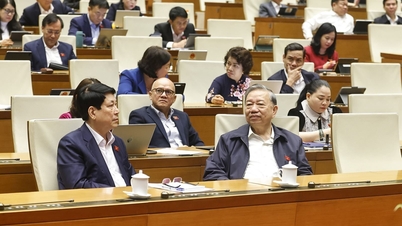
Attending the meeting were comrades: Politburo member, Party Central Committee member, Deputy Secretary of the Government Party Committee, Deputy Prime Minister , Minister, Head of ministerial-level agencies, Government agencies; comrades of the Standing Committee of the Government Party Committee; leaders of a number of relevant ministries and branches.
Delegates assessed that currently the Mekong Delta is not only experiencing landslides, but is also facing many very big problems such as land subsidence, riverbank and coastal erosion, flooding, drought, and saltwater intrusion.
These problems are interrelated and affect each other and are all related to water resources, the solution to one problem may affect another.
According to the 2025 Working Program of the Politburo and Secretariat, the Government Party Committee assigned the Party Committee of the Ministry of Agriculture and Environment to preside over and coordinate with research agencies to develop a Project to prevent subsidence, landslides, flooding, drought, and saltwater intrusion in the Mekong Delta to have more comprehensive, comprehensive, and fundamental solutions for sustainable development of the Mekong Delta.
This is a very important issue, related to the livelihoods and lives of people in the Mekong Delta, which accounts for 12.8% of the country's area, nearly 18% of the country's population, contributes 95% of rice exports, 60% of seafood, and 65% of fruit exports of the country.
The project, chaired by the Ministry of Agriculture and Environment, in coordination with ministries, agencies and localities in the Mekong Delta region, closely followed the Resolutions of the Politburo and the Government on sustainable development of the Mekong Delta in response to climate change; as well as the directions of the Government leaders.
Delegates said that the prevention and control of subsidence, landslides, flooding, drought and saltwater intrusion in the Mekong Delta is a very big, important and difficult issue related to all aspects of social life in the region such as population distribution, economic structure, infrastructure, culture, society...
Therefore, it is necessary to calculate very carefully; put the issue in relation to the planning and development of industries, regions and countries in the Mekong River basin.
Delegates proposed studying non-structural solutions; adaptive solutions; along with arranging and mobilizing resources and having priorities to effectively implement; researching and applying science and technology to turn difficulties into advantages and potentials for sustainable development of the Mekong Delta.

Regarding the "Project to handle some outstanding issues related to flood prevention in Ho Chi Minh City and other projects related to environmental protection and climate change," the Government Party Committee said that the Politburo has issued Conclusion No. 77, the National Assembly has issued Resolution No. 170, and recently the Politburo continued to direct the Government Party Committee to coordinate with the National Assembly Party Committee to add to the program of the 10th Session of the National Assembly to consider and approve the Resolution to expand the scope of application of Resolution No. 170/2024/QH15.
In particular, Ho Chi Minh City's flood prevention project is a long-standing problem. On July 21, 2025, the Government issued Resolution No. 212/NQ-CP to remove difficulties and obstacles of the project.
The Ministry of Agriculture and Environment has also reviewed and synthesized other projects related to the environment and climate change; from there, carefully prepared a draft report to the Politburo on the results of handling a number of outstanding issues.
After discussing and clarifying issues with delegates and concluding the conference, Prime Minister Pham Minh Chinh welcomed and highly appreciated the careful preparation of the Ministry of Agriculture and Environment for the projects submitted to the Politburo according to assigned tasks, especially the Project on prevention and control of subsidence, landslides, flooding, drought, and saltwater intrusion in the Mekong Delta. The Prime Minister basically agreed with the content of the report and proposals of the Party Committee of the Ministry of Agriculture and Environment.
The Prime Minister said that with the position, role, importance and practicality taking place in the Mekong Delta region, the prevention and control of subsidence, landslides, flooding, drought and saltwater intrusion in the region has received special attention from the Central Government, the Politburo, the National Assembly and the Government, which have issued many resolutions, decisions, instructions, as well as invested large resources for the development of the Mekong Delta.
Emphasizing the mindset of flexible and effective adaptation to climate change in the Mekong Delta in the direction of nature, the Prime Minister requested to study and fully absorb the comments of the Party Committee Standing Committee and delegates attending the meeting, promptly complete the dossier and documents to submit to the Politburo according to regulations.
In particular, it is necessary to clearly analyze the situation, causes; political basis, legal basis, practical basis of the Project; report on the process of developing the Project; basic contents of the Project on viewpoints, objectives; tasks, solutions; research objects for prevention and control of subsidence, landslides, drought, flooding, salinity; the Project implementation period should only be within 10 years from 2026-2035.
Considering that prevention and control of subsidence, landslides, flooding, drought and saltwater intrusion in the Mekong Delta region requires large resources, the Prime Minister requested the design of mechanisms and policies to mobilize all resources for this work, in various forms, especially public-private partnership, in the spirit of "harmonious benefits and shared risks," striving to mobilize non-state resources to account for about 35%.
The Prime Minister requested that the Project must propose specific component projects, based on 5 areas that need to prevent and combat subsidence, landslides, flooding, drought, and saltwater intrusion, and have an order of priority, with the motto of overall planning, phased implementation, and ensuring that each step is done properly; in the spirit of "clear people, clear work, clear time, clear results, clear responsibilities, clear authority".
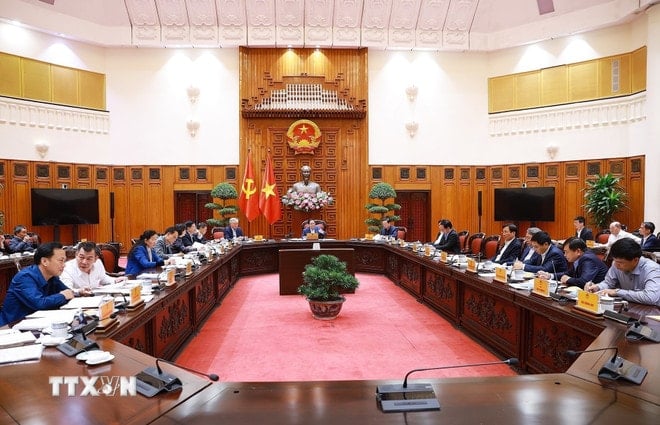
Pointing out the important role of scientific and technological solutions, especially new technologies, the Prime Minister requested promoting solutions that have been and are being effectively implemented; researching non-engineering solutions, combined with engineering solutions; planning population arrangement, production organization, economic structure; traffic solutions that are maximally adapted to riverine areas; getting involved immediately and prioritizing to allocate resources for implementation.
The Prime Minister requested the participation of ministries and branches, especially directly related ministries such as the Ministry of Construction, the Ministry of Finance, the Ministry of Science and Technology, research agencies, experts, scientists at home and abroad, Party committees and authorities of localities in the Mekong Delta region to urgently complete the Project to submit to the Politburo.
Requesting the completion of the Politburo Report on the results of handling a number of outstanding issues, including the Ho Chi Minh City flood control project. The Prime Minister directed that if necessary, research and development of a Project related to environmental protection, quality management, anti-pollution and air quality improvement in urban areas, especially in Hanoi and Ho Chi Minh City, be submitted to the Politburo for comments; especially proposing mechanisms, policies and solutions to ensure feasibility, practicality and effectiveness.
Source: https://daibieunhandan.vn/thu-tuong-pham-minh-chinh-thich-ung-linh-hoat-hieu-qua-voi-bien-doi-khi-hau-tai-dong-bang-song-cuu-long-theo-chieu-thuan-thien-10399410.html


![[Photo] Cat Ba - Green island paradise](/_next/image?url=https%3A%2F%2Fvphoto.vietnam.vn%2Fthumb%2F1200x675%2Fvietnam%2Fresource%2FIMAGE%2F2025%2F12%2F04%2F1764821844074_ndo_br_1-dcbthienduongxanh638-jpg.webp&w=3840&q=75)

![[Photo] 60th Anniversary of the Founding of the Vietnam Association of Photographic Artists](/_next/image?url=https%3A%2F%2Fvphoto.vietnam.vn%2Fthumb%2F1200x675%2Fvietnam%2Fresource%2FIMAGE%2F2025%2F12%2F05%2F1764935864512_a1-bnd-0841-9740-jpg.webp&w=3840&q=75)





























































Comment (0)