

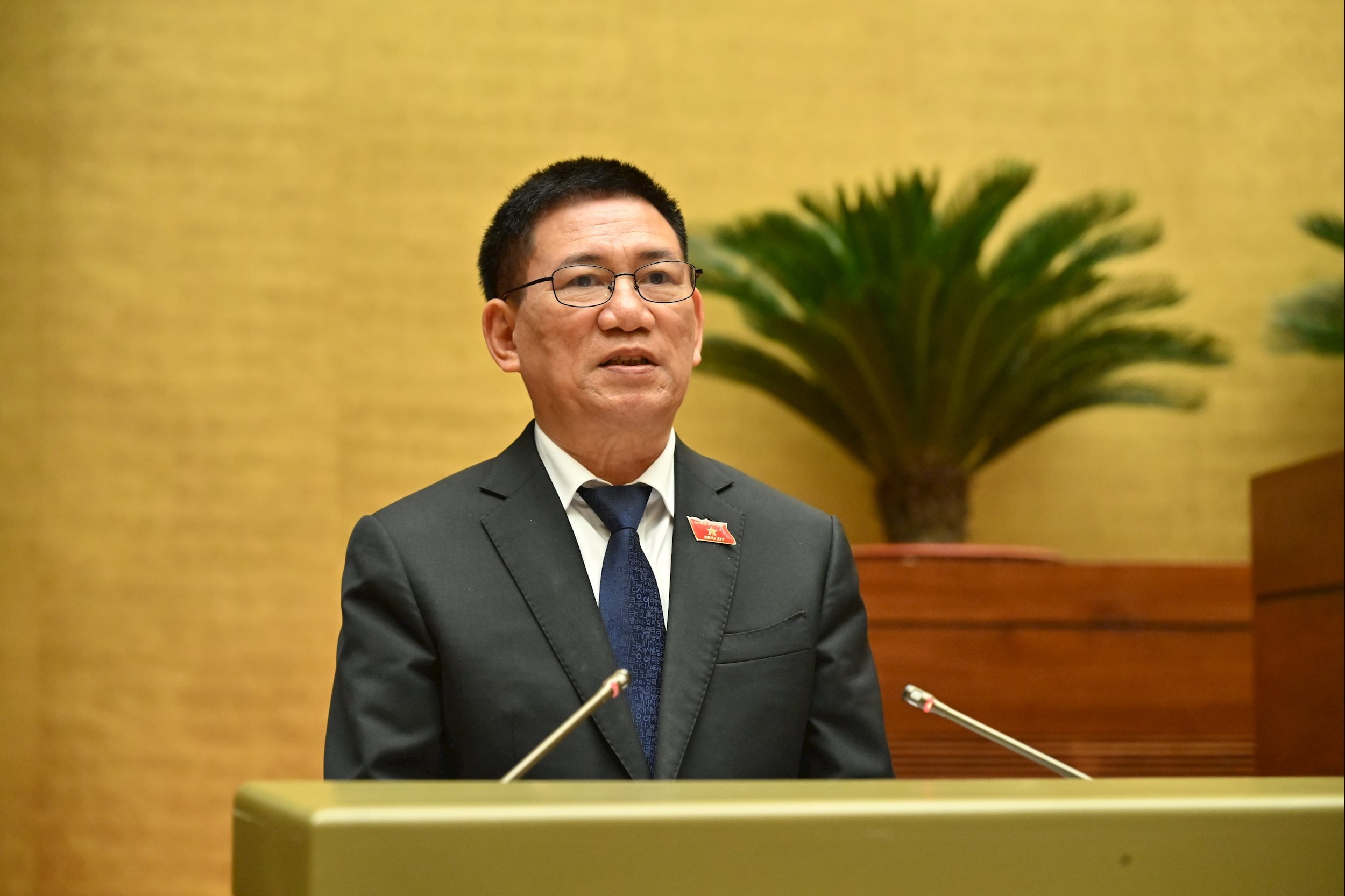
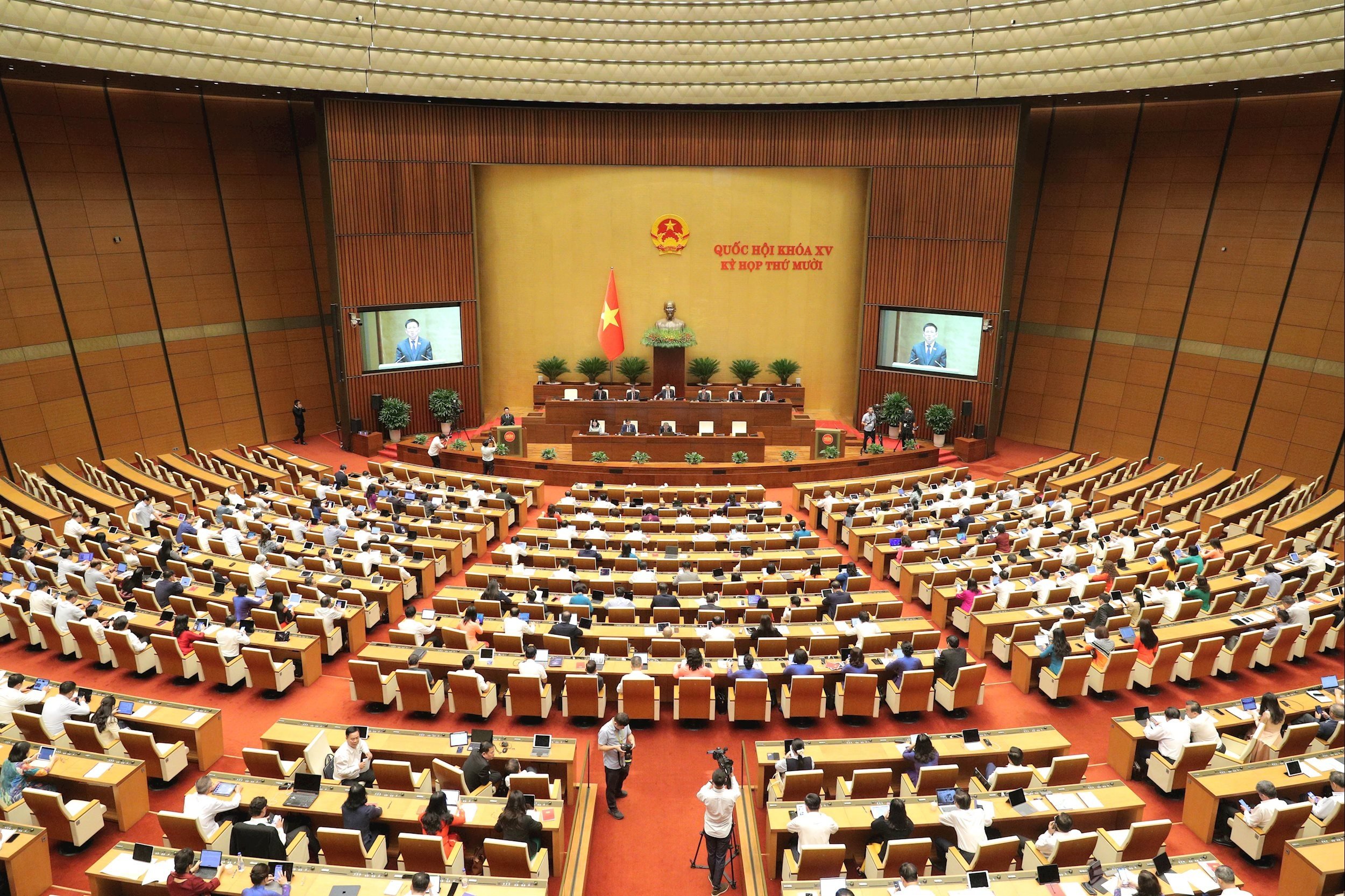
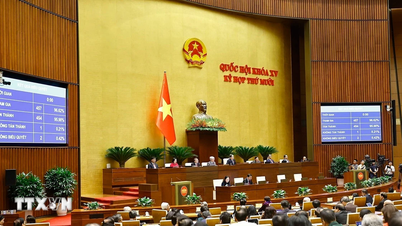
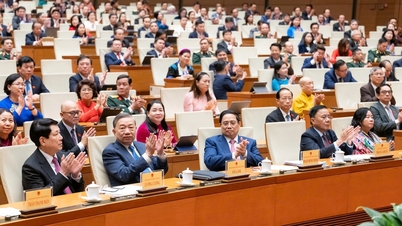
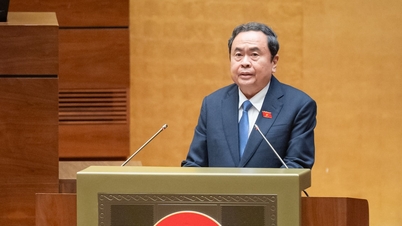
On the afternoon of October 20th, continuing the Tenth Session, the National Assembly heard Deputy Prime Minister Ho Duc Phoc present a report on the results of implementing Resolution No. 31/2021/QH15 of the National Assembly on the Plan for restructuring the economy in the period 2021-2025.
Ten targets are likely to be achieved, while four targets are not expected to be achieved.
Presenting the Report on the results of implementing Resolution No. 31/2021/QH15 of the National Assembly on the Plan for restructuring the economy in the period 2021-2025, Deputy Prime Minister Ho Duc Phoc stated that, regarding the 27 targets set out in Resolution No. 31/2021/QH15, to date, information has been assessed on 23 out of 27 targets. Of these, 10 out of 23 targets are likely to be achieved; 9 out of 23 targets are unlikely to be achieved; and 4 out of 23 targets are expected not to be achieved.
Several indicators, such as increased labor productivity, the number of enterprises, the number of agricultural cooperatives applying high technology, the percentage of agricultural cooperatives linked with enterprises along the value chain, and the proportion of spending on science and technology, have encountered many difficulties and challenges in implementation, requiring significant efforts to achieve.
Regarding the five key tasks outlined in Resolution No. 31/2021/QH15 of the National Assembly for the period 2021-2025, the Government has issued Resolution No. 54/NQ-CP with 102 tasks that have been implemented and yielded many important results. To date, 86 out of 102 tasks have been completed (84.3%); 16 out of 102 tasks (15.7%) have draft plans and are continuing to be implemented.
Regarding the restructuring of the state budget, institutional and legal reforms related to state budget restructuring continue to be implemented in the direction of strengthening the leading role of the central budget and the autonomy and initiative of local budgets; enhancing the role of fiscal policy in mobilizing, allocating, and effectively utilizing domestic and foreign resources for priority socio-economic development goals. The tax policy system continues to be improved in the direction of synchronization, comprehensive coverage of revenue sources, expansion of the tax base, and increase in the proportion of domestic revenue.
Regarding the restructuring of public investment, institutional reforms in investment, including public investment, have been emphasized; decisive leadership and management have resolved many difficulties and obstacles in the implementation of investment projects, contributing to accelerating the disbursement of public investment capital, thereby promoting economic recovery.
Regarding the restructuring of state-owned enterprises, according to the Government's report, the completion of the system of mechanisms, policies, and laws to remove difficulties and obstacles aims to accelerate the equitization and divestment process and limit the loss of state capital and assets during the restructuring of state-owned enterprises. This has facilitated the restructuring process, ensuring strictness, transparency, and maximizing the benefits for the State. The leading role of state-owned enterprises in key sectors and regions has been strengthened, contributing to the restructuring of the economy in conjunction with the innovation of the growth model.
The restructuring of credit institutions, coupled with the handling of non-performing loans, will continue to be implemented during the 2021-2025 period, focusing on improving the institutional framework in accordance with market principles, aiming to create a clear and substantial transformation. This includes focusing on implementing directives from competent authorities regarding the restructuring and handling of weak credit institutions, ensuring operational stability, and supporting their gradual recovery. Furthermore, it involves directing credit institutions to finalize and aggressively implement restructuring plans linked to the handling of non-performing loans during the 2021-2025 period; accelerating the handling and recovery of non-performing loans; improving credit quality; and preventing and limiting the emergence of new non-performing loans.
Deputy Prime Minister Ho Duc Phoc affirmed that the economic structure continues to shift positively, with the contribution of industrial and service sectors to GDP continuing to increase (from 78.5% in 2020 to 80.33% in 2025). The application of digital technology and digital transformation is becoming widespread across industries, sectors, localities, and daily life, production, and business activities, contributing significantly to economic growth. The structure between industries and within industries is shifting towards modernization, promoting a green economy, strengthening the application of science and technology, improving productivity, quality, efficiency, competitiveness, and maximizing potential and advantages.
Exploiting and developing new growth drivers
Highlighting some key priorities in directing and implementing tasks and solutions for restructuring the economy, the Deputy Prime Minister stated that in the coming period, focus will continue on perfecting institutions and the legal system to remove obstacles and promote the economic restructuring process. The government will also expeditiously issue documents to implement the laws recently passed by the National Assembly.
Simultaneously, accelerate progress and complete the restructuring goals of key sectors. Boost the disbursement of public investment capital and national target programs, striving to achieve a 100% disbursement rate for the 2025 plan. Effectively implement solutions to promote enterprise development and accelerate the restructuring of state-owned enterprises. Actively implement the development of a digital government and policy solutions to improve and upgrade the quality of the investment and business environment.
Focus on leveraging the leading role of major cities and growth poles in innovating growth models. Promote the shift of industries towards the use of modern technology; develop a green economy, a circular economy, and a digital economy. Develop various types of markets, strengthen the application of digital technology with breakthrough solutions, and implement strong, comprehensive, synchronized, and far-reaching reforms to promote economic restructuring.
Based on the assessment of the situation and the results of the implementation of the Economic Restructuring Plan for the period 2021-2025, the international and domestic context, and the proposed solutions for the remaining months of 2025, the Government has also identified three groups of tasks that will continue to be implemented in the coming period.
In particular, the Deputy Prime Minister emphasized that research will continue to be conducted on building a new economic development model associated with the high-growth phase to exploit and promote new growth drivers, leverage the achievements of the Fourth Industrial Revolution; apply science and technology, innovation and digital transformation; develop the digital economy, green economy, circular economy, data economy, etc.
This model requires quantifying the performance indicators; ensuring macroeconomic stability; identifying internal dynamics within each region and economic sector; improving labor productivity; facilitating deeper participation in global value chains; and controlling unpredictable risks and fluctuations.
Source: https://daibieunhandan.vn/tiep-tuc-nghien-cuu-xay-dung-mo-hinh-phat-trien-kinh-te-moi-gan-voi-giai-doan-tang-truong-cao-10391097.html
![[Photo] Closing Ceremony of the 10th Session of the 15th National Assembly](/_next/image?url=https%3A%2F%2Fvphoto.vietnam.vn%2Fthumb%2F1200x675%2Fvietnam%2Fresource%2FIMAGE%2F2025%2F12%2F11%2F1765448959967_image-1437-jpg.webp&w=3840&q=75)



![[Photo] Prime Minister Pham Minh Chinh holds a phone call with the CEO of Russia's Rosatom Corporation.](/_next/image?url=https%3A%2F%2Fvphoto.vietnam.vn%2Fthumb%2F1200x675%2Fvietnam%2Fresource%2FIMAGE%2F2025%2F12%2F11%2F1765464552365_dsc-5295-jpg.webp&w=3840&q=75)









![[Video] Secretary General of the National Assembly presides over international press conference announcing the results of the 10th Session](https://vphoto.vietnam.vn/thumb/402x226/vietnam/resource/IMAGE/2025/12/11/1765457358315_img-2357-6607-png.webp)



























![[OFFICIAL] MISA GROUP ANNOUNCES ITS PIONEERING BRAND POSITIONING IN BUILDING AGENTIC AI FOR BUSINESSES, HOUSEHOLDS, AND THE GOVERNMENT](https://vphoto.vietnam.vn/thumb/402x226/vietnam/resource/IMAGE/2025/12/11/1765444754256_agentic-ai_postfb-scaled.png)










































Comment (0)