Ninh Binh province is continuing to make breakthroughs in preserving and promoting the value of the Trang An Scenic Landscape Complex so that it lives up to its World Heritage status.
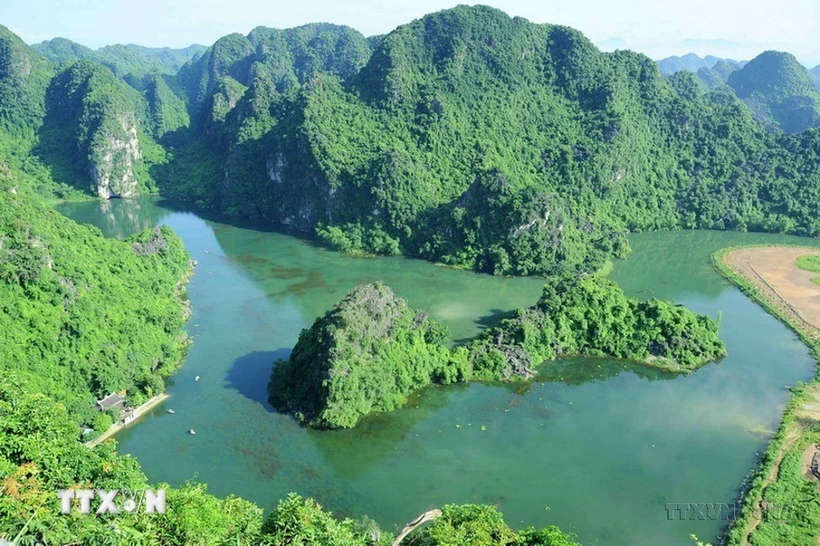
Often referred to as "Ha Long Bay on land" with nearly 100 stunning caves, the Trang An Scenic Landscape Complex is Vietnam's first mixed heritage site to be recognized by UNESCO as a World Heritage Site based on both cultural and natural criteria. (Photo: Minh Duc/VNA)
The Trang An Scenic Landscape Complex in Ninh Binh was inscribed as a World Cultural and Natural Heritage Site by the United Nations Educational , Scientific and Cultural Organization (UNESCO) in 2014.
This first mixed heritage site in Vietnam and Southeast Asia is now not only a green, clean, and beautiful world heritage site and a major driving force for the socio -economic development of Ninh Binh province, but also a model to inspire and promote the protection and preservation of precious human assets.
Ninh Binh province is continuing to make breakthroughs in preserving and promoting the value of the Trang An Scenic Landscape Complex so that it lives up to its World Heritage status.
Reporters from the Vietnam News Agency (VNA) have produced three articles on the theme "Building Trang An Scenic Landscape to be worthy of World Heritage status."
Lesson 1: Where exceptional values converge
Ninh Binh is a land of outstanding people and rich history, with a long-standing cultural tradition and abundant, unique natural landscapes.
Notably, Ninh Binh is the only locality in Southeast Asia to possess the Trang An Scenic Landscape Complex, a dual World Heritage Site encompassing both cultural and natural aspects.
This region boasts a harmonious blend of stunning natural landscapes and rich cultural heritage. Currently, Ninh Binh is positioning itself as one of the safest, friendliest, and most attractive destinations for heritage wonders.
The Trang An scenic complex, with its unique and distinctive landscapes, covers an area of 12,252 hectares and encompasses many particularly important national historical sites in Ninh Binh province, such as: Trang An Eco-tourism Area, Tam Coc-Bich Dong Tourist Area, Bai Dinh Pagoda, Hoa Lu Ancient Capital National Special Monument...
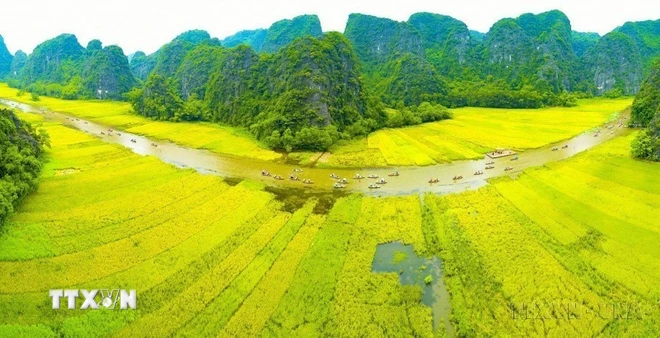
The vibrant yellow of the Ngo Dong tree-lined river welcomes domestic and international tourists to visit Tam Coc-Bich Dong (part of the Trang An scenic complex). (Photo: Minh Duc/TTXVN)
Linking these areas is the Hoa Lu Special Forest ecosystem, which covers limestone mountains, wetlands, and a system of rivers, lakes, and swamps. Trang An is not only a place that combines the essence of nature but also preserves traces of prehistoric people and rich cultures, a blend of past and present.
Following geological traces, domestic and international scientists have noted that Trang An is unique because, over tens of thousands of years, it has been repeatedly encroached upon and transformed by the sea, eventually becoming part of the mainland.
The long-term topographical development has created a stunning landscape, a blend of towering, steep-walled mountains nestled within pristine rainforest, surrounded by valleys that form large, deep, water-filled caverns connected to numerous caves and underground streams navigable by boat.
The Trang An scenic complex is not only known for its unique and distinctive landscapes, but more importantly, it is also a cultural heritage site closely linked to the settlement of people on this land tens of thousands of years ago.
Trang An is a prominent site in Southeast Asia and the world, offering evidence of how humans interacted with the natural landscape and adapted to significant environmental changes over more than 30,000 years.
According to Associate Professor, Dr. Nguyen Khac Su, Institute of Archaeology, Vietnam Academy of Social Sciences, artifacts found during the excavation of more than 30 archaeological sites in the Trang An Scenic Landscape Complex demonstrate the history of human habitation and land and sea use in the face of harsh changes in the natural environment from 30,000 years to the present day, divided into three stages, linked to the periods before, during, and after the sea level rise.
Not only is Trang An a sacred place with many temples and shrines, it is also the cradle of Vietnamese Buddhism. Going back in history to the Ly Dynasty, National Master Nguyen Minh Khong chose Bai Dinh as his place of practice, building temples to worship Buddha and perform rituals to pray for the salvation of sentient beings, making the Hoa Lu-Bai Dinh region the center of Buddhism in Vietnam in the 10th century.
Thanks to the generosity and contributions of many generations of Vietnamese people, today, Bai Dinh Pagoda in Gia Sinh commune, Gia Vien district, covers an area of 700 hectares with many massive and unique Buddhist architectural works, setting records such as being the largest spiritual and cultural center in Southeast Asia; having the largest gold-plated Buddha statue in Asia; having the longest Arhat corridor in Asia; having the tallest Buddha relic tower in Asia and the largest bronze Maitreya Buddha statue in Southeast Asia.
Mr. Nguyen Cao Tan, Deputy Director of the Ninh Binh Provincial Department of Tourism, shared that the Trang An Scenic Landscape Complex serves as a bridge between the past and the present, between history and landscape, and between nature and people, creating a harmonious connection and intermingling into a flourishing landscape and cultural space.
It embodies the glorious milestones of national history and tradition, serving as the first capital of Dai Co Viet in the 10th century and as the royal palace of the Tran dynasty during the resistance against the Mongol invaders in the 13th century.
Along with numerous famous historical and religious sites, all of these, combined with unique natural and cultural values, define outstanding global values.
A destination of breathtaking landscapes.
The Trang An Scenic Landscape Complex is an area where nature and culture blend together, comprising three areas: the Trang An-Tam Coc-Bich Dong Scenic Landscape, the Hoa Lu Ancient Capital Special Historical and Cultural Relic, and the Hoa Lu Special Use Primary Forest.
Among them, the Trang An-Tam Coc-Bich Dong scenic area is a wonder that was recognized as a Special National Monument in 2012.
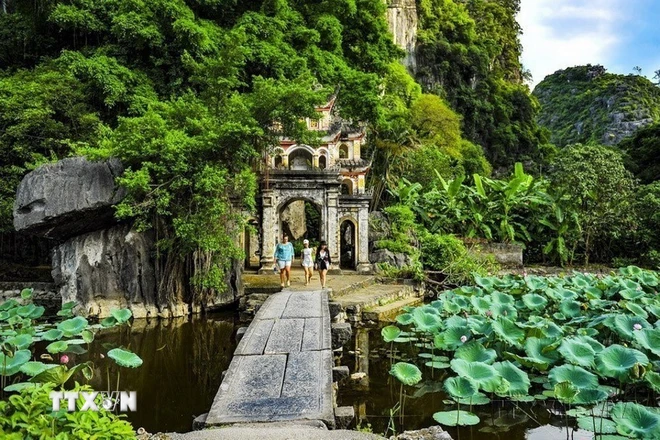
Tourists visit Bich Dong Pagoda - a historical and cultural site belonging to the Trang An Tam Coc-Bich Dong scenic complex. (Photo: Minh Duc/VNA)
This scenic area combines two National Monuments: the Tam Coc-Bich Dong Scenic Area, covering 350 hectares, and the Trang An Scenic Area, covering 1,949 hectares, with its complex of rivers, caves, temples, and pagodas.
The Trang An-Tam Coc-Bich Dong scenic area comprises 50 dry caves and 50 flooded caves, exhibiting great diversity in form and type. Notably, the caves here are often clustered together and closely interconnected. Within each cave, the dissolution and deposition of limestone have created a myriad of colorful and diverse stalactite formations.
In this area, natural landscapes such as the Ngo Dong River, along with caves and mountains, harmoniously combine with architectural structures showcasing human ingenuity and skill, such as the Thai Vi Temple and Bich Dong Pagoda, creating a breathtakingly beautiful scenery.
The structures here are primarily built into cliffs and caves, forming a unified and solid whole, earning this place the title of "the second most beautiful cave in Southern Vietnam."
Architect Pham Thanh Tung, Chief of the Office of the Vietnam Architects Association, said that the karst tower landscape of Trang An makes it likened to a "Ha Long Bay on land," with its magnificent beauty created by a system of strangely shaped rock formations reflecting in the winding rivers and streams connecting the caves and pristine valleys, making it one of the most beautiful and spectacular areas of its kind in the world.
Blending seamlessly with the karst tower landscape is a dense primeval forest covering the cliffs and majestic mountains. Temples and shrines, nestled against the cliffs with their ancient, moss-covered tiled roofs, create a serene and tranquil cultural element that harmonizes with the picturesque natural scenery.
The Trang An scenic landscape complex heritage area currently has more than 400 relics, including: communal houses, pagodas, temples, shrines, palaces, steles, tombs, palaces, ancient houses, etc.
In particular, there are more than 30 archaeological sites including caves and rock shelters; of which 57 sites have been identified and classified, including: 2 Special National Sites, 21 National Sites and 36 Provincial Sites.
Professor, Dr. Do Hau, Vice Chairman and General Secretary of the Vietnam Urban Planning and Development Association, believes that this area boasts spectacular natural landscapes skillfully created by nature with a harmonious combination of natural elements: forests, mountains, caves, fields, and rivers.
The successive limestone mountain ranges, combined with rivers and streams, create a vibrant and fascinating landscape, blending mountains with villages, hamlets, and historical sites.
The Trang An Scenic Landscape Complex is a dual heritage site within the national and world heritage system, deeply rooted in Vietnamese natural landscape and culture, and containing many values in terms of architectural and landscape space.
Thuy Dung
Source: https://www.vietnamplus.vn/trang-an-noi-hoi-tu-nhung-gia-tri-dac-biet-post969914.vnp


![[Image] Nearly 125,000 Hanoi students completed the Literature exam for the 10th grade entrance exam.](https://vphoto.vietnam.vn/thumb/1200x675/vietnam/resource/IMAGE/2026/05/30/1780117233041_ndo_br_thiet-ke-chua-co-ten-2-png.webp)

























![[Photo] Admire the coral "masterpiece" amidst the million-year-old heritage of Dak Lak province.](https://vphoto.vietnam.vn/thumb/1200x675/vietnam/resource/IMAGE/2026/05/30/1780107638639_y25-jpg.webp)

































































Comment (0)