

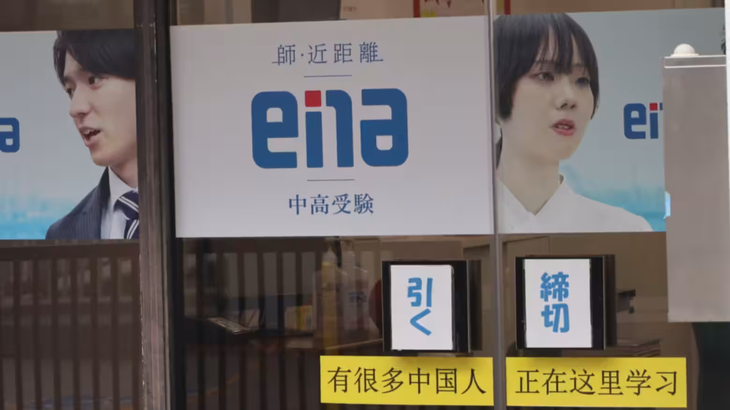
A yellow Chinese sign on the door of a cram school belonging to the Ena chain in Tokyo in early September - Photo: NIKKEI ASIA
At the Ena school system, part of the Gakkyusha Group in Japan, many campuses have displayed signs in Chinese stating that many Chinese students are enrolled, as a way of showing their welcome.
According to the Japan Immigration Agency, the number of Chinese children under 15 with medium- and long-term residency permits in Japan exceeded 90,000 by the end of 2024, a 70% increase compared to a decade earlier.
Due to the rigorous entrance exams in China, coupled with stricter regulations on private tutoring since 2021 under President Xi Jinping, an increasing number of Chinese families are turning to Japan for a more relaxed learning environment.
According to Nikkei Asia , a source familiar with cram schools in Japan said that each class at prestigious schools in Tokyo has one or two Chinese students.
This education industry views attracting talented Chinese students as a positive factor for its business.
"As the market shrinks due to declining birth rates, Chinese students are essential for the stable operation of cram schools," said an executive at the Yotsuya Otsuka cram school chain, adding that they plan to consider hiring Chinese-speaking staff and setting up a Chinese-language website.
In Tokyo, some schools in the Ena chain have up to 40% Chinese students, while larger centers like Sapix and Yotsuya Otsuka are also seeing a rapid increase in the number of Chinese students.
Some centers in Kawaguchi City report that up to 80% of their students are of Chinese origin, reflecting a widespread trend.
Tatsuhiro Son, director of the online cram school Rizapuro, commented: "The Chinese have a long tradition of taking exams dating back to the imperial examination era, so they are very well-suited to the Japanese examination system. Now, cram schools all want to attract more Chinese students."
However, the schools emphasized that they do not conduct separate advertising campaigns or preferential policies for Chinese students, avoiding being seen as "pro-China" amidst the cautious sentiment in Japanese society.
Source: https://tuoitre.vn/truong-luyen-thi-nhat-rong-cua-don-hoc-sinh-trung-quoc-20251023124253777.htm



























































































Comment (0)