

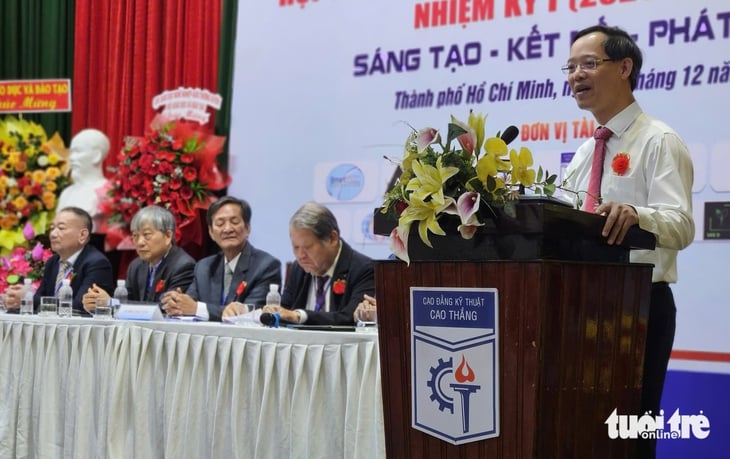
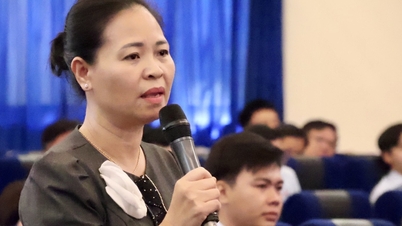
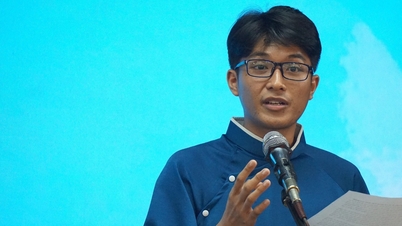
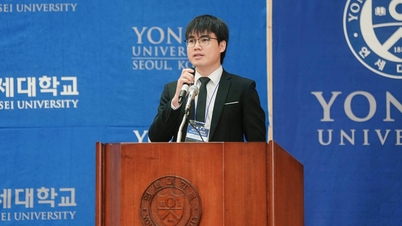
Dr. Truong Anh Dung speaks at the congress - Photo: TRONG NHAN
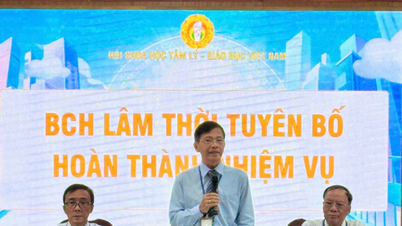
Linking vocational schools and businesses is one of the hot topics mentioned by experts at the Congress of Delegates of the Ho Chi Minh City Vocational Education Association, term I (2025-2030).
Dr. Truong Anh Dung, Director of the Department of Vocational Education and Continuing Education ( Ministry of Education and Training ), emphasized that many vocational schools have proactively innovated, approached international standard programs, participated in foreign training cooperation, ASEAN and world skills competitions, etc.
However, standardization on a large scale is still limited, and the standardization level among school groups is not uniform. Therefore, by 2030, we strive to have 80% of vocational training facilities upgraded, modernized, and capable of training according to international standards.
Dr. Truong Anh Dung emphasized that digital transformation and digital skills are mandatory pillars for vocational training institutions. The Ministry of Education and Training is developing legal documents for synchronizing data of learners, teachers and training institutions, connecting directly with the common enrollment system.
In particular, Mr. Dung emphasized that vocational training activities in the vocational education system need to be implemented with businesses, which are also the direct employers.
The connection should not stop at internship cooperation, but also need to participate in program design, teaching, skills assessment and recruitment. Therefore, it is necessary to promote extensive cooperation between schools - businesses - professional associations to form a strong and sustainable vocational skills ecosystem.

A denture manufacturing center right in Guangxi Academy of Transport Engineering (China), a model connecting vocational schools and businesses so that students can both study and work - Photo: TRONG NHAN
Dr. Dang Minh Su - Principal of Global Polytechnic College - said that cooperation between schools and businesses needs to shift from formality to substance.
He said that hundreds of memorandums of understanding should not be signed without any implementation. It is important that each school has a number of deep-rooted business partners, jointly build competency standards, co-design learning materials and participate in assessing learners' skills.
"HCMC needs to establish a "New Occupational Standards Working Group" consisting of experts, vocational schools and businesses to build 10-20 new occupational standards each year, especially in booming fields," Mr. Su commented.
Connecting vocational school and business resources
Mr. Tran Anh Tuan, Vice President of the Ho Chi Minh City Vocational Education Association, said that Ho Chi Minh City is entering a period of acceleration in human resource needs, with a forecast of needing 800,000 - 1 million new workers in the 2025-2030 period.
Service industries, high-tech industries, logistics, digital economy and green energy will account for 70% of recruitment needs.
He said that one of the biggest bottlenecks today is that the labor market information system is not fully connected between vocational schools - businesses - employment centers. Many businesses are still not deeply integrated into the common data system.
Ho Chi Minh City needs to invest heavily in digital technology for human resource forecasting activities, including building software to manage a labor supply and demand database that connects directly with businesses, universities, colleges, secondary schools and employment service organizations.
Source: https://tuoitre.vn/truong-nghe-khong-nen-ky-voi-hang-tram-doanh-nghiep-roi-khong-lam-gi-20251206124109583.htm



![[Photo] National Assembly Chairman Tran Thanh Man attends the VinFuture 2025 Award Ceremony](/_next/image?url=https%3A%2F%2Fvphoto.vietnam.vn%2Fthumb%2F1200x675%2Fvietnam%2Fresource%2FIMAGE%2F2025%2F12%2F05%2F1764951162416_2628509768338816493-6995-jpg.webp&w=3840&q=75)
![[Photo] 60th Anniversary of the Founding of the Vietnam Association of Photographic Artists](/_next/image?url=https%3A%2F%2Fvphoto.vietnam.vn%2Fthumb%2F1200x675%2Fvietnam%2Fresource%2FIMAGE%2F2025%2F12%2F05%2F1764935864512_a1-bnd-0841-9740-jpg.webp&w=3840&q=75)





































































Comment (0)