

Ho Chi Minh City – Ms. Dung, 26 years old, gained 10 kg in three months, thinking she was just "getting fat" after getting married. Doctors diagnosed her with an adrenal gland tumor causing Cushing's syndrome.
Besides weight gain, Ms. Dung's belly accumulated fat, her legs atrophied making walking difficult, she experienced hair loss, hair growth on her back, thin and stretchy skin that bruised easily, and a red face like an allergic reaction. Thinking she had gained weight after marriage, she tried many weight-loss methods such as dieting and using weight-loss supplements... After two months, she lost two kilograms but felt tired and exhausted, so she stopped using them.
She visited several hospitals in Ho Chi Minh City for examination and was diagnosed with Cushing's syndrome (an endocrine disorder) due to the use of corticosteroid-containing medication. She took Western medicine for two months, then switched to traditional Chinese and Vietnamese medicine, but her condition did not improve, so she went to Tam Anh General Hospital in Ho Chi Minh City for examination.
On November 10th, Dr. Tran Thuy Ngan, a specialist in Endocrinology and Diabetes, stated that the patient's symptoms were due to Cushing's syndrome. This is an endocrine disorder caused by prolonged high cortisol levels in the blood or long-term use of corticosteroids (which have a similar effect to cortisol). However, the patient did not respond to treatment for Cushing's syndrome due to the corticosteroid-containing medication. The doctor suspected an endogenous cause related to the pituitary or adrenal glands.
The ACTH (cortisol-stimulating hormone) test results showed normal levels, ruling out hypersecretion of ACTH as the cause.
An abdominal ultrasound revealed a tumor above the kidney, followed by a CT scan which clearly identified a tumor in the right adrenal gland, approximately 4 cm in size. This was the cause of increased cortisol secretion (secreted by the adrenal gland), leading to Cushing's syndrome.
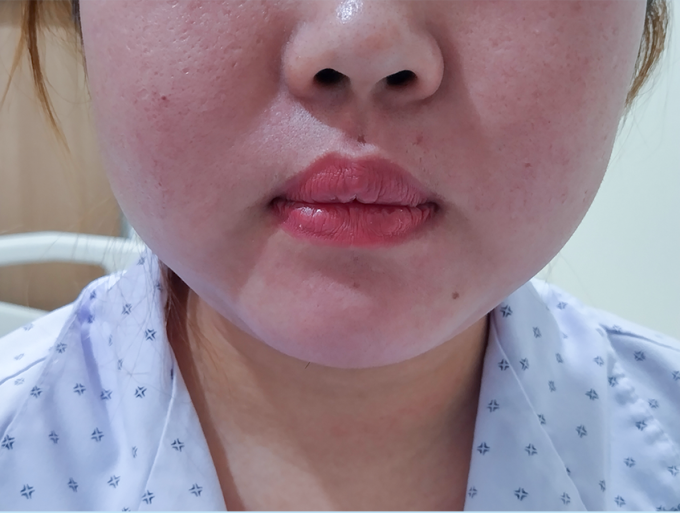
The patient's face has accumulated fat. Photo: Dinh Tien
Patients receive treatment to regulate adrenal hormones, electrolytes, and blood pressure, and undergo a health assessment before surgery to remove the tumor.
Dr. Nguyen Tan Cuong, Deputy Head of the Urology Department at the Center for Urology, Nephrology and Andrology, stated that the patient's adrenal gland tumor was large, with many proliferating blood vessels, and surrounded by organs such as the liver, kidneys, spleen, and large blood vessels. Even a minor surgical error could cause bleeding or damage to adjacent organs. The adrenal gland tumor secretes a large amount of cortisol hormone, causing a sudden and difficult-to-control increase in blood pressure, potentially leading to a risk of cardiac arrhythmias and stroke during surgery.
Anesthesiologists place a catheter in the patient's wrist to monitor arterial blood pressure and a venous catheter in the neck to measure blood flow and control blood pressure. This allows doctors to quickly address situations such as increased blood pressure or blood loss.
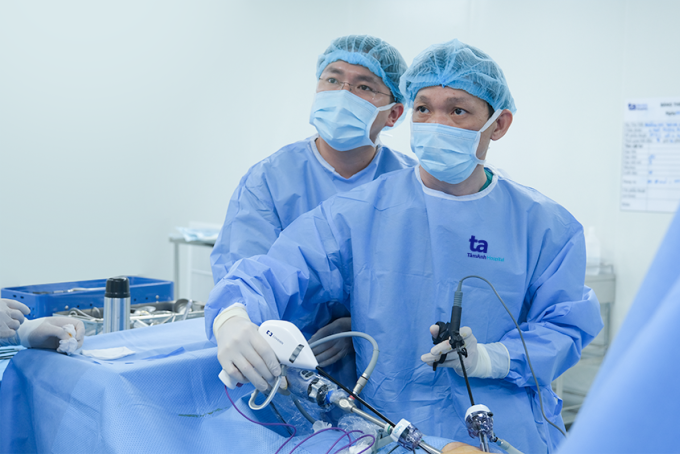
Doctor Tan Cuong (right) and Specialist Doctor Phan Huynh Tien Dat (left) perform adrenal gland tumor removal surgery on a patient. Photo: Dinh Tien
Dr. Cuong and his colleagues performed a laparoscopic retroperitoneal adrenalectomy through three small incisions in the flank. An ultrasonic scalpel helped the surgeons dissect the tissue surrounding the adrenal gland, cut the tissue, and control bleeding immediately. The tumor was removed, the patient experienced minimal blood loss, and the right adrenal gland was preserved to reduce the risk of postoperative adrenal insufficiency.
Ms. Dung recovered well; her electrolytes, blood cortisol levels, and blood pressure were stable, her face was no longer flushed, and she was no longer tired. Both adrenal glands were functioning stably, and she was discharged after two days.
According to Dr. Ngan, Cushing's syndrome mainly occurs in women aged 25-40. The disease is caused by two factors: exogenous and endogenous. Exogenous causes include medications, such as long-term use of corticosteroids to treat autoimmune diseases, arthritis, lupus, asthma, etc., or the misuse of medications without a doctor's prescription. Endogenous causes are usually due to the pituitary gland oversecreting ACTH or tumors in the adrenal glands.
The disease progresses over a long period, causing complications such as obesity, hypertension, diabetes, osteoporosis, vertebral collapse, increased risk of fractures, mental disorders, skin discoloration, kidney stones, etc.
Doctors advise people not to self-medicate with drugs containing corticosteroids, such as painkillers, medications for bone and joint problems, or sinusitis medications, to prevent corticosteroid-induced Cushing's syndrome. Regular health checkups at least once a year help detect the disease early.
People who experience unexplained weight gain, facial and abdominal fat, shoulder fat; arm and leg atrophy, flushed cheeks, thin skin, easy bruising, slow wound healing, stretch marks, excessive facial and body hair growth... should see an endocrinologist or diabetes specialist for examination.
Dinh Tien
* Patient's name has been changed
| Readers can post questions about endocrine disorders and diabetes here for doctors to answer. |
Source link





















![[Photo] Prime Minister Pham Minh Chinh holds a phone call with the CEO of Russia's Rosatom Corporation.](/_next/image?url=https%3A%2F%2Fvphoto.vietnam.vn%2Fthumb%2F1200x675%2Fvietnam%2Fresource%2FIMAGE%2F2025%2F12%2F11%2F1765464552365_dsc-5295-jpg.webp&w=3840&q=75)











































Comment (0)