

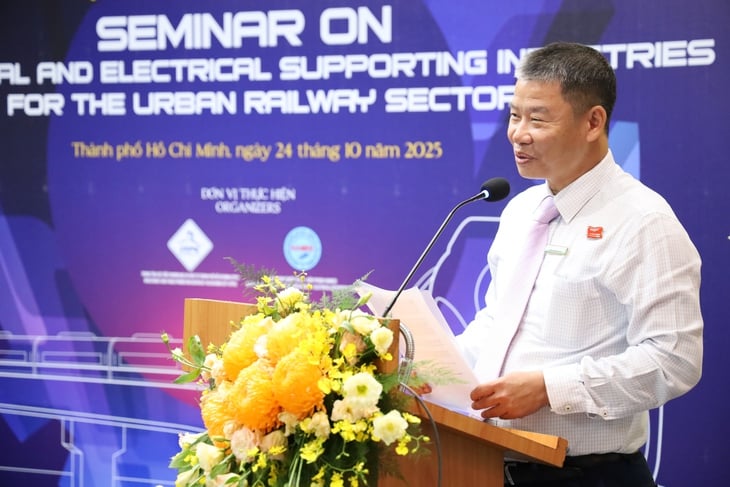
Mr. Tran Thanh Trong - Vice Chairman of the Ho Chi Minh City Mechanical and Electrical Business Association (HAMEE) - speaking at the workshop - Photo: TRUONG LINH
On October 24th, the thematic workshop "Mechanical and Electrical Supporting Industries for Urban Railways," organized by the Ho Chi Minh City Trade and Investment Promotion Center (ITPC) in collaboration with the Ho Chi Minh City Mechanical and Electrical Business Association (HAMEE), provided valuable information and practical proposals regarding localization opportunities in metro projects.
"Domestic electromechanical businesses are now strong enough."
In her opening remarks, Ms. Ho Thi Quyen, Deputy Director of ITPC, stated that the metro is an important tool for the city to restructure urban areas, reduce traffic pressure, and develop multi-centers. With a transport capacity 6-10 times greater than buses and far exceeding private cars, the metro is also considered a green, clean, and modern mode of transportation.
Mr. Tran Thanh Trong, Vice Chairman of the Ho Chi Minh City Mechanical and Electrical Engineering Business Association (HAMEE), stated that Vietnamese businesses are capable of installing metro support systems such as electricity, ventilation, fire protection, and external control. However, to progress further, businesses need to proactively improve their production capacity and invest in technical personnel.
"The Law on Bidding and current decrees have created incentives for domestic goods with a high localization rate. The question is whether Vietnamese businesses are ready to seize this opportunity," Mr. Trong questioned.
He also suggested that there should be clear binding agreements with international contractors regarding technology transfer, operation, and maintenance.
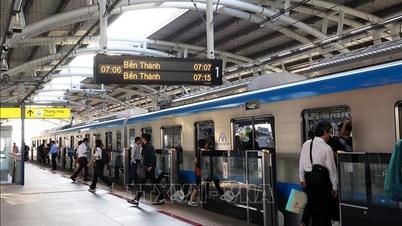
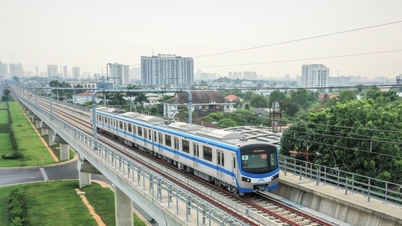
Mr. Bui Anh Huan, Deputy Head of the Ho Chi Minh City Urban Railway Management Board, said that Metro Line 2 (Ben Thanh - Tham Luong) is currently the focus of implementation, part of the overall plan for 27 metro lines totaling over 1,000km. Phase 1 alone is 11.6km long, has 11 stations, and is expected to commence construction in April 2026, with operation scheduled for the end of 2030.
Notably, Metro Line 2 utilizes 1,500V DC overhead power supply technology, features GoA4 automation design (initially operating at GoA3 level), and is supported by specific mechanisms from Resolution 188/2025/QH15.
Therefore, this is also a great opportunity for businesses to delve deeper into large "billion-dollar" value chains, but he also emphasized that participation in projects must be gradual, through mechanisms of technology transfer and order placement for Vietnamese businesses.
The human resources problem needs to be solved.
From a training perspective, Dr. Nguyen Minh Khoa, a lecturer at Ho Chi Minh City University of Technology, predicts that from 2025 to 2030, the metro industry will need at least 35,000 high-quality personnel, including more than 14,000 engineers and 12,000 operation and maintenance staff. Meanwhile, the system of specialized training schools remains limited.
Dr. To Thanh Tuan, Vice Principal of LILAMA2 International College of Technology, proposed a tripartite collaboration model involving the government formulating policies, schools supplying human resources, and businesses commissioning training. According to Dr. Tuan, if this collaboration is effective, businesses will reduce retraining costs, and students will adapt to real-world work more quickly.
From a planning perspective, Mr. Nguyen Vinh Toan, Deputy Director of the Ho Chi Minh City Department of Construction, stated that the merged urban railway network will consist of 27 lines totaling 1,012 km. The majority of these lines, located in the former Ho Chi Minh City, Binh Duong, and Ba Ria - Vung Tau, will be connected to form a unified system.
Ho Chi Minh City Metro project shortened timeline thanks to new mechanism.
Resolution 188/2025/QH15 has significantly shortened the project implementation time for Ho Chi Minh City. For example, the progress of metro line 1 has been reduced by 3-6 months; metro line 2 was awarded through a direct bidding process for consulting services, saving at least 12 months compared to international bidding. Notably, the project bypassed the investment approval process, shortening the timeline by 3-5 years.
To date, many private enterprises have expressed interest, such as Vingroup (investing in the Can Gio line), Truong Hai and Hyundai Rotem (metro line 2 and Thu Thiem - Long Thanh), Sovico (researching line 4)... The city has assigned these units to research and implement investment procedures.
Source: https://tuoitre.vn/tuyen-metro-so-2-tp-hcm-co-hoi-tham-gia-cung-ung-thiet-bi-cua-doanh-nghiep-viet-the-nao-2025102414250643.htm















![[Photo] Prime Minister Pham Minh Chinh holds a phone call with the CEO of Russia's Rosatom Corporation.](/_next/image?url=https%3A%2F%2Fvphoto.vietnam.vn%2Fthumb%2F1200x675%2Fvietnam%2Fresource%2FIMAGE%2F2025%2F12%2F11%2F1765464552365_dsc-5295-jpg.webp&w=3840&q=75)









































Comment (0)