

Airline tickets and textbooks continue to be subject to price caps by the government as a means of management, preventing negative impacts on citizens, especially low-income earners.
On the afternoon of June 19th, with a majority of delegates voting in favor, the National Assembly passed the amended Law on Prices. Accordingly, airfares and textbooks will continue to be subject to price caps by the State to provide a management tool and prevent negative impacts on the people, especially low-income earners.
Why continue imposing price caps on airline tickets?
Before the National Assembly voted to pass the law, on behalf of the Standing Committee of the National Assembly, the Chairman of the Finance and Budget Committee, Le Quang Manh, explained why the price ceiling had not yet been abolished to allow this commodity to be subject to market mechanisms.
Currently, six airlines operate domestic routes, but in reality, the market share is still dominated by three major carriers: Vietnam Airlines (approximately 35%), Vietjet Air (40%), and Bamboo Airways (16%). According to the Competition Law, this market has limited competition, and for the time being, the government still needs tools to regulate domestic air service prices to stabilize the market.
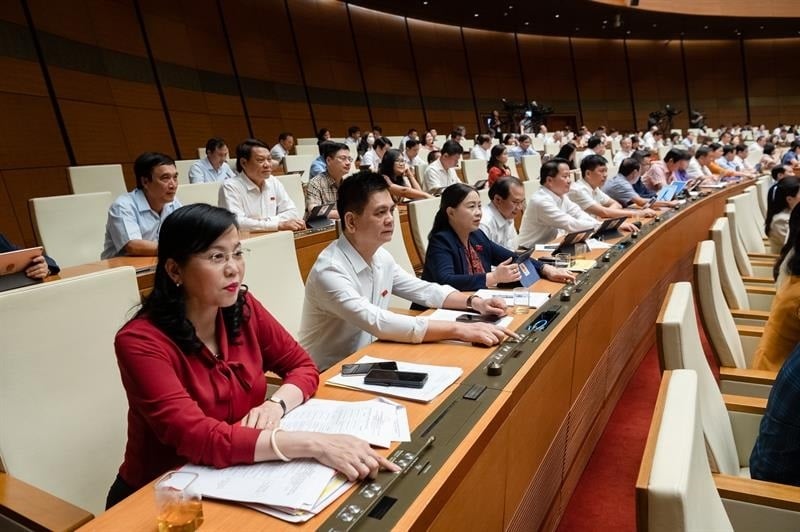 |
| Members of the National Assembly voted to approve the draft Law on Prices (amended). |
In the long term, as various modes of transportation develop synchronously and offer more choices for the public, regulations on domestic air passenger transport service prices will be considered accordingly. The regulation of a price ceiling for air tickets still ensures the autonomy of businesses. This is because airlines currently have full discretion to determine service prices, including airfares, except for economy class, which cannot exceed the price ceiling.
"If there is no price ceiling, it means the State is abandoning its price regulation tool. Airlines can completely set high airfares for economy class, especially during holidays, Tet (Lunar New Year), and peak travel seasons when demand for travel is high. This affects the people, especially those with low incomes, making it difficult for them to access air travel services, thus increasing social costs. In reality, there have been times (such as the recent April 30th and May 1st, 2023) when airlines simultaneously increased airfares, negatively impacting tourism and public sentiment," explained Le Quang Manh, Chairman of the Finance and Budget Committee.
Imposing price caps on textbooks; excluding pork from the price stabilization program.
Furthermore, according to the amended Price Law passed today, textbook pricing will also be based on a price ceiling.
Explaining this, the Chairman of the Finance and Budget Committee, Le Quang Manh, stated that this is an essential commodity with a very large consumer base, and its price directly impacts the majority of the population. Currently, publishers still add distribution costs and offer very high discounts (28-35% of the cover price), leading to prices being pushed up compared to the income of many people. Therefore, it is necessary to have control mechanisms to ensure that there is no negative impact.
Furthermore, the Standing Committee considered the decision not to set a price floor for textbooks reasonable because this is a unique commodity with a mandatory consumer base, including vulnerable groups. If a price floor were set, book publishers would not be able to sell to the public at a price lower than the floor, thus directly affecting the rights, especially of low-income individuals.
On the other hand, textbooks are a diverse commodity, consumed nationwide, making it difficult to calculate a floor price that is appropriate for each type of book and suitable for all regions. In practice, depending on the socio-economic situation at any given time, the Government will decide on an appropriate ceiling price...
"Therefore, in order to stabilize the market for textbook prices, create healthy competition, and protect consumer interests, the Standing Committee of the National Assembly proposes to only regulate a price ceiling, not a price floor, for textbooks in the draft law," Chairman Le Quang Manh said.
 |
| Chairman of the Finance and Budget Committee Le Quang Manh speaks at the session. |
In particular, the State continues to set prices for electricity. The Standing Committee of the National Assembly explained that price setting is the highest level of state regulation of goods and services to ensure the objectives of limiting monopolies and improving people's lives.
According to Article 30 of the Electricity Law, electricity prices are adjusted based on cost factors, and the extent and timing of price changes are considered in the context of the country's socio-economic development and people's incomes.
Thus, when implementing pricing measures, the State has taken into account the goal of harmonizing the interests of all parties, including the goal of stabilizing prices in accordance with socio-economic conditions.
The amended Law on Prices, which was passed, also removed pork and milk for the elderly from the list of goods subject to price stabilization after incorporating feedback from National Assembly deputies and the Standing Committee of the National Assembly.
GRASSLAND
Source
![[Photo] Closing Ceremony of the 10th Session of the 15th National Assembly](/_next/image?url=https%3A%2F%2Fvphoto.vietnam.vn%2Fthumb%2F1200x675%2Fvietnam%2Fresource%2FIMAGE%2F2025%2F12%2F11%2F1765448959967_image-1437-jpg.webp&w=3840&q=75)



![[Photo] Prime Minister Pham Minh Chinh holds a phone call with the CEO of Russia's Rosatom Corporation.](/_next/image?url=https%3A%2F%2Fvphoto.vietnam.vn%2Fthumb%2F1200x675%2Fvietnam%2Fresource%2FIMAGE%2F2025%2F12%2F11%2F1765464552365_dsc-5295-jpg.webp&w=3840&q=75)














































![[OFFICIAL] MISA GROUP ANNOUNCES ITS PIONEERING BRAND POSITIONING IN BUILDING AGENTIC AI FOR BUSINESSES, HOUSEHOLDS, AND THE GOVERNMENT](https://vphoto.vietnam.vn/thumb/402x226/vietnam/resource/IMAGE/2025/12/11/1765444754256_agentic-ai_postfb-scaled.png)







































Comment (0)